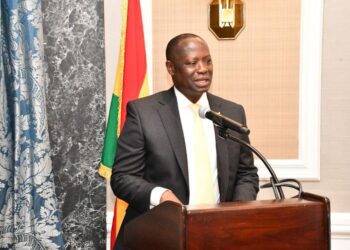
Dr. Theo Acheampong, an Economist and Technical Advisor at the Ministry of Finance, has sounded a clarion call for Ghana to strategically entrench its recent mining successes, as gold now commands a staggering 60% of the nation’s total export revenue.
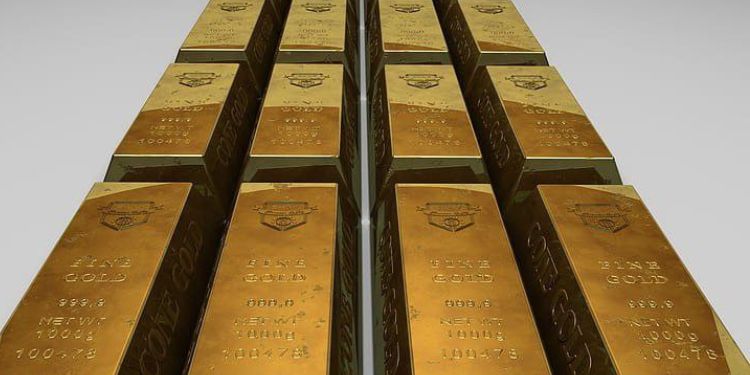
According to current Bank of Ghana (BoG) statistics, the precious metal has evolved into the primary driver of the country’s fiscal health, establishing a vital link between mineral exports and national economic resilience.
“Ghana has potentially a 2-to-3-year window to consolidate these gains before gold prices start mean reversion. However, maximising this opportunity also requires addressing supply chain concerns around traceability, particularly in the artisanal and small-scale mining sector. The latter is a key focus of the work of the Ghana GOLDBOD.”
Dr. Theo Acheampong
Dr. Acheampong highlighted that a positive and statistically significant Pearson correlation now exists between gold exports and the state’s reserves, a relationship that is “notably stronger with import cover than with raw reserves in billions.”
Expanding on this fiscal phenomenon, the data suggests that every uptick in gold production is “meaningfully associated” with an increase in the number of months the country can sustain its imports.
As Africa’s leading gold producer, Ghana has seen its export earnings surge to record highs, with 2025 figures showing gold exports nearly doubling compared to previous periods.
This windfall has allowed the central bank to take an increasingly active role as an intermediary in the foreign exchange market, utilizing “stronger payment inflows” to stabilize the cedi.
However, Dr. Acheampong warned that this period of abundance is not permanent, and the structural reliance on a single commodity necessitates a shift from mere extraction to strategic consolidation.
The Strategic Window: Building a National ‘War Chest’

The current market cycle has provided Ghana with a finite 36-month opportunity to “consolidate these gains” before global prices inevitably undergo a mean reversion.
With gold prices hovering near historic peaks, Dr. Acheampong argues that the government must move with urgency to “build a buffer, or, as we put it, to build a war chest.”
This strategic reserve is not merely an accounting exercise but a “means to an end” the end being the long-term stabilization of the economy and the protection of the cedi against future volatility.
If the state fails to capitalize on this high-price era to solidify its Gross International Reserves (GIR), it risks entering the next commodity downcycle with its “economic shield” significantly weakened.
Traceability and the Mandate of Ghana GOLDBOD

A critical hurdle in sustaining this growth lies in the Artisanal and Small-Scale Mining (ASM) sector, which contributed nearly 40% of total output in 2024 but continues to face scrutiny over “supply chain concerns around traceability.”
To address this, the established GhanaGOLDBOD operating under the Ghana Gold Board Act of 2025 is spearheading a nationwide traceability program.
By deploying “modern traceability technology” and blockchain systems, GOLDBOD aims to ensure every gram of gold is sourced sustainably.
This formalization is essential to “maximising this opportunity,” as it prevents “unregulated gold from being laundered into the system” and ensures that the billions generated in the ASM sector are captured through official banking channels rather than lost to smuggling.
Mitigating the Risks of Price Reversion and Smuggling

The potential impacts of ignoring these structural reforms could be catastrophic for Ghana’s medium-term stability.
Historical data from Swissaid suggests that Ghana lost an estimated $11.4 billion to gold smuggling between 2019 and 2023; failing to resolve these leakages now would mean the country is “forfeiting its future” when prices eventually soften.
If the “mean reversion” occurs before the GOLDBOD has fully formalized the ASM supply chain, the sudden drop in revenue could trigger a balance-of-payments crisis.
By enforcing “rigorous traceability” and local refining today, Ghana can transition from a raw ore exporter to a sophisticated gold hub, ensuring that the current 60% revenue share becomes a permanent foundation for growth rather than a fleeting peak.
READ ALSO: GHS1.5bn Assets Frozen in ORAL Prosecutions – Presidential Spokesperson