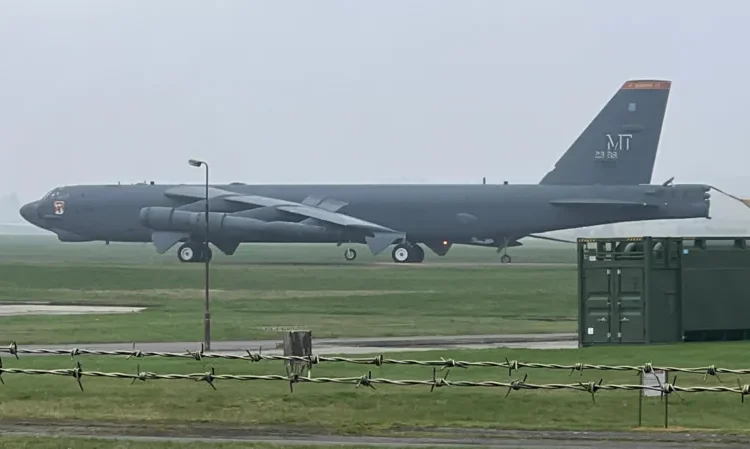
A fleet of U.S. military bombers has touched down at RAF Fairford in Gloucestershire, southwest England.
This marks a significant escalation in Western military involvement linked to the ongoing conflict with Iran.
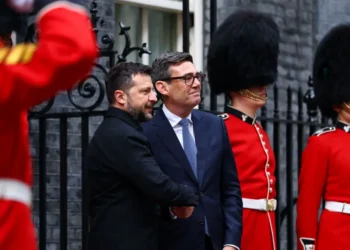
The deployment follows approval by British Prime Minister, Keir Starmer, allowing the United States to use UK territory for “specific defensive operations” related to Iranian missile threats.
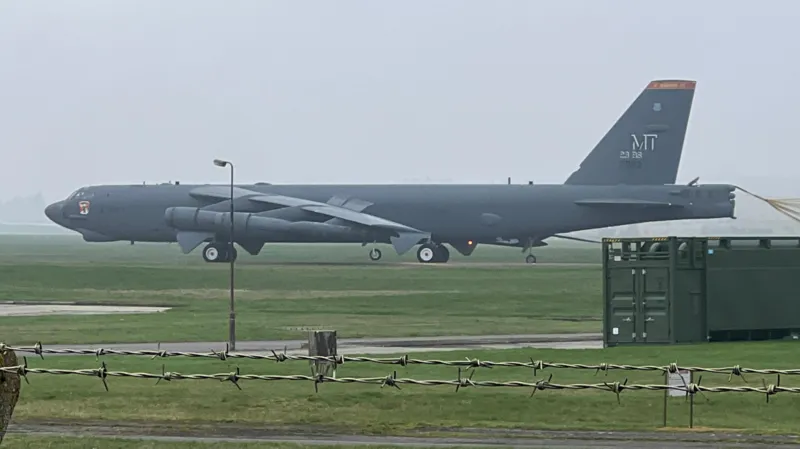
Britain’s Ministry of Defence confirmed that the U.S. Air Force bombers, including long-range B-1 Lancers, arrived at Fairford after their trans-Atlantic flights from the United States.
Earlier, the UK Ministry of Defence announced that “the United States has begun using British bases for specific defensive operations to prevent Iran firing missiles into the region.”
These aircrafts carry substantial weapons payloads and are positioned to support missions tied to the broader conflict, which was triggered by U.S. and Israeli strikes on Iranian missile and nuclear infrastructure.
The arrival of the bombers at RAF Fairford, a facility previously utilized by the United States Air Force for strategic deployments in Europe, also demonstrates UK’s changing posture as the conflict escalated.
While Starmer has stated that the UK will not participate in offensive actions against Iran, the use of British facilities, such as RAF Fairford and the Diego Garcia station in the Indian Ocean, suggests more cooperation between the UK and US armed forces.
The UK Prime Minister had initially refused to grant permission for the US to use UK bases in its joint offensive with Israel against Iran, which caused a disagreement with President Donald Trump.
However, later, Starmer approved the US request in the interest of “collective self-defence” of allies and the protection of British lives, AC using Iran of pursuing a “scorched-earth strategy.”
The Prime Minister added that the US would use UK bases for the “specific and limited defensive purpose” of destroying Iran’s missiles “at source.”
RAF Fairford has historically hosted U.S. strategic aircraft, including B-1 Lancers and B-52 Stratofortress bombers and serves as one of the very few European bases certified to operate bombers like the B-1, B-52, and B-2.
These platforms provide long-range strike capabilities with payloads exceeding 30 tons, allowing rapid deployment over Europe, the Middle East, and North Africa.
Making it far more efficient for operations targeting Iran, which lies beyond the range of US-based flights without refueling. A Gloucestershire Police spokesperson said that officers were working to tackle parking issues created by plane spotters.
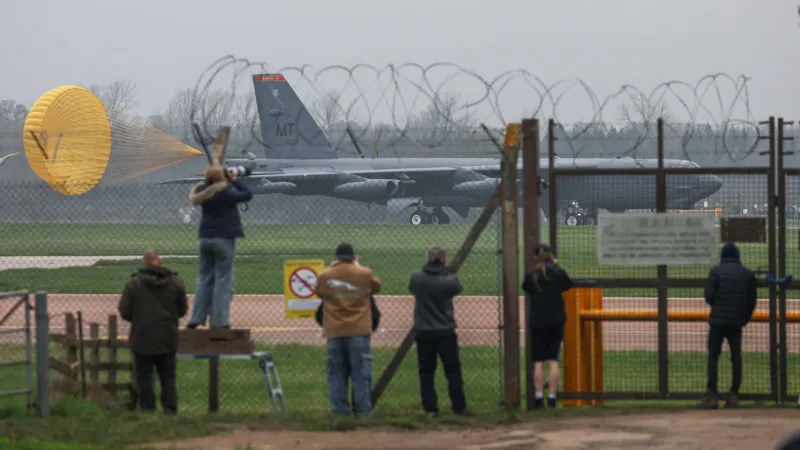
The arrival of these US Bombers has resulted in several roads being blocked in response the increasing number of crowds gathering to have a look at them.
“Work is ongoing with partner agency colleagues to ensure that crash gates, access roads, and pavements remain clear. We are closing side roads to the crash gates to keep these usable, but the issue of pavement parking continues. Anyone visiting the area is asked to park responsibly, as whilst plane spotting is a popular hobby, the safety of those people, members of the public, and RAF staff is our priority.”
Gloucestershire Police spokesperson
Impact of U.S. Bomber Deployment to RAF Fairford
It is revealed that, the B-52 bomber has a wingspan of 160 feet (49 meters) and can launch missiles over 1,500 miles (2,414 km). miles (2,414 km). They join a growing fleet of U.S. military aircraft at RAF Fairford.
Alongside earlier-deployed B-1 Lancer bombers, these planes substantially enhance the United States operational reach in the Middle East.
This allows rapid response to potential Iranian missile threats. The B‑52, one of the Air Force’s longest-serving and most versatile bombers, can carry up to 70,000 pounds (31,751 kg) of mixed munitions.
Strategically, RAF Fairford’s location near the Gloucestershire-Wiltshire border provides a critical forward-operating base for long-range missions targeting Iranian missile sites.
It is one of the few European bases certified to operate heavy bombers such as the B-1, B-2, and B-52, making it far more efficient than launching missions directly from the U.S., which would require extensive midair refueling and increase operational complexity.
The deployment has larger regional security consequences. Iran has responded against US assets in the area and neighbouring states, therefore the heightened air activity serves as a visual deterrence.
It sends a message to Tehran that Western nations are capable of firmly reacting to missile or drone assaults. Given the strategic importance of the Strait of Hormuz, the deployment will eventually have an economic and political impact on global energy markets, notably crude oil prices.
This demonstrates how military activities, even while defensive, may have far-reaching implications for global trade, energy supply, and geopolitical relationships.