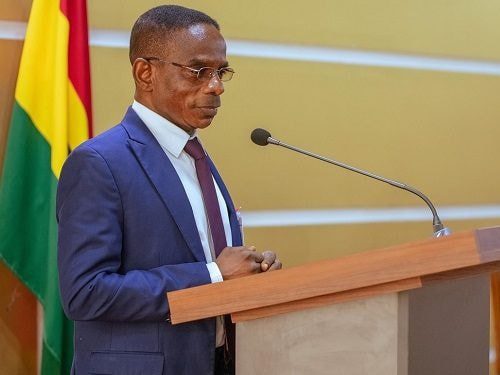
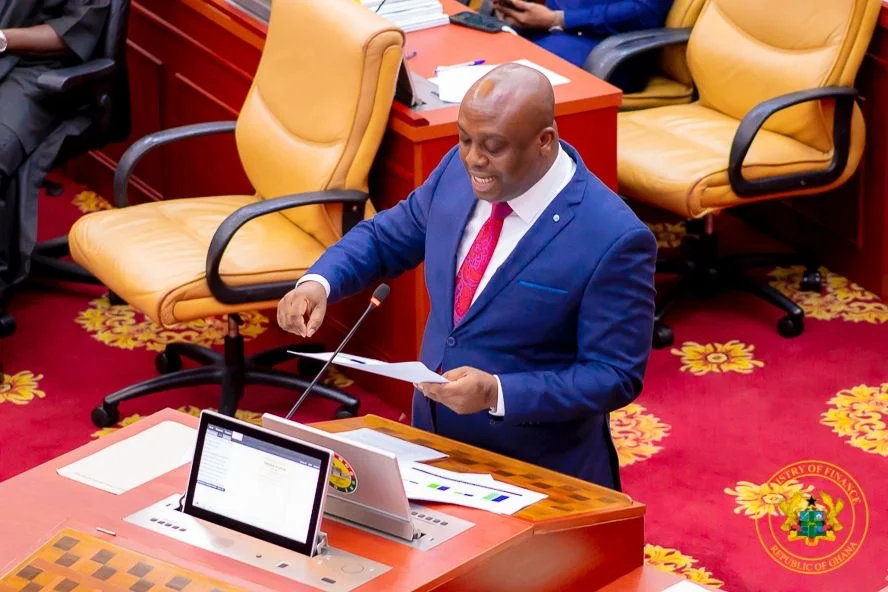
Serious irregularities involving hundreds of millions of cedis in public financial records have been uncovered following an audit of government arrears presented to Parliament by Deputy Minister for Finance Thomas Ampem Nyarko on behalf of Finance Minister Cassiel Ato Forson.
The report revealed that bank transfer advisers amounting to GH¢293 million were processed by several government institutions without the necessary supporting documentation. In addition, auditors identified forged documents worth GH¢9.4 million used to justify payments for goods that were never delivered.
Presenting the findings to Parliament, the Deputy Minister warned that the audit has exposed serious weaknesses within the public financial management system.
“This is a report on the systemic plunder and abuse of the public financial management system. By the time I am done with this presentation, it will become clear that something needs to be done to save our economy.”
Deputy Minister for Finance Thomas Ampem Nyarko
The audit forms part of a broader verification exercise initiated by the Ministry of Finance to validate government arrears accumulated across ministries, departments and agencies.
Unsupported Bank Transfer Advisers Identified
One of the most troubling findings of the audit involved bank transfer advisers submitted by several ministries and public institutions without proper documentation.
According to the report, six ministries and agencies were linked to BTAs amounting to GH¢293 million that lacked supporting evidence. The Deputy Minister told Parliament that auditors found no contracts, no interim payment certificates and no record of any work having been executed to justify the payment requests.
The largest share of the unsupported BTAs came from the Ministry of Gender, Children and Social Protection, which accounted for GH¢241.2 million of the total amount.
The Ministry of Roads and Highways was associated with unsupported BTAs worth GH¢26.3 million, while the Judicial Service of Ghana accounted for GH¢18.2 million.
Additional amounts were linked to the Ministry of Special Initiatives with GH¢3.7 million, the Ministry of Health Ghana with GH¢2.4 million, and the Office of the Attorney General and Ministry of Justice Ghana with GH¢782,262.
The Deputy Minister noted that the absence of documentation in these cases represents a significant breach of financial control procedures within the affected institutions.
Forged Documents Used to Support Payment Requests
The audit also uncovered instances where fraudulent documentation had been submitted to support requests for government payments. Auditors discovered forged stores receipt advice valued at GH¢9.4 million. These documents were used to confirm the supposed receipt of goods that had never been delivered.
One of the cases involved the Ministry of Defence, Ghana, where GH¢4.8 million in transactions were supported by store receipt advices claiming that vehicles had been delivered. The vehicles were reportedly part of a contract intended for border surveillance and monitoring during the 2024 Ghana General Election.
However, despite documentation indicating that the vehicles had been received on 12 October 2024, auditors found no evidence that the vehicles were ever delivered.

Another case involved the Judicial Service of Ghana, where a stores receipt advice dated 25 October 2024 claimed that seven Toyota saloon cars had been received.
Following the launch of the audit investigation, the supplier reportedly wrote to the Judicial Service on 10 April 2025 to indicate that it had been unable to supply the vehicles as scheduled.
The Deputy Minister explained that the situation demonstrated how falsified documents had been used in an attempt to secure payment from the Ministry of Finance.
The verification exercise was conducted by the Ghana Audit Service in partnership with international accounting firms Ernst & Young and PricewaterhouseCoopers.
The auditors were tasked with reviewing financial commitments submitted to the Ministry of Finance as part of unpaid invoices, interim payment certificates and bank transfer advisers. In total, claims amounting to GH¢68.7 billion were submitted for validation.
According to the Deputy Minister, GH¢50.5 billion of this amount consisted of outstanding invoices and interim payment certificates submitted by contractors and suppliers. Another GH¢18.3 billion represented bank transfer advisers processed through government financial systems and awaiting settlement.
The audit was intended to verify whether these claims represented legitimate government obligations or irregular payment requests.
Government Moves to Strengthen Oversight
According to the Deputy Minister, the cases uncovered by the audit reveal what he described as a disturbing pattern of fraudulent practices within some public institutions.
He said the irregularities include the recycling of already paid invoices and interim payment certificates as well as the submission of forged documents to justify payment requests.
Officials say the Ministry of Finance has already taken steps to prevent further occurrences of such irregularities by strengthening verification procedures before payments are approved.

The ongoing audit is expected to guide broader reforms aimed at improving transparency and accountability within the government’s financial management systems.
Authorities believe the exercise will also help recover public funds that may have been improperly claimed or processed within government financial records.
The Deputy Minister concluded that protecting public resources requires stronger institutional oversight and stricter enforcement of financial regulations across all government institutions.