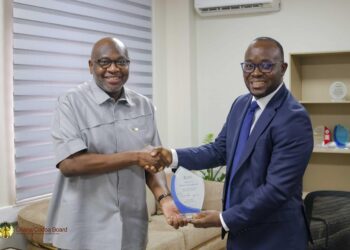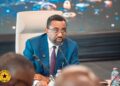

In a significant display of South-South cooperation and regional knowledge sharing, the Ministry of Food and Agriculture (MoFA) has hosted a 38-member delegation from the National Defence College (NDC) of Abuja, Nigeria.
The high-level delegation, currently on a seven-day regional study tour in Ghana, visited the Ministry to dissect the intricacies of Ghana’s agricultural success, under the specialized theme, “Cocoa Production and Economic Growth in Ghana: Lessons to Nigeria,”.
According to MoFA, the visit highlighted how the Administration’s management of the cocoa sector has become a blueprint for economic resilience and national security in the West African sub-region.
“The visit was intended to provide participants with insights into Ghana’s agricultural sector, particularly best practices in cocoa production, while enabling them to learn from Ghana’s expertise and experiences in leveraging agriculture for economic growth. It provided a valuable opportunity for knowledge exchange and strengthened regional cooperation in agriculture”
MoFA
The NDC delegation was led by Rear Admiral Abdullahi Ahmed, who emphasized that Nigeria is keen to understand how Ghana has consistently leveraged its agricultural sector – particularly cocoa – to anchor its macroeconomic stability.
Welcoming the visitors on behalf of the Minister for Food and Agriculture, Hon. Eric Opoku, the Chief Director of the Ministry, Mr. Paul Siameh, provided a comprehensive overview of the policy frameworks that have sustained Ghana’s position as a global leader in premium cocoa production.

The engagement served as a technical bridge between the two largest economies in West Africa, focusing on how Agriculture can be utilized as a tool for poverty reduction and industrial feedstock. For the Nigerian delegation, the focus on cocoa is a strategic choice.
While Nigeria was once a dominant force in global cocoa production, its output has fluctuated significantly over the decades. Ghana, by contrast, has maintained a robust regulatory environment through the Ghana Cocoa Board (COCOBOD), ensuring price stability for farmers and high-quality standards for the international market.
Mr. Paul Siameh noted that cocoa remains Ghana’s leading agricultural export commodity, contributing significantly to foreign exchange earnings and providing a livelihood for millions of rural households.
The discussions delved into the “Social Contract” between the Administration and the cocoa farmer, including the annual determination of the producer price, the provision of subsidized inputs, and the implementation of the Cocoa Life programs that focus on sustainability and the eradication of child labor.
These “best practices,” were of particular interest to the National Defence College, as economic stability in rural agricultural heartlands is a direct deterrent to social unrest and security challenges.
Crop Diversification
While cocoa was the primary focus, the Ministry utilized the engagement to showcase its broader “Crop Diversification Strategy.” Mr. Siameh highlighted the economic potential of other key value chains, including cashew, mango, shea, and oil palm.

He noted that the goal of the government is to replicate the “Cocoa Model,” across these sectors to ensure that the nation’s export base is not overly reliant on a single crop – a step that is essential for building a resilient economy capable of weathering global commodity price shocks.
A major highlight of the presentation was the “Feed Ghana Programme,” – the foundation of Ghana’s current agricultural policy.
Mr. Siameh noted that central to this programme is the establishment of Farmer Service Centres (FSCs) across the country, designed to be “one-stop shops” for the modern farmer, providing streamlined access to mechanization services, high-quality fertilizers, improved seeds, and technical extension support.
For the Nigerian delegation, the FSC model represented a pragmatic solution to the challenge of smallholder productivity, offering a scalable method for modernizing the agricultural landscape.
Rear Admiral Abdullahi Ahmed observed that by studying Ghana’s agricultural successes, the Nigerian NDC is essentially conducting a “security audit,” of the value chain, identifying how agricultural prosperity contributes to the overall stability of the ECOWAS region.
The visit also facilitated a deep dive into the “Commercialization” of agriculture. MoFA explained that the current focus is on moving farmers from subsistence to agribusiness, which involves creating linkages between the farmgate and the industrial sector, and ensuring that raw materials produced in Ghana are processed in Ghana.
This focus on Industrialization within the agricultural sector is expected to create thousands of jobs for the youth, further strengthening the social fabric and reducing the migration of labor from rural areas to urban centers.

The seven-day regional study tour of the Nigerian National Defence College serves as a reminder of the deep-seated ties between Ghana and Nigeria. As the two nations navigate the complexities of the 21st-century global economy, the exchange of technical expertise in Agriculture remains a powerful tool for mutual growth.
The “Lessons to Nigeria,” from Ghana’s cocoa sector are not just about agronomy; they are about the political will to protect a vital industry and the administrative foresight to plan for long-term sustainability.
For the participants from Abuja, the insights gained in Accra – from the Ministry of Trade, Agribusiness and Industry (MoTAI), and now from the Ministry of Food and Agriculture – will likely inform future strategic planning, ensuring that the giant of Africa can also harness the power of its soil to drive its next chapter of economic expansion.