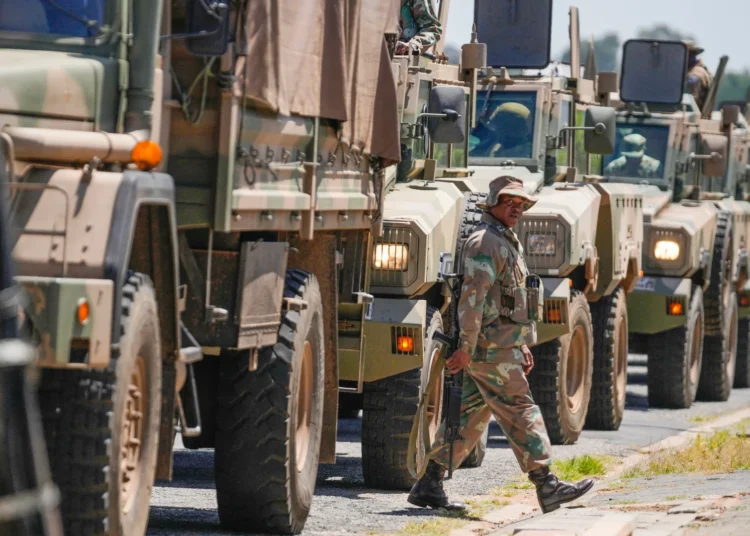
South Africa’s deployment of troops to assist police in tackling illegal mining and organized crimes has raised concerns over the chain of command and operation’s scope and mandate.
Speaking at a recent joint standing committee on defense meeting, Ian Cameron, a member of the National Assembly of South Africa, disclosed that the South African National Defense Force (SANDF) have indicated, that they would not take instructions from the South African Police Service.
“This is hugely problematic because that means that we now have soldiers doing police work without the police. Obviously, they’re not trained for that.”
Ian Cameron
Cameron further warned that soldiers may operate independently of the South African Police Service, prompting questions about legality and coordination, even as the government stresses that the deployment is critical to combating organized crime and protecting public safety.
“We indicated that we need a joint meeting between the Police Portfolio Committee and the Joint Standing Committee on Defense. That hasn’t happened yet. The letter to schedule that only went off yesterday or today.”
Ian Cameron
South African President, Cyril Ramaphosa, announced the deployment in Parliament during his State of the Nation Address.

According to Cyril Ramaphosa, “organized crime is now the most immediate threat to our democracy, endangering both economic stability and public safety,” particularly in Gauteng and the Western Cape where children are caught in the crossfire of gang wars and residents being chased out of their homes by illegal miners in Gauteng.
To address these challenges, Ramaphosa mentioned that the South African National Defence Force will support the South African Police Service in security operations with the aim of disrupting illegal mining network and reduce gang-related violence.
He added that to combat the negative effects of rising crime rates on people’s lives, the government is prioritizing technology-driven intelligence and coordinated law enforcement against criminal syndicates.
Rising Concerns Over Illegal Mining and Organized Crime
South Africa faces persistent violent crime challenges, with one of the world’s highest homicide rates of about 63 killings per day in 2025. Despite strict gun regulations, illegal firearms are widely used in crimes linked to gangs and organized groups.
Illegal mining poses a serious security and economic threat in South Africa as thousands of abandoned shafts serve as entry points for illegal gold mining.
Organized criminal groups known locally as “zama zamas” often control these operations. Heavily armed syndicates frequently run these groups, overseeing the extraction and distribution of illegally mined gold, according to law enforcement agencies.
These syndicates generally recruit informal miners from underprivileged communities and send them underground to look for mineral treasures in abandoned tunnels. Working without sufficient safety equipment or ventilation, these miners frequently encounter exceedingly hazardous situations.
It is estimated that about 30,000 illegal miners are currently operating across South Africa, many of them working in some of the country’s roughly 6,000 abandoned mine shafts.
The activities of illegal mining have expanded significantly in recent years, with criminal syndicates generating significant profits from the trade, and more than $4 billion worth of gold is lost each year to illegal mining and illicit trading networks.
Aside that, illegal mining gang activities are linked to violence and crime in surrounding communities. Turf battles between rival groups competing for control of mining areas have led to shootings, intimidation, and the forced displacement of residents in some neighborhoods.
Several high-profile incidents have drawn national attention to the problem. In 2022, the government investigated a case involving about 80 suspected illegal miners accused of gang-raping eight women filming a music video near an abandoned mine. The case sparked nationwide outrage and intensified calls for stronger action against illegal mining networks.
Another major incident occurred in 2024, when police and illegal miners clashed inside an abandoned mine, resulting in at least 87 miners being reported dead. After the miners refused to surrender, the government decided to cut off their food supplies in an attempt to force them to leave the underground site.
This deployment, intended to protect public safety, recalls the era of apartheid, when military presence in civilian areas was common and often associated with state control and unrest.
President Ramaphosa, acknowledging this painful past, cautioned against deploying the army without a clear justification. Stating that the current surge in violent organized crime now requires this action to protect public safety and state authority, he noted that 550 soldiers will be stationed in Gauteng, home to Johannesburg, through the end of April whiles preparing to send troops to five of the country’s nine provinces.
READ ALSO: Iraq Suspends Oil Port Operations