

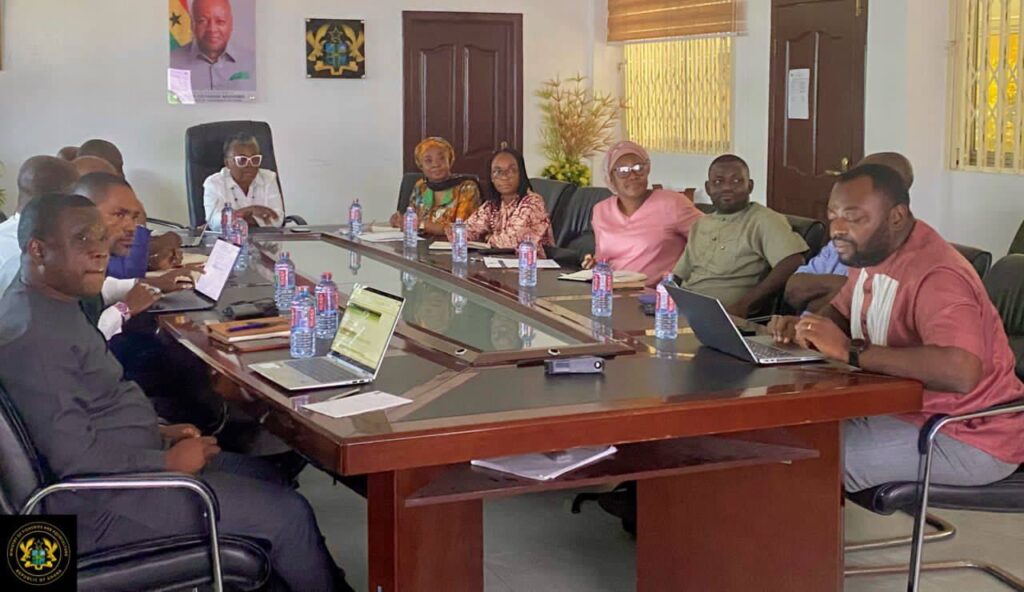
The Ministry of Fisheries and Aquaculture Development (MoFAD) has moved into a high-intensity enforcement phase of the newly enacted Fisheries and Aquaculture Act, 2025 (Act 1146), as the Sector Minister, Hon. Emelia Arthur, formally endorsed the IEZET Project.
Presented by the Director of the Global Fisheries and Resilience Action (GFRA), Socrates Apetorgbor Segbor, the initiative is designed to serve as the technological and operational “teeth” of the new Fisheries and Aquaculture Act.
According to MoFAD, this strategic partnership marks the end of “paper-based” maritime regulation, replacing it with a sophisticated, data-driven enforcement mechanism specifically engineered to protect Ghana’s artisanal fishers from the predatory encroachment of illegal industrial vessels.
“The IEZET Project will complement these efforts by promoting transparency in policy implementation, improving monitoring systems, and supporting effective enforcement of the Expanded IEZ. The new law has significantly strengthened regulatory and monitoring frameworks in the fisheries industry”
Ministry of Fisheries and Aquaculture Development
For the Ministry, the IEZET Project is not merely a conservation effort, but a critical component of the Feed Ghana and Industrialization pillars, as securing the Expanded Inshore Exclusive Zone (IEZ), will protect the primary protein source for millions of Ghanaians and the livelihoods of over 200,000 artisanal fishers.

Hon. Arthur framed the project as a non-negotiable defense of Ghana’s sovereign blue economy, ensuring that the wealth of the sea is preserved for those who have harvested it for generations. At the heart of the IEZET Project is the aggressive protection of the Expanded IEZ.
For decades, artisanal fishers have faced dwindling catches due to the illegal, unreported, and unregulated (IUU) activities of industrial trawlers that often venture into restricted shallow waters.
The IEZET Project introduces an advanced monitoring and safety framework that utilizes real-time tracking to ensure that industrial vessels remain in deep-sea corridors, leaving the inshore zones exclusively for the artisanal fleet. Hon. Arthur emphasized that the success of the 24-Hour Economy in coastal communities depends on the security of the sea.
For MoFAD, deterring illegal fishing ensures that the “night shift” for Ghanaian fishers is safe and productive. This enforcement is backed by a mandate for total transparency, where vessel movements and enforcement actions are logged and audited to eliminate the possibility of regulatory bypass.
The “fortress” approach is intended to stabilize the fish stock, allowing for a biological recovery that will eventually translate into higher yields and lower food prices for the national consumer.
Building Blue Talent
Beyond immediate enforcement, MoFAD noted that the IEZET Project is designed to build the long-term institutional foundation of the sector, with a primary objective being the full operationalization of the Anomabo Fisheries College.
Under the industrialization pillar, the government seeks to move beyond simple harvesting to high-value aquaculture and professionalized maritime management, and the college will serve as the premier training ground for a new generation of fisheries officers, maritime engineers, and aquaculture specialists.
The project will fund capacity-building programs that move research “from the classroom to the deck.” It will equip the Anomabo Fisheries College with modern research tools and IEZET monitoring data that ensures management of Ghana’s marine resources is led by local experts rather than foreign consultants.
According to the Minister, this “Blue Talent” pipeline is essential for the sustainability of the Fisheries and Aquaculture Act (Act 1146), ensuring that the technology deployed today can be maintained and evolved by Ghanaians tomorrow.
Hon. Arthur further noted that the IEZET Project breaks away from traditional “top-down” policing by prioritizing active engagement with fishing communities. The Minister and Mr. Segbor both highlighted that the most effective maritime security starts on the shore.
By involving chief fishermen and local landing beach committees in the monitoring process, the IEZET Project creates a “community-watch” system for the ocean, and these communities are being trained to recognize and report IUU activities – turning every artisanal vessel into an auxiliary eyes-and-ears for the national enforcement agencies.
For MoFAD, this inclusive model is designed to foster a culture of Responsible Fisheries Management. It explained that when local fishers see that the law is effectively barring industrial competitors from their zones, they are more likely to adhere to sustainable practices themselves, such as observing closed seasons and avoiding prohibited nets.
The IEZET Project provides the safety mechanisms and economic security that allow these communities to invest in their own future, knowing that their “Blue Commons,” are being protected by the full might of the state.
As the presentation at the Ministry concluded, it was clear that the IEZET Project will set a new standard for maritime governance in West Africa. Ghana, by linking the GFRA’s technical expertise with the MoFAD’s legislative mandate, has established a maritime enforcement zone that is among the most sophisticated on the continent.
As MoFAD noted, Hon. Enelia Arthur’s endorsement was the final signal to the international fishing community that Ghana’s waters are no longer an open frontier for illegal exploitation.
READ ALSO: Mahama Declares Overhaul of Ghana’s Pension System to Protect Workers