European Union leaders have criticised Hungarian Prime Minister, Viktor Orbán, accusing him of hijacking critical aid for Ukraine and undermining EU decision-making in an effort to win an election at home.
The leaders insisted that Orbán must respect the 27-nation bloc’s decision in December to fund Ukraine’s armed forces and war-ravaged economy for the next two years. Orbán himself had previously approved what is seen as a critical lifeline for war-ravaged Ukraine.
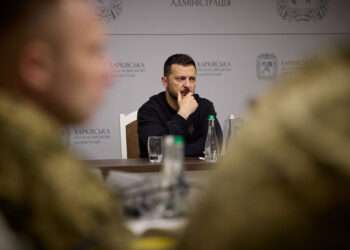
Ukraine and Hungary have been locked in an escalating feud since deliveries of Russian oil to Hungary and Slovakia were halted in January due to damage to the Druzhba pipeline, which crosses Ukrainian territory. Ukrainian officials blame the damage on Russian drone attacks, but Orbán accuses Ukraine’s President, Volodymyr Zelenskyy of deliberately holding up oil supplies.
Hungary has not only vetoed the loan package, it’s also blocking a new round of EU sanctions against Russia.
The standoff has highlighted important weaknesses in EU decision-making procedures, which often require unanimous agreement among the 27 member countries. Hungary has a population of almost 10 million, a fraction of the bloc’s 450 million people.
In an effort to break the deadlock, European Commission President, Ursula von der Leyen and European Council President António Costa offered this week to pay for repairs to the pipeline. An EU technical team is in Kyiv awaiting security clearance to inspect the site.
Speaking to reporters as the leaders gathered for a summit in Brussels, Finland Prime Minister Petteri Orpo stated that Orbán is “using Ukraine as a weapon in his election campaigning, and it’s not good.” “We had a deal, and I think that he betrayed us,” he added.
Ukraine’s economy is in shambles. EU officials believe it must get at least a sizeable part of the 90-billion-euro ($103-billion) loan by the start of May. For that to happen, work must move forward on the EU agreement within two to three weeks.
German Chancellor Friedrich Merz insisted that all 27 EU member countries must respect the decision they made together in December. “The guiding principle of the European Union is one of loyalty and reliability,” he said.
On the eve of the summit Merz had accused Orban of “setting up this blockade in Europe now for domestic political reasons and because of an election campaign that is being conducted there.”
Belgian Prime Minister Bart De Wever said “it’s unacceptable to decide with the leaders and then after say ‘but I’m not ready to execute what I decided.’”
Orbán Defiant Over Ukraine Loan Veto
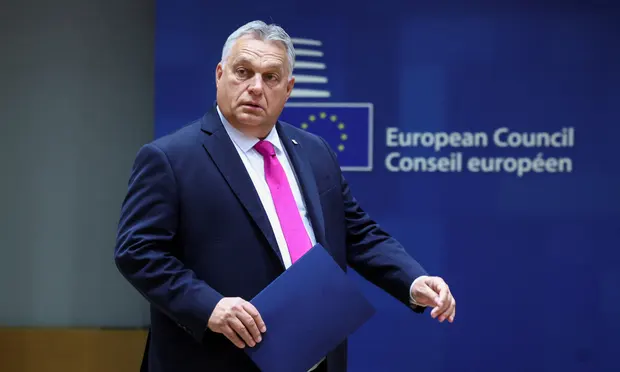
However, Orbán vowed to continue to block the loan as long as oil shipments to Hungary are halted. Arriving in Brussels, Orbán made it clear that he won’t compromise.
“We would like to get the oil which is ours from the Ukrainians and which is … blocked by the Ukrainians. I will never support any kind of decision here which is in favour of Ukraine [as long as] the Hungarians are not able to get the oil which belong to us.”
Viktor Orbán
He asserted that there is no other option to agree a way forward. “Sorry, no other option,” he said.
“We need it because it’s existential. What we are speaking about is not politics. It’s existential for Hungary to get the oil. … Without getting that oil, all the households, Hungarian companies will go to bankruptcy. So you know, it’s not a joke, not a political game. Zelenskyy should understand it that this is not a game. This is absolutely existential for the Hungarians.”
Viktor Orbán
The EU mostly weaned itself off Russian oil and natural gas after 2022 as Putin used the bloc’s dependence on it as leverage to undermine European support for Ukraine.
However, Hungary and Slovakia were given exemptions to keep using Russian oil. Their leaders say they are landlocked and have no easy access to other suppliers, although they are currently receiving oil via an alternative route through Croatia. However, Croatian Prime Minister Andrej Plenković noted that Hungary and Slovakia pay about 30% less for Russian oil.
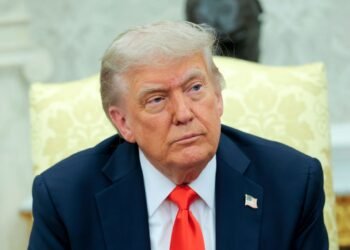
Orbán, who is seen as Russian President Vladimir Putin’s closest ally in Europe and is a strident nationalist admired by US President Donald Trump, is trailing in opinion polls ahead of elections on April 12.
Part of his election campaign has been to portray Ukrainian President Volodymyr Zelenskyy as an existential threat to Hungary. He has alleged that the Ukrainian leader, along with European Commission President Ursula von der Leyen, wants to drag Hungary into Russia’s war, now in its fifth year. He has claimed that his reelection is the only guarantee of peace and security.
READ ALSO: Iran’s Tactics Of Targeting Neighbours Erodes Trust