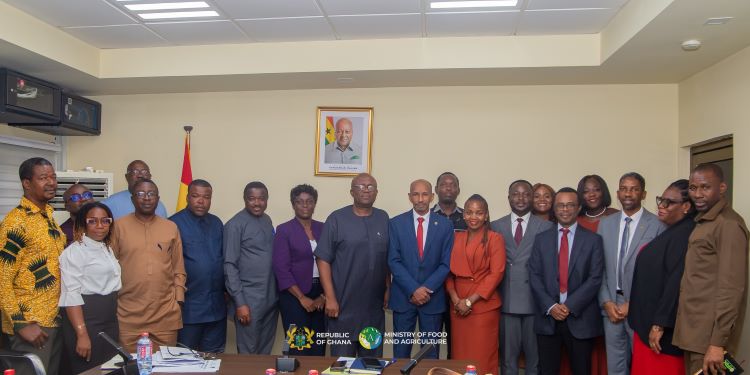
The Ministry of Food and Agriculture (MoFA) has officially hosted a high-level delegation from the African Development Bank (AfDB), to align the Bank’s strategic investments with the government’s current priorities, signaling a reinforced commitment to the total transformation of Ghana’s agricultural landscape.
The meeting, held in Accra, served as a critical consultation mission. Led by the Ministry’s Chief Director, Mr. Paul Siameh, on behalf of the sector Minister, Hon. Eric Opoku, the discussions focused on the urgent need to transition from subsistence farming to a modernized, industrial agrarian economy through the flagship “Feed Ghana Programme.”
“Welcoming the delegation on behalf of the Honourable Minister for Food and Agriculture, Honourable Eric Opoku, the Chief Director, Mr. Paul Siameh, expressed appreciation to the AfDB for its longstanding support to the Ministry, dating back to 1973”
Ministry of Food and Agriculture
According to MoFA, the engagement arrives at a time when food security and regional value chain resilience are at the forefront of the national economic discourse. The AfDB, a longstanding partner in Ghana’s development journey, sought to deepen its interventions in areas that offer the highest return on investment for rural livelihoods and national stability.
For the Ministry, the visit was an opportunity to dissect the operations of its current initiatives and secure the technical and financial backing necessary to scale them nationwide.
The Feed Ghana Programme – government’s primary vehicle for achieving self-sufficiency in key staples was at the heart of the consultation. Mr. Paul Siameh provided a detailed briefing on the program’s progress, emphasizing that while the foundational structures are in place, an “enhanced partnership,” with the AfDB is required to accelerate its implementation.

Mr. Siameh noted that the program will create a seamless link between smallholder farmers and industrial processors, ensuring that “Made in Ghana,” produce dominates the local market and expands into the sub-region. The Ministry’s strategy involves a shift toward “Specialized Agricultural Zones,” where infrastructure, credit, and extension services are clustered to maximize productivity.
Securing AfDB support for these zones reduces the infrastructure deficit that has historically hampered the movement of goods from the farm gate to the urban consumer.
The Chief Director noted that the Feed Ghana agenda is not just a social intervention; it is a hard-nosed economic strategy to reduce the nation’s import bill and stabilize the cedi through increased local production.
Bridging the Productivity Gap
The discussion pivoted to agricultural mechanization, as both the MoFA team and the AfDB delegation agreed that the traditional “hoe and cutlass,” model is no longer viable for a nation seeking industrial status.
The Ministry called for increased investment in Agricultural Mechanization Service Enterprise Centres (AMSECs), which provide farmers with affordable access to tractors, harvesters, and irrigation technology. The AfDB’s expertise in funding large-scale agricultural equipment schemes was highlighted as a primary area for collaboration.
According to MoFA, digitizing the management of these mechanization centers guarantees efficient maintenance and utilization of equipment. The goal is to triple the acreage under mechanical cultivation by the end of 2027, a target that Mr. Siameh insisted is achievable with the right mix of development finance and private sector participation.
Furthermore, the poultry value chain emerged as a specific strategic priority, during the talks. Ghana currently spends hundreds of millions of dollars annually on imported poultry products, a drain on foreign exchange that the Ministry is determined to reverse.
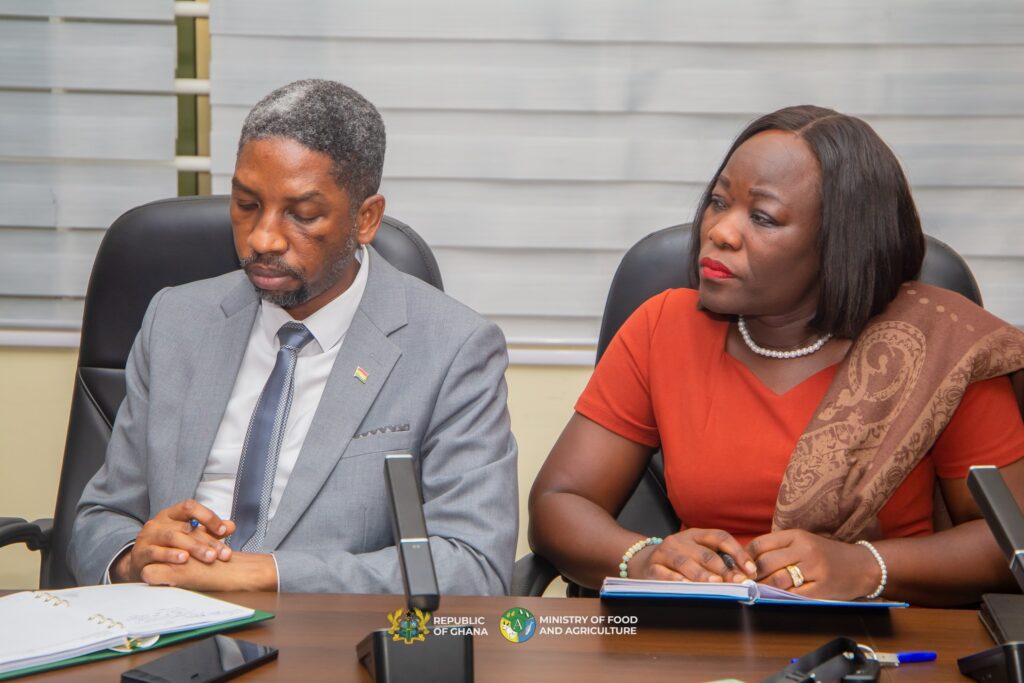
The AfDB delegation, led by Dr. Elsiddig Mohamed Rahma, the Executive Director representing Ghana’s constituency, “expressed a strong interest in supporting a poultry revolution.” The proposed collaboration involves the creation of integrated poultry hubs that manage everything from feed mill production to hatchery services and processing plants.
Both sides agreed that lowering the cost of locally produced poultry feed – which currently accounts for nearly 70% of production costs – makes Ghanaian chicken more competitive than imported alternatives. This import substitution strategy is a key pillar of the Feed Ghana Programme and is expected to create thousands of jobs for youth in the agribusiness sector.
Dr. Elsiddig Mohamed Rahma reaffirmed the Bank’s “unwavering commitment to Ghana’s agricultural transformation.” He noted that the AfDB views Ghana as a strategic leader in the West African agricultural space and is eager to see the nation succeed in its self-sufficiency goals.
He added that the Bank’s intervention strategy for 2026-2030 will likely focus on climate-smart agriculture and resilient supply chains, ensuring that the gains made today are not wiped out by environmental shifts or global market shocks.
The Executive Director’s visit is part of a broader consultation mission to ensure that the Bank’s portfolio in Ghana remains high-performing, and reviewing ongoing interventions helps identify bottlenecks, and realign resources to where they are most needed.
Dr. Rahma emphasized that the AfDB is not just a lender, but a technical partner invested in the long-term “sustainable economic growth,” of the Ghanaian people.
The Ministry and the AfDB explored the potential for Agro-Industrial parks that provide a one-stop-shop for processing, cold storage, and logistics, anchoring the Feed Ghana Programme so that surplus produce does not go to waste during peak harvest seasons.

The visit of the African Development Bank delegation to the Ministry of Food and Agriculture was the redefinition of a 53-year partnership for the modern era, with the “Feed Ghana,” agenda representing a new level of ambition.
As Mr. Paul Siameh and Dr. Elsiddig Mohamed Rahma concluded their deliberations, the roadmap for the next phase of collaboration became clear.
With a focus on mechanization, poultry, and logistics, the Ministry is positioning agriculture as the engine room of the national economy, and the support of the AfDB provides the financial and technical “fuel” needed to keep that engine running at full capacity.
READ ALSO: House Committee Holds Hearing On Partial DHS Shutdown