
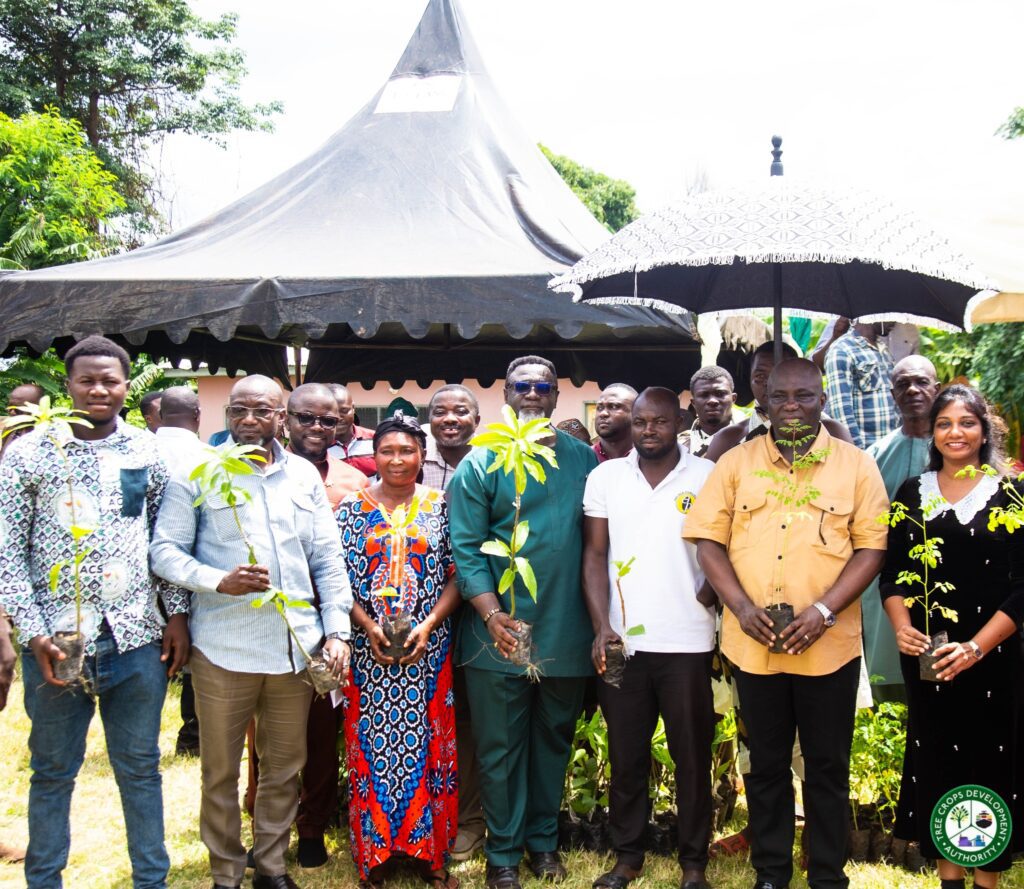
The Chief Executive Officer of the Tree Crops Development Authority (TCDA), Dr. Andy Osei Okrah, has recently joined the Minister for Food and Agriculture, Hon. Eric Opoku, in Nkoranza to execute the massive distribution of three million high-value seedlings to smallholder farmers across the Bono East Region.
According to the Authority, this strategic deployment of mango, cashew, and moringa planting materials marks a definitive strategy in Ghana’s agricultural policy, moving beyond mere food security toward a sophisticated model of agroforestry-led carbon sequestration.
Supported by the World Food Programme (WFP), the initiative is designed to transition 21,000 farmers into the global carbon market via the Agroforestry Carbon Removal Units for the Organic Restoration of Nature (ACORN) platform, anchored in the Bono East hub to effectively operationalize a high-yield industrial reset.
“Dr. Andy Osei Okrah underscored TCDA’s broader strategy to improve farmers’ access to quality and certified planting materials across the country through the registration and licensing of all actors, particularly nursery operators, to enhance and maintain seedling standards.
“He emphasized that quality seedlings are fundamental to establishing productive, resilient, and commercially viable plantations capable of meeting both domestic and international market standards”
Tree Crops Development Authority
The ceremony in Nkoranza served as the launchpad for a multi-district saturation strategy, targeting the Techiman North, Techiman South, Kintampo Municipality, Kintampo South, Nkoranza North, and Nkoranza Municipality zones.
For these participating districts, the distribution of three million seedlings represents more than an agricultural input; it is a long-term capital injection that leverages the environmental services of tree crops as a new, monetizable commodity for the rural economy.

The inclusion of moringa alongside the TCDA’s primary mandates of cashew and mango highlights an intentional diversification of the regional crop portfolio, aimed at creating a resilient landscape that can withstand the volatile climate conditions of the middle belt.
This is an intervention that aligns regional farming practices with the rigorous standards of the international carbon-removal market, where the “organic restoration of nature” is now a measurable and tradeable metric of success. The TCDA noted that the mechanics of the ACORN platform represent the most significant technical evolution in this project.
Unlike traditional seedling giveaways that focus solely on harvest yields, the ACORN framework treats the tree itself as a biological machine for carbon capture. By integrating these three million trees into the existing smallholder landscape, the project creates “Carbon Removal Units” (CRUs) that can be verified and sold on the international market.
This provides the 21,000 beneficiary farmers with a dual-income stream: the traditional sale of cashew and mango fruits and the recurring revenue from carbon credits.
Mr. Okrah added that this secondary income will serve as a financial buffer, rewarding farmers for the biological maintenance of their plantations and ensuring that the “restoration of nature” is an economically rational choice for the rural worker. He also highlighted that the World Food Programme’s role in this ecosystem is particularly noteworthy.
Through facilitating the ACORN platform, the WFP acknowledges that long-term food security in the Bono East Region is contingent upon environmental stability. The distribution of these seedlings is expected to be a hedge against soil degradation and erratic rainfall, using agroforestry to restore the micro-climate of the participating districts.
For the TCDA, this partnership is a validation of the authority’s mandate to turn tree crops into the cornerstone of Ghana’s non-traditional export (NTE) sector, while simultaneously addressing the global imperative for climate mitigation.
Regulatory Sanitization
Beyond the environmental metrics, Dr. Andy Osei Okrah used the Nkoranza ceremony to signal a rigorous new era of regulatory oversight for the tree crop sector. The CEO’s emphasis on the registration and licensing of all value chain actors, particularly nursery operators, was a strategic move to eliminate “wildcat” or substandard planting materials from the Ghanaian market.

Historically, the failure of large-scale plantations has often been traced back to the use of uncertified seedlings lacking the genetic vigor to reach commercial maturity. The TCDA is enforcing a “certification wall” to ensure that the three million seedlings distributed in this phase are not just biological survivors, but high-performance assets capable of meeting international export benchmarks.
This licensing regime is to professionalize the nursery industry, turning it from an informal activity into a regulated component of the national agricultural infrastructure.
Furthermore, the involvement of the Bono East Regional Minister, Hon. Francis Owusu Antwi, underscored the regional importance of this rollout. The selection of districts such as Kintampo and Techiman was a recognition of their status as the primary transition zones between the forest and savanna belts, making them ideal theaters for agroforestry restoration.
The transition of 21,000 farmers into this program is expected to have a multiplier effect on local agribusiness, creating a demand for processing facilities, logistics, and carbon-verification services within the region. This is a regional industrialization strategy that turns the Bono East into a specialized hub for carbon-neutral export crops.
Hon. Eric Opoku added that synergy between the Ministry of Food and Agriculture and the TCDA reflects a unified executive front on the “Reset Agenda.” Focusing on cashew and mango – crops that have long gestation periods but high long-term returns – the government hopes to encourage farmers to think in decadal terms rather than seasonal ones.
The provision of these elite seedlings reduces the initial financial burden on the farmer, while the ACORN platform provides the liquidity needed to maintain the plantation until it reaches peak productivity.
For the TCDA, the ultimate success of the intervention will be measured by the competitiveness of the resulting harvests. As global markets increasingly demand “green” or “carbon-neutral” supply chains, the ACORN-verified plantations in Bono East will have a distinct competitive advantage.
A cashew nut or a mango fruit that can be traced back to a certified, carbon-sequestering nursery is more valuable to international buyers than a commodity with an opaque environmental footprint.
Dr. Okrah concluded that his focus on “market standards” is a direct response to this shift in global consumer behavior, positioning Ghanaian farmers as leaders in the sustainable agriculture movement.
READ ALSO: GoldBod Advances Partnership with Chamber of Mines to Secure GANRAP Targets