

The Ghana Investment Promotion Centre (GIPC) has signaled a renewed era of bilateral economic cooperation following a strategic engagement between the Centre’s CEO, Mr. Simon Madjie, and a delegation from the UK Department for Business and Trade.
The meeting served as a technical platform to align the United Kingdom’s industrial and financial expertise with Ghana’s rapidly evolving investment framework. Accompanied by Jo Ann Sackey, Mark Smithson of the UK Department for Business and Trade explored a roadmap for “impactful and mutually beneficial partnerships,” that move beyond traditional commodity-based trade.
“The meeting explored opportunities to deepen UK-Ghana collaboration in priority sectors, including infrastructure development, fintech and financial services, and transnational education.
“With Ghana’s evolving investment framework and the UK’s strong expertise in areas such as road construction, digital finance, and higher education, both sides reaffirmed their commitment to advancing impactful and mutually beneficial partnerships”
Ghana Investment Promotion Centre
The discussions centered on three critical pillars: infrastructure development, fintech and financial services, and transnational education, all of which are viewed as the primary engines for Ghana’s long-term economic modernization and regional competitiveness.
Mr. Simon Madjie emphasized that Ghana is currently undergoing a reconfiguration of its investment climate to attract high-value capital that creates jobs and transfers technology. He noted that the UK’s proven track record in global finance and large-scale infrastructure makes it a natural partner for Ghana’s current industrial ambitions.

The GIPC is specifically looking to leverage British expertise to bridge the nation’s infrastructure gap, particularly in road construction and urban development, which are essential for the smooth operation of the 24-Hour Economy.
For the UK delegation, the meeting was an opportunity to reaffirm their commitment to supporting Ghana’s growth through sustainable and transparent investment models.
The dialogue also focused on infrastructure development, with a specific focus on the UK’s expertise in road construction and civil engineering. As Ghana continues to expand its transport networks to link rural agribusiness hubs with urban industrial centers, the need for “durable and high-tech,” infrastructure has never been greater.
The Centre noted that attracting British firms can provide not only the capital but also the technical innovation required for climate-resilient road networks in Ghana. Mr. Madjie pointed out that efficient transportation is the backbone of trade, and partnering with the UK will accelerate the country’s goal of becoming the transport hub of West Africa.
Fintech and Digital Finance
The fintech and financial services sector was identified as a “high-growth frontier” for the UK-Ghana partnership. With Ghana already established as a leader in mobile money and digital payments in Africa, the GIPC is now looking to scale this success into the realms of cross-border digital trade and advanced financial services.
Mark Smithson highlighted that the UK, particularly London, remains a global center for financial innovation, and there is significant potential for knowledge transfer between the two nations to build a robust digital finance ecosystem that supports MSMEs and facilitates seamless transactions under the AfCFTA.

The GIPC advocated for the establishment of fintech sandboxes and joint ventures that allow British and Ghanaian startups to co-create solutions for the African market. It argued that integrating UK financial expertise with Ghana’s local market insights, provides new financial products that improve financial inclusion and lower the cost of credit for small businesses.
This digital transformation is a key component of the Ministry of Trade’s vision for a modernized economy where every entrepreneur has access to the global financial system from their smartphone.
The third pillar of the engagement, transnational education, addressed the skills gap that often limits the impact of industrial investment. The GIPC and the UK Department for Business and Trade discussed ways to deepen ties between British universities and Ghanaian educational institutions.
The focus was on creating industry-ready graduates who possess the technical skills required for the modern manufacturing and digital sectors, as facilitating the presence of UK higher education providers in Ghana, has the potential to turn the country into a “regional education hub,” for the West African sub-region.
Mr. Simon Madjie noted that “investment in people is the ultimate guarantee of economic success.” The partnership will explore models for joint degree programs, vocational training, and research collaborations that align with Ghana’s industrial needs.
For the GIPC, this transnational approach allows Ghanaian students to access world-class education without leaving the country, while British institutions benefit from a diverse and growing talent pool. The Centre is working to ensure that education is treated as a strategic investment sector that underpins all other areas of national development.
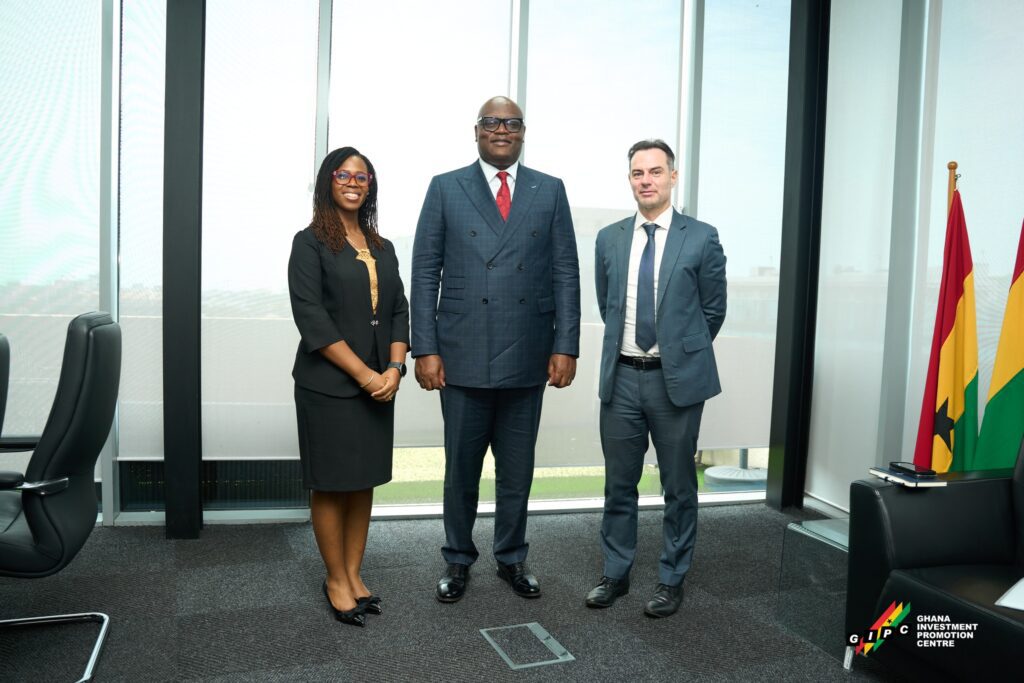
The high-level engagement between Mr. Simon Madjie and the UK Department for Business and Trade marked a definitive milestone in the bilateral relationship, focusing on infrastructure, fintech, and education.
The GIPC’s proactive approach to deepening these ties ensures that Ghana remains a preferred destination for British capital and expertise. As the roadmap for 2026 and beyond takes shape, the impactful partnerships discussed will begin to yield tangible results on the ground.
Whether it is through the construction of new road networks, the launch of innovative digital finance platforms, or the expansion of world-class educational opportunities, the UK-Ghana collaboration is set to drive significant progress.
READ ALSO: Ghana Partners with Japan, UNICEF to Strengthen Fight Against Child Labour