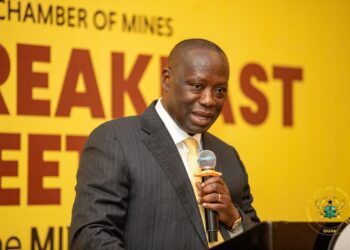
President John Dramani Mahama has signaled a strategic government intervention to stabilize domestic fuel prices should the current volatility in the global crude oil market persist due to escalating geopolitical tensions.
Speaking during a high-level engagement with Civil Society Organizations (CSOs) at the Jubilee House, the President emphasized that while the Ghana cedi remains remarkably resilient, the external “push factor” from rising international crude and finished product prices necessitates a proactive fiscal response.
“The push factor in the oil price buildup is not coming from the currency, because happily the currency is remaining stable. My hope is that sooner than later this war will come to an end and we’ll see more stable fuel prices. But if it doesn’t, we will look at the margins and the development levy to try and cushion consumers.”
President John Dramani Mahama

Dwelling on this commitment, the President noted that the administration is prepared to deploy specific “weapons” within the petroleum price buildup to shield Ghanaians from the harsh realities of the global energy crisis.
These measures include a critical review of existing industry margins and the potential suspension or reduction of the recently implemented one-cedi development levy.
President Mahama highlighted that the current stability of the cedi, which recently strengthened to approximately GH¢10.50 against the dollar, has been the primary reason the country has “absorbed” the initial shocks without catastrophic pump price hikes; however, he warned that “decisive decisions” would be taken if the war involving international actors like Netanyahu and Trump-era policies continues to disrupt supply chains.
Mitigating the Domino Effect on Inflation and Transport

The President’s strategy is deeply rooted in the understanding that fuel prices are the “main driver of inflation” in the Ghanaian economy.
Because the transport sector dictates the cost of moving essential goods, any spike at the pump immediately translates to higher prices in the “food basket,” disproportionately affecting the vulnerable.
By targeting the one-cedi development levy and internal margins, the government aims to break the transmission mechanism between global crude spikes and local food inflation.
This move is particularly vital in a year where the National Petroleum Authority (NPA) has already seen floor prices for diesel climb toward GH¢14.35, a trend the President is keen to arrest through fiscal cushioning.
Enhancing Household Disposable Income and Business Viability

Beyond the macro-level inflation targets, these proposed cushions offer a direct lifeline to Ghanaian households and the private sector.
For the average family, stabilized fuel costs mean more “disposable income” for healthcare and education, as daily commuting costs remain predictable.
For the business community ranging from small-scale traders to large logistics firms the government’s intervention serves as a “buffer against operational insolvency.”
In the context of a green transition, keeping liquid fuel prices stable while the country builds its electric vehicle (EV) infrastructure ensures that the current fossil-fuel-dependent economy does not collapse before sustainable alternatives reach a critical mass.
Securing National Economic Resilience and Social Stability

The broader economic benefit of this price-cushioning strategy lies in its ability to maintain “social and industrial harmony.”
President Mahama’s engagement with thinkers like Duncan Williams and various CSOs underscores a collaborative approach to national stability.
By preventing “drastic transport fare hikes,” the government effectively reduces the risk of labor agitations and protects the purchasing power of the cedi.
This fiscal discipline, combined with the strategic use of levies as a “cushioning tool,” reinforces Ghana’s position as a resilient economy capable of navigating external shocks while staying committed to its long-term energy transition and development goals.
READ ALSO: GIPC Boss Signals $2.6 Billion Investment Surge as Stability Returns