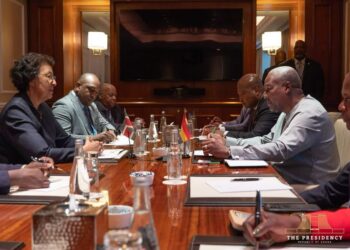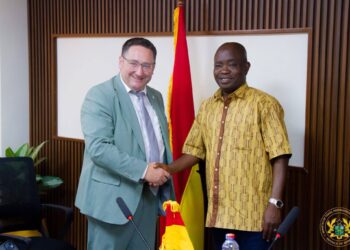
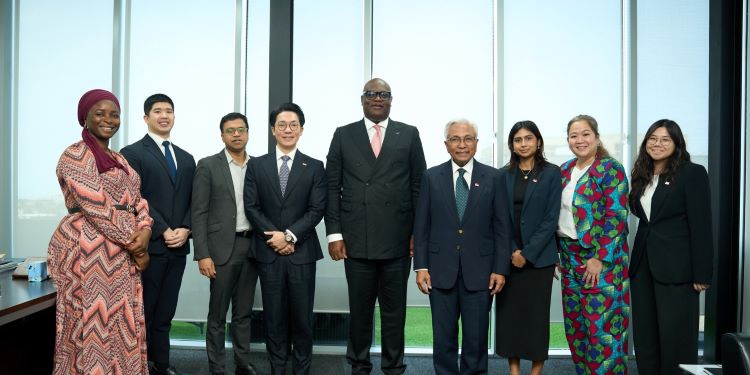
The Chief Executive Officer (CEO) of the Ghana Investment Promotion Centre (GIPC), Mr. Simon Madjie, has unveiled a streamlined regulatory architecture to position Ghana as the primary entry point for Asian “smart capital,” during a high-level briefing with a Singaporean delegation led by High Commissioner H.E. Hawazi Daipi.
According to GIPC, this diplomatic exchange was a technical pitch aimed at Singapore’s sovereign wealth and private equity appetite, focusing on the removal of minimum capital requirements and the aggressive expansion of the 24-Hour Economy Programme into the industrial heartlands of cocoa and cashew processing.
“Mr Madjie outlined recent reforms aimed at improving Ghana’s investment climate, including the removal of minimum capital requirements and reduced retail investment thresholds. He noted that these, alongside incentives under the government’s 24-Hour Economy Programme, are designed to drive value addition”
Ghana Investment Promotion Centre
For the Singaporean delegation – representing a nation defined by its mastery of logistics, fintech, and high-density manufacturing – the “new Ghana” pitch is built on the elimination of friction. By reducing retail investment thresholds and removing the capital gatekeeping that previously deterred mid-market innovators, Mr. Madjie is betting on a volume-based investment strategy.
The Centre noted that the objective is to transition from a commodity-exporting economy to a high-value processing hub, where Singaporean “yield-enhancement” technologies meet Ghanaian raw materials in specialized agro-processing parks.

The centerpiece of the GIPC’s strategy presentation was the integration of the 24-Hour Economy Programme as a fiscal and operational sweetener. In the discussions with H.E. Hawazi Daipi, it became clear that Singapore’s interest in large-scale manufacturing is contingent on energy reliability.
To this end, the GIPC pitched a technology-energy nexus, where Singaporean expertise in gas processing and solar investments provides the base-load power necessary for round-the-clock industrial activity. This is a move toward industrial sovereignty, where energy generation is decentralized and embedded directly into manufacturing enclaves.
For Mr. Madjie, Singapore’s interest in Fintech and AI is particularly telling. As Ghana digitizes its industrial backbone, the need for sophisticated credit-scoring algorithms and automated logistics becomes paramount.
He positioned the 24-hour cycle not just as a “night shift” but as a data-rich environment where AI can optimize energy consumption and supply chain throughput.
Smart Agribusiness
The Centre also revealed that with Ghana’s perennial challenge being the “yield gap,” – the difference between potential and actual agricultural output – Ghana’s Agro-processing Park model remains the most immediate opportunity for Singaporean capital.
Mr. Madjie’s invitation to explore smart agriculture and yield-enhancement solutions was a direct call for Singaporean AgTech to lead in the northern savannah and coastal plains, as integrating advanced irrigation projects with Singaporean water-management tech can end Ghana’s reliance on rain-fed agriculture.

The strategic focus on cocoa and cashew processing was a deliberate attempt to capture more of the global value chain, since currently, Ghana retains only a fraction of the final retail value of these commodities.
Leveraging Singapore’s experience in global trade hubs, the GIPC hopes to build processing facilities in Tema and Takoradi that can compete with European and Asian refineries, noting that this is value addition in its purest form: shifting from being a price-taker in the raw nut market to a price-setter in the semi-processed and finished goods markets.
Perhaps the most significant long-term outcome of the GIPC-Singapore dialogue was the emphasis on skills development. The Singapore delegation noted its economic miracle was built on human capital, identifying “skills development” as a key entry point for collaboration.
For Ghana to sustain a 24-hour manufacturing economy, it will require a workforce trained in AI-driven logistics, advanced robotics, and renewable energy maintenance, and the GIPC considered this while looking into Singapore’s “SkillsFuture” model as a blueprint for retraining the Ghanaian youth to meet the demands of the fourth industrial revolution.
In the realm of Fintech, the interest expressed by the Singaporean delegation suggested a potential influx of venture capital into Ghana’s digital payment systems.
With the Bank of Ghana moving toward a more digitized fiscal environment, the integration of Singaporean fintech solutions could provide the “plumbing” for the $2.5 billion in FDI that the GIPC is tracking for the 2026 fiscal year.

This financial infrastructure is the invisible force that will allow the “Accelerated Export Development,” goals to be met, ensuring that capital flows as efficiently as the goods being produced in the new industrial enclaves.
The engagement between the GIPC and the Singaporean delegation marked a maturation of Ghana’s investment promotion strategy, with the GIPC CEO moving the conversation beyond potential to mechanics.
READ ALSO: Ghana’s First Post-DDEP 7-Year Bond Attracts GH¢3.1bn Bids