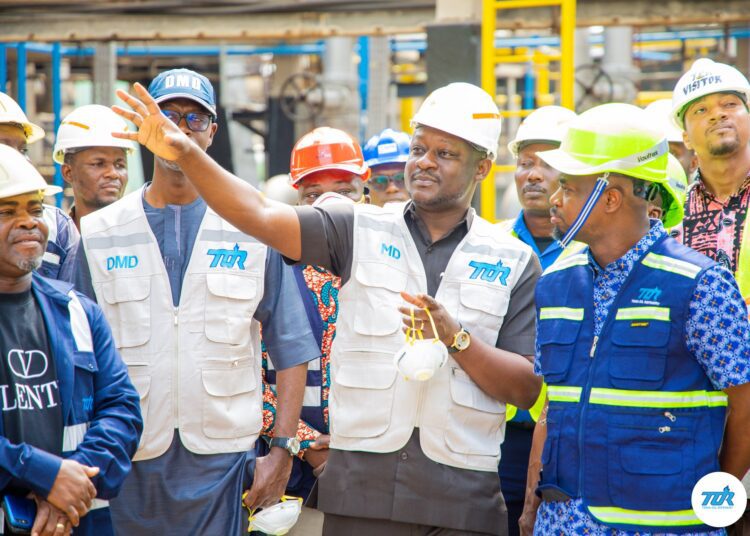
Edmond Kombat, the Managing Director of the Tema Oil Refinery (TOR), has voiced grave concerns regarding the escalating geopolitical instabilities in the Middle East and their direct, stifling effect on the refinery’s recovery.
As global energy markets grapple with the fallout from the Iranian conflict and the disruption of critical maritime corridors like the Suez Canal, the refinery finds its operational costs skyrocketing and its supply chain security severely compromised.
This external pressure arrives at a sensitive time for the state asset, which has been navigating a fragile path toward financial stability and technical restoration after years of inactivity.
“One of the challenges that we had was that our crude had just finished, and we had two vessels that were coming which were loaded in Egypt. And then that was the time that the Iranian war started and they were re-diverted. So, one of the things we are doing is to try as much as possible to rely on a lot of West African crude.”
Edmond Kombat, the Managing Director of the Tema Oil Refinery (TOR)

The crisis has fundamentally altered the economics of crude procurement, with Kombat highlighting a dramatic surge in logistics expenses that threatens to erode the refinery’s narrow margins.
Specifically, the diversion of vessels and the heightened risk environment have caused ship freight rates to leap from a pre-conflict average of $3 or $4 per barrel to a staggering $12 per barrel.
Coupled with rising insurance premiums and the literal “re-diversion” of ships already loaded with crude, the refinery is being forced to abandon traditional international routes in favor of a “localized resilience” model.
By pivoting toward a heavier reliance on West African crude sources, Tema Oil Refinery (TOR) aims to bypass the volatility of the Strait of Hormuz and the Suez Canal, effectively shortening its supply lines to mitigate the “transport risk” and “geopolitical disruptions” that currently define the global oil trade.
The Economic Ripple Effect on Ghana’s Oil Sector

The operational hurdles at TOR are not merely internal corporate struggles; they represent a significant bottleneck for Ghana’s broader energy architecture.
The refinery’s inability to maintain a steady, cost-effective flow of crude directly impacts the national Petroleum Hub project and the country’s foreign exchange reserves. Currently, Ghana spends approximately $400 million monthly amounting to roughly $4.8 billion annually into import refined petroleum products.
This massive outflow of US dollars is a primary driver of currency depreciation, as the demand for forex to settle import bills puts relentless pressure on the Cedi.
When TOR’s operations are “derailed” by global tensions, the country remains “held hostage by distant conflicts,” as it cannot leverage its own domestic refining capacity to buffer against international price shocks.
A fully functional TOR, as envisioned under Kombat’s leadership, is expected to refine enough crude to meet at least 50% of national demand, which would significantly lower the “toxic link” between global volatility and local pump prices.
The current reliance on expensive, finished-product imports means that any hike in global freight or insurance is immediately felt by the Ghanaian consumer, further fueling domestic inflation.
Strategic Shifts and Regional Integration

To combat these “external pressures,” the refinery is aggressively pursuing a strategy of regional energy integration. By sourcing crude from neighboring West African producers, TOR is not only lowering its exposure to “volatile international shipping routes” but also fostering a more integrated ECOWAS energy market.
This pragmatic shift is designed to ensure that the refinery’s Crude Distillation Unit (CDU) recently restored by in-house engineers remains fed even when the Middle East is in turmoil.
Industry analysts suggest that this “localization” of the supply chain is the only viable path for TOR to survive its “tight financial constraints.”
Shortening the distance between the wellhead and the refinery reduces the “unrealized potential” of the facility and transforms it back into a “symbol of national energy security.”
If successful, this shift could save the country billions in foreign exchange and provide a “national emergency battery” of fuel reserves, ensuring that Ghana’s economy continues to flow even when global supply chains break.
A Vision for Sustainable Recovery
Despite the “depressing” state of disrepair and debt inherited by the current administration, the narrative at the Tema Oil Refinery is beginning to shift toward one of “deliberate decisions and firm leadership.“
The recovery efforts, though still in their “early stages,” are centered on rebuilding trust with private petroleum service providers and attracting regional clients from landlocked neighbors like Burkina Faso.
The “prayer of many” in the energy sector is that this transition toward West African crude will provide the stability needed for TOR to reclaim its role as a “cornerstone of Ghana’s industrial growth.”
By reducing “fuel import dependence,” the refinery is positioned to be more than just an industrial asset; it is becoming the frontline of Ghana’s “geopolitical resilience.”
READ ALSO: Ghana Welcomes Burkina Faso’s Decision to Lift Tomato Export Ban