
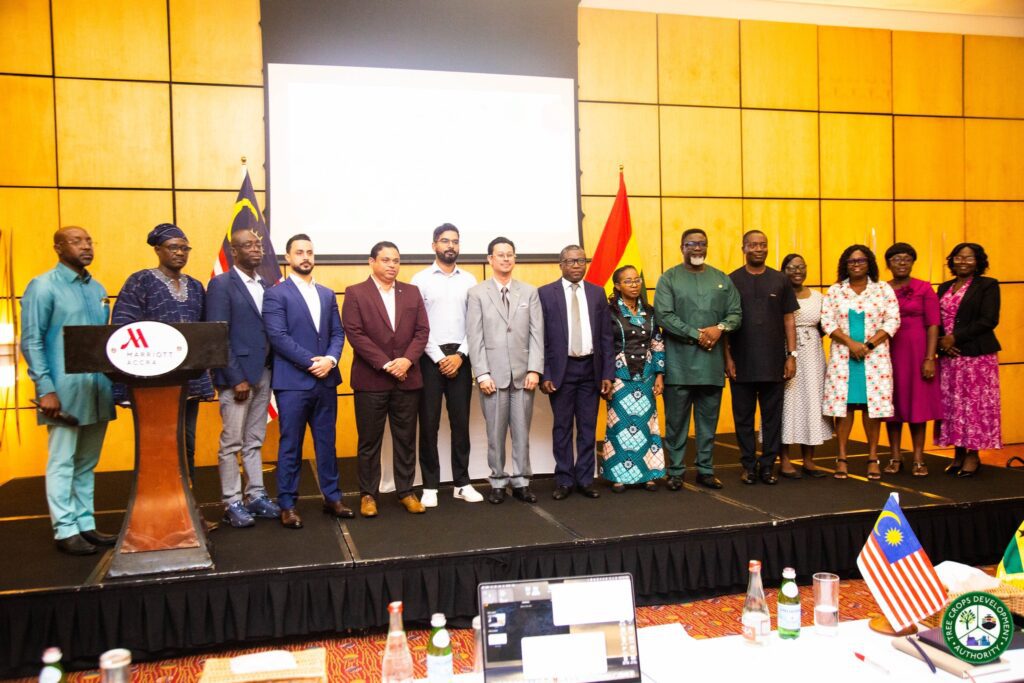
In a strategic move to reposition Ghana as a global powerhouse in the tree crop sector, the Tree Crops Development Authority (TCDA) has formalized a high-stakes partnership with Malaysia at the Malaysian Palm Oil Council (MPOC) Technical Seminar held in Accra.
According to the Authority, CEO Dr. Andy Osei Okrah briefed a powerful assembly of diplomats, researchers, and value chain actors on the future of Ghana’s oil palm industry at the engagement, transitioning the bilateral meeting to a strategic effort to inject Malaysian industrial precision into the Ghanaian economy.
“The seminar featured key dignitaries including the Chargé d’Affaires of Malaysia, Mr. Syed Nauzer Idid Bin Syed Yusoff, the Director General of Research (CSIR), Professor Paul Pinnock Bosu among other High-level delegates. The seminar aimed to strengthen Malaysia, Ghana collaboration in the palm oil sector”
Tree Crops Development Authority
The seminar featured an elite delegation, bringing together the architects of Malaysia’s palm oil success with Ghana’s primary regulatory and research bodies, to signal that the era of fragmented, low-yield production is over. The focus has shifted to the industrialization of the value chain, from high-performance seedlings to export-grade refining.
The TCDA noted that Malaysia’s ascent to becoming a global leader in palm oil was not an accident of geography, but a triumph of technical discipline and research-led governance, adding that the collaboration with the MPOC is a deliberate attempt to import this blueprint.
Dr. Andy Osei Okrah’s briefing emphasized that for Ghana to compete on the global stage, it must adopt the technical standards that have made Malaysia a benchmark for efficiency. He explained that the collaboration targets the yield gap – the discrepancy between what Ghanaian smallholders currently produce and the potential of modern, high-yield varieties.

The TCDA reiterated plans of facilitating the transfer of Malaysian agrotechnology, focusing on sustainable milling practices and the development of specialized nurseries, through its partnership with the CSIR – leveraging international expertise to build localized sovereign capability.
The Industrial Engine
A significant highlight of the seminar was the involvement of Professor Paul Pinnock Bosu and the CSIR, as industrialization in the tree crop sector is impossible without a robust scientific foundation.
The TCDA’s strategy involves integrating Malaysian research data with Ghanaian soil and climatic conditions to create a “localized precision model,” ensuring that the inputs and techniques introduced are not just imported, but optimized for the Ghanaian landscape.
The focus on research extended beyond the field talks and into the laboratory. The seminar addressed the need for standardized testing and certification, which are the gatekeepers of international trade.
By aligning Ghana’s regulatory framework with Malaysian technical standards, the TCDA is ensuring that “Made in Ghana,” palm oil meets the stringent quality and sustainability requirements of the global market. This is a direct intervention to increase the basket of exports and reduce the nation’s reliance on raw material shipments.
The TCDA’s triple helix model approach to the oil palm industry features a seamless collaboration between government, academia, and the private sector. Dr. Okrah’s briefing to the diverse group of stakeholders underscored that the authority is no longer just a regulator, but a facilitator of growth, ready to move the industry to an “industrial ecosystem.”

Connecting smallholder farmers to industrial millers and refiners is expected to create a closed-loop supply chain, while the Malaysian collaboration provides the technical know-how to improve milling efficiency, which is currently a significant bottleneck in Ghana.
The TDCA explained that increased extraction rates mean higher profitability for both the miller and the farmer, providing a self-sustaining cycle of reinvestment meant to be the bedrock of the 24-Hour Economy in the agribusiness sector. For stakeholders, this will guarantee that factories have the consistent, high-quality feedstock needed to operate at maximum capacity.
The presence of Mr. Syed Nauzer Idid Bin Syed Yusoff highlighted the diplomatic weight of this partnership, as Malaysia views Ghana as a strategic entry point into the West African market, particularly under the AfCFTA framework.
For Ghana, Malaysia is the ultimate mentor in the palm oil space and a synergy of this kind is expected to lead to increased Foreign Direct Investment (FDI), with Malaysian firms looking to partner with Ghanaian entities to establish refineries and processing hubs.
According to the TCDA, this diplomatic alignment will also facilitate “brain gain,” – the exchange of technical experts and researchers between the two nations. As Dr. Andy Osei Okrah noted, the TCDA is committed to creating an environment where such high-level collaborations can thrive.
The success of the Malaysian Palm Oil Council Technical Seminar is a testament to the fact that Ghana is now perceived as a serious, technically-minded partner in the global agribusiness arena. The briefing by Dr. Andy Osei Okrah at the MPOC Technical Seminar marks the beginning of a more sophisticated chapter for Ghana’s tree crop economy.
As the TCDA continues to roll out its industrialization agenda, the focus remains on the output, with success depending on the increased yields of Ghanaian farmers and the volume of refined palm oil moving through the ports in the nation’s not-so-distant future.
READ ALSO: OPEC+ Output Increase Amid Global Oil Supply Disruption