A new political analysis by Mussa Dankwa has revealed a significant shift in political allegiance among Ghana’s high income voters, with the New Patriotic Party losing substantial support to the National Democratic Congress between 2024 and 2026.
The data, based on polls conducted by Global InfoAnalytics, suggests that a demographic traditionally seen as a stronghold for the New Patriotic Party is undergoing a major realignment. The findings point to deeper structural and economic factors influencing voter behaviour, raising questions about future electoral dynamics.
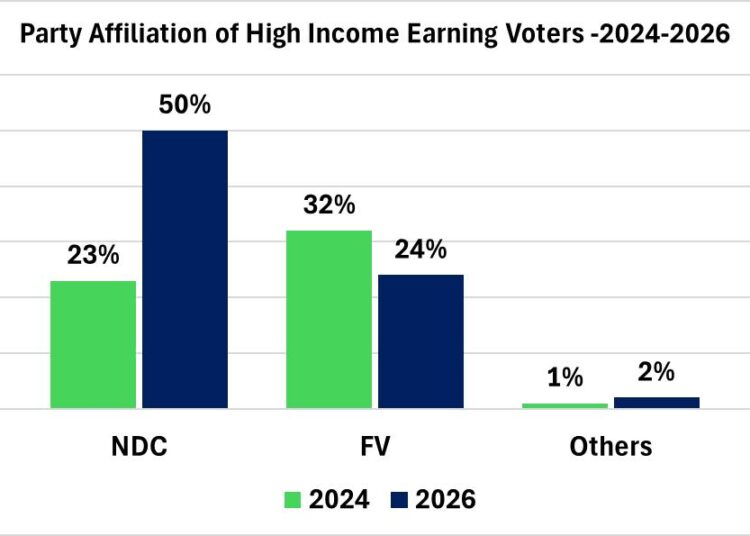
According to the October 2024 poll, 33 percent of high income respondents identified with the New Patriotic Party, while 23 percent aligned with the National Democratic Congress. Floating voters made up 32 percent, with smaller proportions identifying with other parties or declining to disclose their affiliation.
However, by March 2026, the political landscape within this group had changed markedly. Support for the New Patriotic Party dropped sharply to 15 percent, while the National Democratic Congress saw a significant rise to 50 percent. Floating voters declined to 24 percent, with marginal changes recorded among other categories.
The shift, according to Dankwa, reflects a deeper problem for the New Patriotic Party than previously understood. “From this data, it is very clear the problem NPP has with high income voters is bigger than previously thought,” he noted.
Voting patterns confirm electoral shift
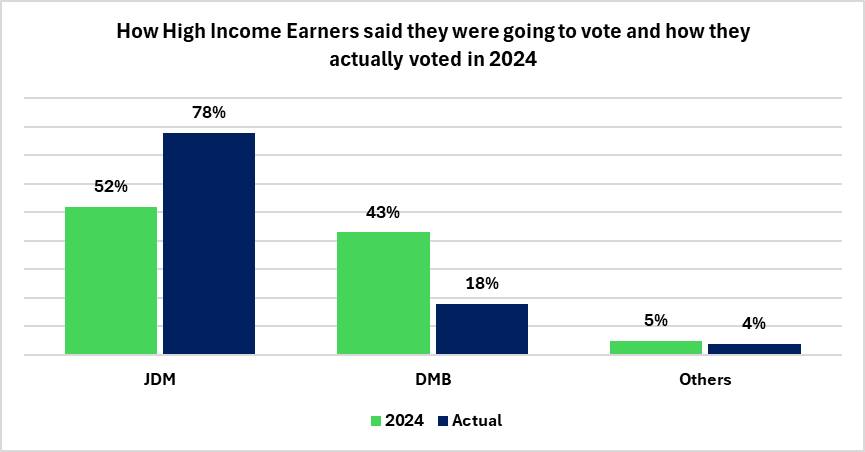
The polling data also provides insight into how these voters behaved during the 2024 general elections. When respondents were asked ahead of the election about their voting intentions, 52 percent indicated support for John Dramani Mahama, while 43 percent favoured Mahamudu Bawumia. Five percent indicated support for other candidates.
However, post election responses collected in March 2026 revealed a much wider margin. According to the data, 78 percent of high income voters reported voting for Mahama, compared to 18 percent for Bawumia, with 4 percent supporting other candidates.
This discrepancy between pre election intentions and actual voting behaviour suggests that late stage factors may have influenced voter decisions. It also underscores the extent to which the National Democratic Congress was able to consolidate support within this demographic.
Projections for 2028 elections
Looking ahead, the data offers projections for potential matchups in the 2028 general elections, providing an early indication of voter preferences among high income earners.
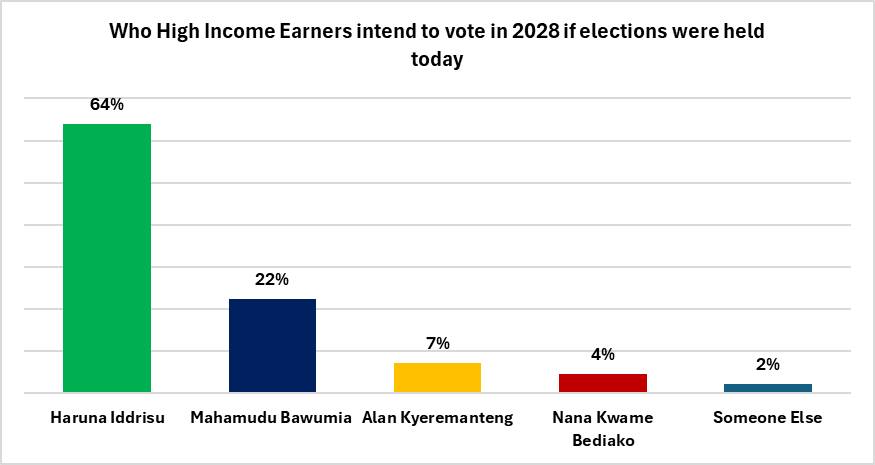
In a hypothetical contest between Cassiel Ato Forson and Bawumia, 72 percent of respondents indicated support for Ato Forson, compared to 21 percent for Bawumia. Similarly, in a scenario involving Haruna Iddrisu, the National Democratic Congress candidate secured 64 percent support against Bawumia’s 22 percent.
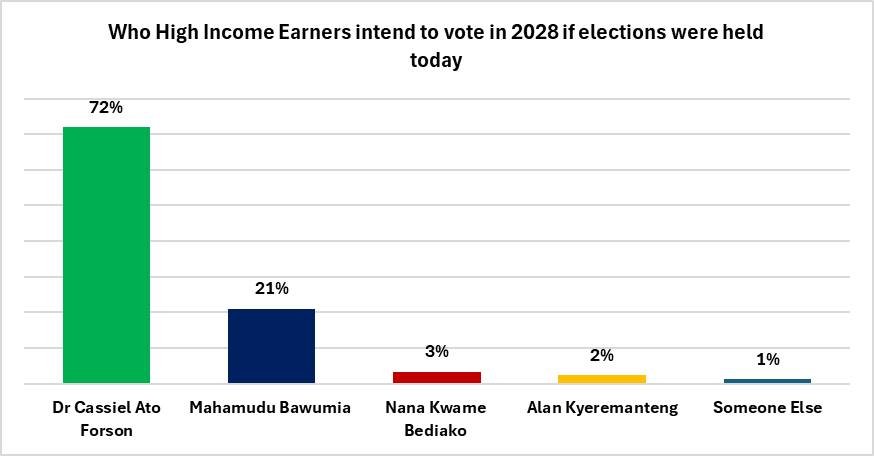
Further scenarios showed Johnson Asiedu Nketia attracting 63 percent support, while Naana Jane Opoku-Agyemang received 68 percent, both outperforming Bawumia significantly.
These projections indicate that the shift in voter sentiment may extend beyond a single election cycle, potentially shaping the political landscape in the years ahead.
Economic factors influencing voter behaviour
Mussa Dankwa pointed to several economic factors that may have contributed to the shift in support. One key issue he identified is the legacy of the Domestic Debt Exchange Programme, which affected investor confidence and financial stability.
He also highlighted improvements in currency stability as a potential factor influencing voter perceptions. According to him, a more stable currency has had a direct impact on high income earners, particularly in areas such as mortgage financing and vehicle ownership.
“Mortgages have become affordable and many have been able to clear the mortgage debts,” he observed. He added that professionals in the financial services sector are increasingly able to purchase new vehicles due to improved pricing conditions.
These developments, he suggested, may have contributed to a more favourable view of the current economic environment among high income voters.
Implications for political strategy
The findings present important implications for political parties as they prepare for future elections. For the New Patriotic Party, the data highlights the need for a reassessment of its engagement with high income voters, a group that has historically formed part of its core support base.
Mussa Dankwa noted that the party must develop a clear strategy to regain the trust of this demographic. “The party must have a clear strategy to win back these voters who have previously been loyal to their cause,” he said.
At the same time, the National Democratic Congress may seek to consolidate its gains by addressing the economic concerns and expectations of this group.
The data also raises broader questions about the role of economic performance in shaping political preferences. As Ghana’s economy evolves, voter priorities may shift in response to changing conditions, influencing electoral outcomes.

Data offers lessons for stakeholders
Beyond its immediate political implications, the analysis provides valuable insights for policymakers, strategists, and communication experts. Dankwa emphasised that the data is available to all stakeholders, including both government and opposition parties.
“Any lessons for political and communication strategy from this data is up to you how you use this data,” he stated, underscoring the importance of evidence based decision making.
The findings highlight the need for political actors to engage more effectively with key voter segments and to align their messaging with the realities of economic conditions.
The shift in high income voter support reflects broader changes in Ghana’s political landscape, where traditional voting patterns are being reshaped by economic and social factors.

As parties prepare for future contests, the ability to understand and respond to these changes will be critical. The data presented by Global InfoAnalytics offers a snapshot of these evolving dynamics, providing a foundation for further analysis and strategic planning.
For now, the sharp decline in support for the New Patriotic Party among high income voters serves as a reminder that political loyalty is not fixed and can shift in response to changing circumstances.
READ ALSO: AUC Welcomes Iran–US Ceasefire