
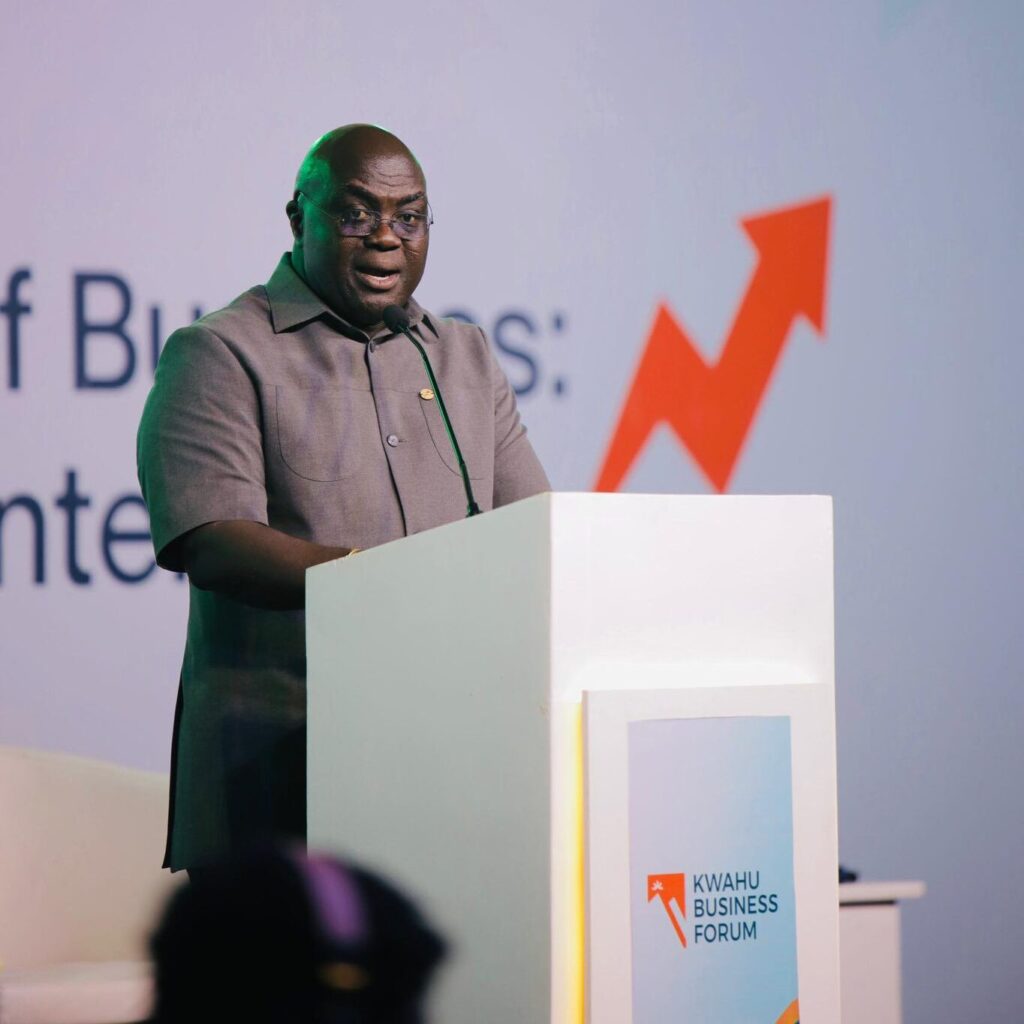
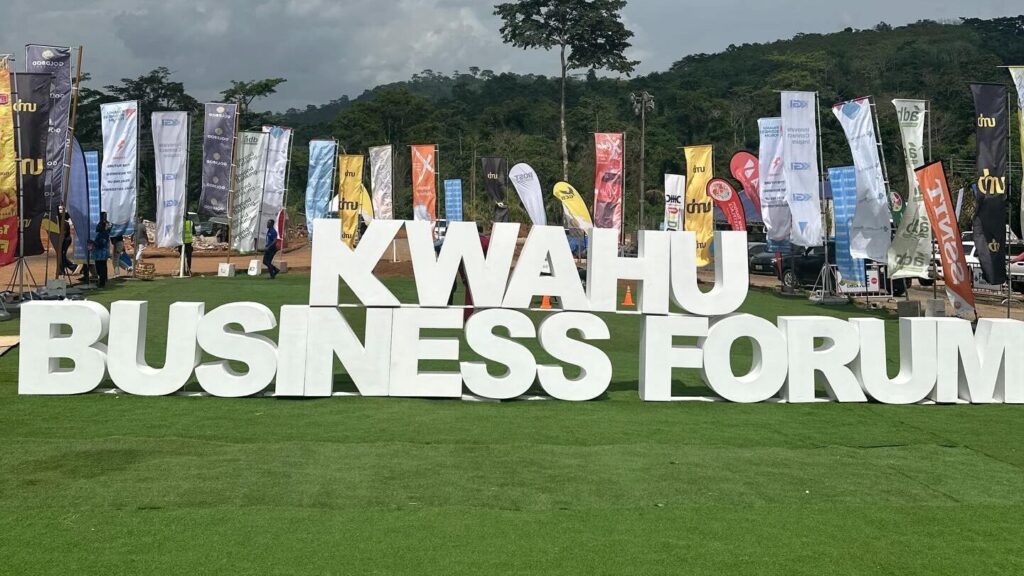
The transition of the Ghanaian economy from a “nation of shopkeepers,” to a manufacturing powerhouse requires a fundamental recalibration of the private sector’s DNA. This was the message presented by Mr. Maxwell Dawson, a youth advocate and policy analyst, in a Vaultz News exclusive following the 2026 Kwahu Business Forum.
In a wide-ranging analysis of the Chief of Staff, Hon. Julius Debrah’s “new compact,” proposal at the Forum, Mr. Dawson argued that the private sector’s survival in a volatile global economy depends on a “wedding cake,” model of sustainability – where the environment and people serve as the non-negotiable base for long-term industrial profit.
“If you consider the base of a wedding cake as the environment, the second layer as people, and the final layer as profit… you can imagine that if there was no environment, there cannot be people, and if there are no people, there is no profit.
“If businesses understand this perspective, it will shape and enhance everything that we do in the business community”
Mr. Maxwell Dawson, Youth Advocate and Policy Analyst
Addressing the call for a new government-business alliance at the 2026 Kwahu Business Forum, Mr. Dawson was blunt regarding the private sector’s obligations. Beyond fiscal discipline and policy clarity, he charged businesses to move beyond “short-termism” and “entitlement.”
He posited that the “new compact,” creates a social contract where the business community must invest in the quality of the human resource and the environment that feeds its industries, or risk obsolescence within a generation.
“If there is any social contract between the government and the private sector, that social contract must do good to society – in terms of people who can show up in their everyday life empowered. Both sides must have the mindset to do the long-term things, the hard things that are required to change every society and community”
Mr. Maxwell Dawson, Youth Advocate and Policy Analyst
A primary hurdle for local firms remains the historically high cost of credit. However, Dawson acknowledged that the current regime is making progress, noting a significant drop in the Ghana Reference Rate (GRR) from approximately 21% in 2025 to 10.28% following the most recent Monetary Policy Report.
Yet, he warned that these technical gains must be protected from being “thrown away,” during election seasons or regime changes, as is often the case. For Dawson, the true measure of a “nation built for the long term,” is its ability to maintain positive macroeconomic indicators across political cycles – a level of resilience Ghana has yet to institutionalize.
National Mentorship and Energy Concerns
On Hon. Debrah’s national mentorship strategy, Mr. Dawson offered a sharp rebuttal to the idea of government-sponsored programs.
Drawing on the “epileptic” history of past initiatives like the Nation Builders’ Corps (NaBCO), the analyst argued that the government has “no business,” initiating new mentorship frameworks through tax incentives or fresh policy layers for the private sector.
Instead, he advocated for a lean approach: integrating mentorship directly into the existing academic process and the national service scheme to avoid creating redundant institutions that serve as “mechanisms for siphoning funds.”
“Our government has been very, very unstable in implementing initiatives like these. I find it very inconsistent that in one school, the Chief of Staff said that the government’s work is to provide policy, and in another school, the government is going ahead to implement a mentoring program. It’s such a disconnect, right, singing different chords in the same hymn”
Mr. Maxwell Dawson, Youth Advocate and Policy Analyst
Mr. Dawson further addressed the energy sector, labeling the 25% to 35% loss in electricity generation as “shameful,” and a primary barrier to Ghana’s manufacturing competitiveness. He linked this to the broader volatility of fuel prices, questioning why a nation with crude oil in the Sankofa Basin remains so vulnerable to global geopolitical shocks.

For him, the “lip service,” regarding energy and power must end if the government’s vision presented at Kwahu for an industrial hub is to be realized. He challenged state managers to run the country with the same discipline a father would run a well-managed home, by first ensuring the factors needed for production are adequately provided.
“We have done well in the very short term, but we must concentrate on building our strategic resources,” he added.
24-Hour Economy
Finally, the discussion turned to the 24-hour economy, where Mr. Dawson expressed skepticism about the policy’s implementation, describing it as a slogan that has “struggled for explanation.”
Regardless, for the 24-hour economy to be effective, he argued, it must be entrenched in a national development document that survives changing governments for at least a decade, preventing the “recalibration” of slogans like Planting for Food and Jobs into new branding exercises.
“Norway, I’m told, discovered oil and made a policy that you cannot directly spend the proceeds from the oil, you can only spend the returns. For about 36 years or so, they have kept faith with that policy. The people who developed the policy probably have died, but their children are benefiting from it.
“So the 24-Hour Economy may be useful, but it will be useful to the extent that it can be implemented for 10 years plus, and politicians respect it as part of our long-term national development agenda”
Mr. Maxwell Dawson, Youth Advocate and Policy Analyst
As Ghana navigates the aftermath of the Kwahu Business Forum 2026, Mr. Dawson’s critique serves as a reminder that policy clarity is only the first step. Without a commitment to the long-term – from stable electricity to integrated academic mentorship – Ghana’s transition to a manufacturing powerhouse may remain a borrowed dream.
For the private sector, the “new compact,” is not a gift from the state, but a mandate to govern with a sustainability focus that ensures the bottom line survives the next global shock, while the state approaches industrialization with a competitive advantage strategy, provides tax incentives, infrastructure, and policy guidance.
The path forward, according to Mr. Dawson, requires a focus on identifying specific products that Ghana excels in producing and ensuring they are processed locally rather than exported raw.
By providing the necessary benchmarks for these specific layers, the government can finally put its “money where its mouth is,” creating an environment where industrialists, manufacturers and have the confidence to show up and act.