German Chancellor Friedrich Merz has acknowledged that the Iran war has become a “stress test” for NATO, stating that he doesn’t want it to burden trans-Atlantic relations further.
Merz said that he and Trump discussed the alliance’s future in a phone and that he offered to discuss it again before a NATO summit in Ankara, Turkey, in July.
Merz said that “it is my firm intention to do everything to preserve the protection of NATO, including the United States of America, for Europe.”
He added that “this alliance, at least at present, cannot be replaced by anything, so I have a great interest in preserving it and developing it further with the American President.”
This comes a day after US President Donald Trump lashed out at NATO over its reluctance to join Washington’s war on Iran, and appeared to revive threats over Greenland, following a meeting with the alliance’s Secretary-General, Mark Rutte.

Writing on his TruthSocial platform, Trump said that “NATO wasn’t there when we needed them, and they won’t be there if we need them again.”
Ahead of the meeting, White House Spokesperson Karoline Leavitt said that member states had “turned their backs on the American people”, who fund their nations’ defence. She said that Trump would have a “very frank and candid conversation” with the NATO Chief and quoted the US President as saying, “They were tested, and they failed.”
The Chancellor said that the German government would start talking to Iran again, in consultation with the US and its European partners, in the interest of making “our own contribution” to the success of peace negotiations. “After a long period silence, which we had serious reasons for, we are now as a government restarting talks with Tehran,” he said.
He added that Germany will join efforts to secure the Strait of Hormuz if Iran and the US manage to agree on a peace deal and if certain conditions are met. Merz said that he was convinced that Trump’s intention isn’t to destroy a whole civilisation, referring to an inflammatory comment the US leader made a few days ago.
Merz Urges Israel To End Attacks On Lebanon
Chancellor Friedrich Merz said that “the severity with which Israel is waging war on Lebanon could cause the failure of the peace process as a whole, and that must not happen.”
He said that he and others had asked Israel to “end its further intensified attacks” and that his Foreign Minister had spoken twice to his Israeli counterpart.
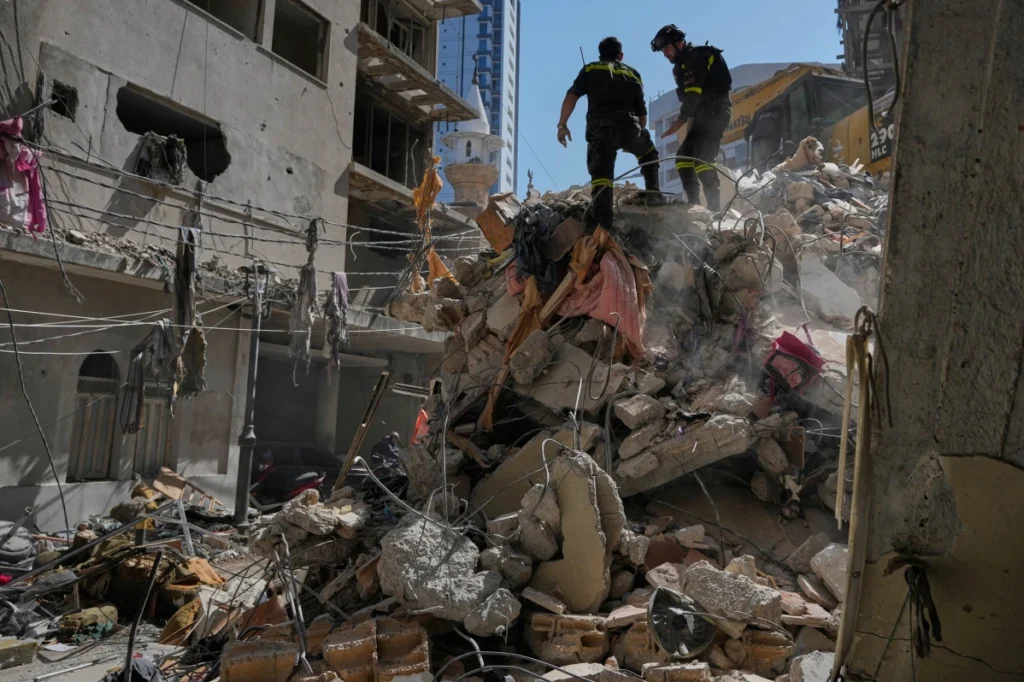
Israel continued striking southern Lebanon on Thursday. Israel also said that it had killed an aide and nephew of Hezbollah leader Naim Kassem, Ali Yusuf Harshi.
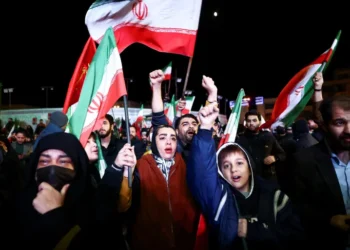
Iran’s Parliament Speaker, Mohammad Bagher Qalibaf, warned that continued Israeli attacks on Lebanon would bring “explicit costs and STRONG responses,” while insisting that a two-week ceasefire in the Iran war extended to Lebanon.
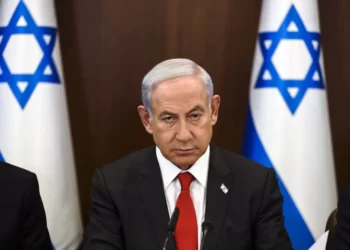
Israeli Prime Minister Benjamin Netanyahu said that strikes would proceed “with force, precision and determination.” Israel’s military has accused Hezbollah members of moving out of the group’s main areas of influence in southern Lebanon and Beirut’s southern suburbs, known as Dahiyeh, and blending into civilian areas.
Lebanese Prime Minister Nawaf Salam said his country will file an urgent complaint with the UN Security Council, calling the attacks a “blatant violation” of international and humanitarian law.
Salam added that the cabinet has ordered security forces to tighten control over the capital by “enhancing the state’s full authority across Beirut and restricting arms to legitimate forces.”
Even before the renewed war, Lebanon’s government had sought Hezbollah’s disarmament. The issue has inflamed tensions among Lebanese who are deeply divided over Hezbollah and its arsenal.
Melhem Khalaf, a reformist legislator representing Beirut, was critical of Israel’s strikes but also of Hezbollah for dragging Lebanon back into war. “All the targeted areas are safe residential Lebanese areas,” Khalaf said, adding, “What we are witnessing is a massacre against civilians.”
More than a million people have been displaced by the war, many from the south and Dahiyeh. Israel’s military has issued warnings for the population to leave those areas, followed by heavy bombardment
READ ALSO: High Royalty Rate Responsible for Petroleum Production Declines – PIAC Chairman