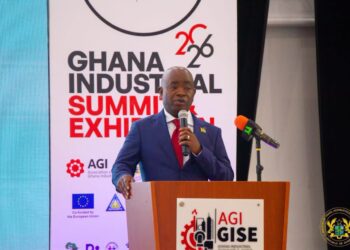

A high-stakes regulatory standoff between the Customs Division of the Ghana Revenue Authority (GRA) and the Association of Free Zones Enterprises (AFZE) reached a critical turning point as the Minister for Trade, Agribusiness, and Industry, Hon. Elizabeth Ofosu-Adjare, intervened to resolve the growing crisis.
The engagement, necessitated by a formal petition from the AFZE, over a sudden directive that had effectively paralyzed the movement of finished goods into Ghana’s Free Zone enclaves, highlighted the delicate friction between the state’s drive for revenue mobilization and the private sector’s need for operational certainty.
According to the Ministry of Trade, Agribusiness and Industry (MoTAI), the conflict stems from a recent Customs directive that halted the processing and receipt of finished goods within the enclaves.
While the policy was intended as a corrective measure to protect the national treasury, its implementation created an immediate bottleneck at the ports, leaving legitimate consignments in limbo and threatening the viability of businesses operating under Commercial Free Zone Licenses.
“During the deliberations, the Commissioner of Customs, Mr. Aaron Kanor, clarified that the directive was a necessary response to emerging cases of abuse, where some companies were found to be smuggling finished goods into the Free Zones enclave under the guise of operating within the law”
Ministry of Trade, Agribusiness and Industry
He explained that the entities using the cover of Free Zone status to smuggle finished goods into the country, were bypassing the standard duty structures intended to protect the domestic economy and generate state revenue.

This illicit activity creates an uneven playing field, where companies operating outside the law gain an unfair price advantage over compliant manufacturers and importers. The Customs Division argued that without a temporary halt to assess the scale of the infractions, the integrity of the entire Free Zone system would remain compromised.
However, the blanket nature of the directive meant that the “sin” of a few began to dictate the operational reality for the many, leading to the urgent petition by the AFZE. For the Ministry, the challenge lies in sustaining the attractive incentives of the Free Zones regime while closing the loopholes exploited by bad actors.
Safeguarding Business Continuity
The Association of Free Zones Enterprises made a compelling case for the immediate restoration of operations, citing the mounting costs of demurrage at the ports and the potential for long-term supply chain disruptions.
In the highly competitive regional market, any perception of instability in Ghana’s trade directives can deter foreign direct investment and undermine the economic and industrial growth goals the nation has set for 2026.
Hon. Ofosu-Adjare acknowledged that while the GRA’s concerns regarding smuggling were legitimate, the remedy could not be allowed to kill the patient. The meeting focused on identifying a surgical approach to compliance – one that targets the smugglers without suffocating the legitimate commercial enterprises that contribute significantly to Ghana’s export earnings and employment.
The Minister’s intervention shifted the dialogue from a binary choice between “compliance or trade,” to a search for a collaborative middle ground.

The resolution proposed by the Ministry centered on a significant shift in the administrative work of the enclaves. Rather than relying on distant directives, the Minister underscored the necessity of a balanced approach that strengthens the collaboration between the Ghana Free Zones Authority (GFZA) and the Customs Division.
In the past, these two entities have often operated in distinctly, leading to the information gaps that smugglers exploited. Moving forward, the Ministry has proposed a framework for enhanced joint monitoring.
This will involve real-time data sharing and physical presence within the enclaves, ensuring that every finished good entering the zone is accounted for and verified against its declared purpose. This joint oversight, is expected to provide “green channels,” for vetted, compliant companies while maintaining a “red channels” of high scrutiny for suspicious actors.
This crisis management session serves as a broader indicator of the government’s industrial policy for 2026. The Ministry’s stance reflects a commitment to a “compliance-driven” trade environment where the rules are clear, but the enforcement is fair.
Hon. Ofosu-Adjare emphasized that the state cannot afford to be lax on revenue leakages, especially as it works toward fiscal consolidation, but it also cannot afford to alienate the very industries that drive the GDP. The proposed joint monitoring framework, forcing the regulator (Customs) and the facilitator (GFZA) into a tighter partnership is to bring an immediate end to the compliance challenges.

As the meeting concluded, priority shifted to the clearing of the backlog at the ports, with the Minister’s leadership in this matter being regarded as a necessary “de-escalation” of a situation that threatened to boil over into a broader industrial dispute.
READ ALSO: Vietnam Seeks To Bolster Ties With China