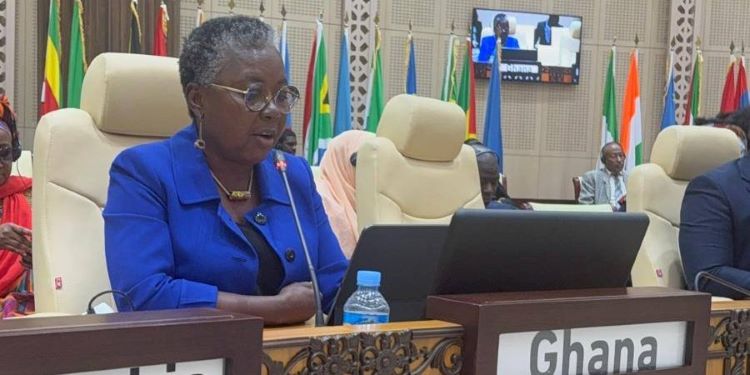
At the high-level 34th FAO Ministerial Conference in Nouakchott, Mauritania, the Minister for Fisheries and Aquaculture Development, Hon. Emelia Arthur, delivered a decisive presentation positioning Ghana as a primary architect of sustainable “blue food” transformation.
Speaking on the theme “Ghana’s Lessons in Delivering Blue Transformation,” the Minister outlined a sovereign roadmap that bridges the gap between high-level policy and port-side reality, noting that the transformation of aquatic food systems is not a peripheral environmental goal but a core pillar of national security.
With fish accounting for 60% of animal protein intake in Ghana, Hon. Arthur’s presentation in Mauritania follows a series of aggressive domestic reforms, including the recent declaration of Ghana’s first Marine Protected Area (MPA) at Cape Three Points and the passage of the Fisheries and Aquaculture Act, 2025.
“Central to Ghana’s progress, she noted, is an integrated and inter-sectoral approach anchored in a national Blue Economy Strategy with a 10-year implementation plan. The strategy spans marine, inland, and wetland ecosystems and is built on key pillars including economic growth, environmental sustainability, knowledge, equity, and security”
Minister for Fisheries and Aquaculture Development
Through showcasing these “lessons” on a global stage, Hon. Arthur signaled that Ghana is moving beyond theoretical strategies toward a “year of delivery,” utilizing the 10-year Blue Economy implementation plan to industrialize the sector while safeguarding the livelihoods of the three million people who depend on it.

Central to the Minister’s address was the concept of an integrated, inter-sectoral approach to ocean governance. She detailed Ghana’s National Blue Economy Strategy, a decade-long implementation plan that seeks to dismantle the traditional silos between fisheries, environment, and investment.
To drive this vision, the government is advancing the establishment of a dedicated Blue Economy Commission, which will serve as the institutional engine for Ghana’s maritime industrial revolution.
For the Minister, the creation of a comprehensive policy and legal framework is the prerequisite for attracting the large-scale investment needed to scale impact across the entire value chain.
Access for Sustainability
Hon. Arthur was candid about the pressures facing Ghana’s fisheries resources, particularly within the artisanal sector, which contributes over 70% of marine fish production. She argued that sustainability is unattainable without strict management of access and capacity.
This includes the controversial but necessary deployment of licensing, canoe registration, and closed seasons, alongside a massive upgrade in monitoring, control, and surveillance (MCS) systems to combat illegal, unreported, and unregulated (IUU) fishing.
The Minister specifically cited the Fisheries and Aquaculture Act, 2025, as the legal backbone of these reforms. This new legislation provides the state with the teeth required to enforce conservation measures, including the landmark designation of the Greater Cape Three Points as a Marine Protected Area.

For Hon. Arthur and the Ministry of Fisheries and Aquaculture Development (MoFAD), these measures are the restoration phase of the blue transformation, as they are projected to allow fish stocks to regenerate while ensuring that artisanal fishers remain the primary beneficiaries of a healthier ocean.
One of the most significant industrial stakes highlighted in Mauritania was the urgent need to address post-harvest losses, which are currently estimated at 20% to 30% in some segments.
Hon. Arthur argued that “blue transformation must extend from water to the market,” signaling a shift in MoFAD’s focus toward processing infrastructure and food safety. This involves reducing waste and enhancing market access to ensure that more of the catch’s value remains within the local economy.
The Minister’s emphasis on the “ecosystem approach” highlights a reliance on public-private partnerships (PPPs) to solve these infrastructure gaps. She added that bringing together the private sector, academia, and civil society is intended to birth innovations in cold-chain logistics and processing technology.
This industrialization of the value chain is seen viewed as a way to insulate the sector from the volatility of capture volumes, turning a raw resource into a high-value, processed commodity.
“The Minister noted that post-harvest losses – estimated at 20 to 30 percent in some segments – remain a significant challenge. Interventions are therefore targeting improved processing infrastructure, reduced waste, enhanced food safety, and expanded market access”
Minister for Fisheries and Aquaculture Development

As capture fisheries reach their natural limits, Hon. Arthur positioned aquaculture as the primary engine for future growth. Currently contributing 15% of national fish production, aquaculture is being scaled through community-based systems and targeted investments in youth and women.
The Minister revealed a major technological pivot, where Ghana is now advancing toward its first mariculture systems, opening new frontiers for sustainable fish production in the open ocean. However, the Minister cautioned that this transformation requires structured investment.
She called for a move toward blended financing mechanisms and investment-ready projects to bridge the institutional gaps that currently hold back the sector. For Hon. Arthur, the goal is to define the future of sustainable aquatic food systems not just for Ghana, but for the entire African continent through collective action and policy alignment.
The Minister’s presentation in Mauritania serves as a global proof of concept for Ghana’s maritime strategy.
The lessons Ghana shared are those of a nation that has moved from aspiration to action, utilizing the Fisheries and Aquaculture Act, 2025, and the 10-year Blue Economy Strategy to harden its maritime sovereignty.
READ ALSO: Medikal Calls for Improved Structures in Ghana’s Music Industry