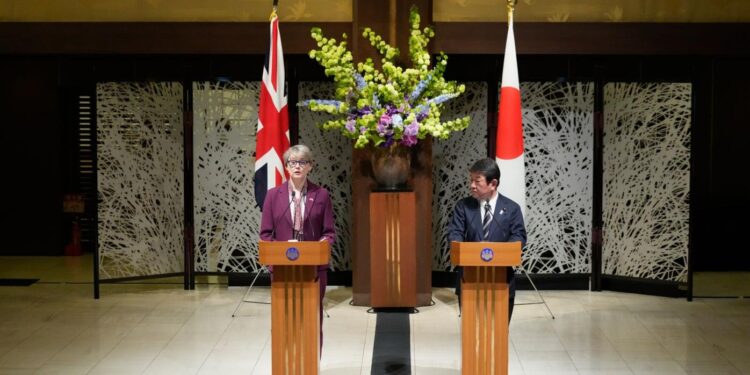
UK and Japan have reaffirmed their commitment to deepening cooperation across defence, economic security, and global diplomacy, as both sides pledged to strengthen what they describe as one of their closest “strategic partnerships.”
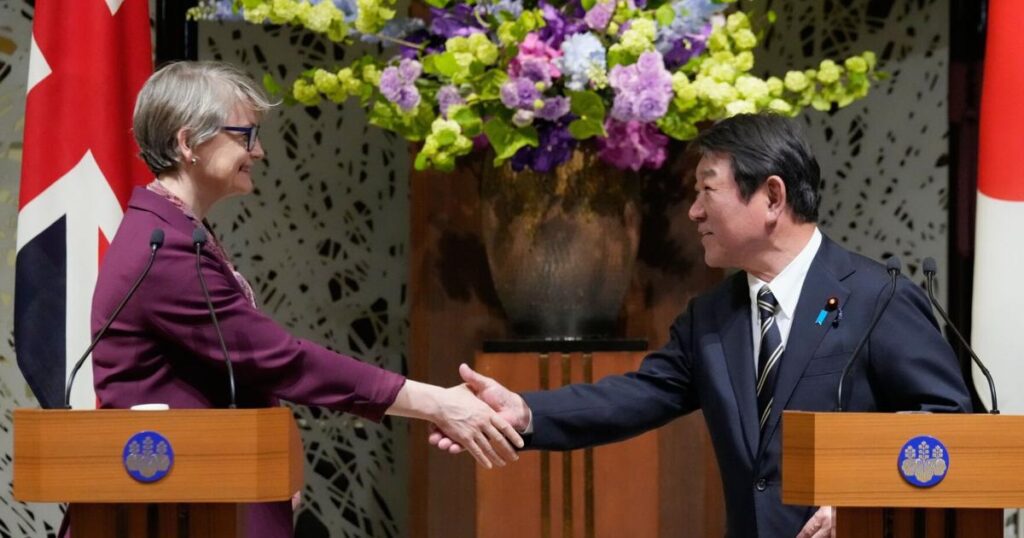
In discussions with Japanese Foreign Minister Motegi at the tenth Japan-UK Foreign Ministers’ Strategic Dialogue in Tokyo, UK Foreign Secretary Yvette Cooper stated that the two governments’ partnership is based on common values such as democracy, the rule of law, human rights, and open and fair trade.
Japan and UK reaffirmed their commitment to cooperating to address global issues and promote security, resilience, and prosperity, especially in the Indo-Pacific area, as Enhanced Global Strategic Partners under the 2023 Hiroshima Accord and reiterated their commitment to strengthening shared defence capabilities, including accelerating industrial and technological cooperation on the next-generation fighter aircraft under the Global Combat Air Programme (GCAP), which also includes Italy.
Both states highlighted progress in joint military activity, including the visit of the UK Carrier Strike Group to Japan in 2025 and Japan’s Air Self-Defence Force deployment to Europe and North America under the “Atlantic Eagles” exercise. These exercises were carried out under the Reciprocal Access Agreement, which facilitates deeper operational cooperation.
Moreover, they welcomed Japan’s review of its defence transfer principles, describing it as an important step toward strengthening regional stability through cooperation with like-minded partners.
Cybersecurity and hybrid threats featured prominently in discussions, with both countries reaffirming cooperation under the “Strategic Cyber Partnership,” elevated in early 2026. They committed to addressing threats to critical undersea infrastructure and expanding crisis management cooperation, including a new agreement on mutual assistance for nationals abroad.
Under the Comprehensive and Progressive Agreement for Trans-Pacific Partnership and the Japan-UK Comprehensive Economic Partnership Agreement, both countries reiterated their commitment to boosting trade and investment.They expressed concern over economic coercion, non-market practices, and export restrictions that threaten vital minerals and global supply networks, while emphasising the significance of strengthening the World Trade Organization and changing the global trade system.
Additionally, the two parties reiterated their collaboration under their Industrial Strategy and Economic Security agreements, which they claimed have already produced noticeable commercial results. They decided to expand collaboration in areas such as offshore wind, nuclear energy, and fusion technologies, as well as science, technology, sustainable energy, and supply chain resilience.
Energy market stability and supply chain security were also highlighted, alongside a shared commitment to supporting global energy resilience and the transition to clean energy systems.
Consensus Reached on Key Global Security Risks
UK and Japan further discussed global and regional security problems, affirming their support for Ukraine’s sovereignty and territorial integrity. They agreed to continue working with G7 allies to put pressure on Russia through sanctions and other measures, while also aiding Ukraine’s reconstruction through international forums.
The ministers also reviewed Middle Eastern tensions. On Iran, both sides stressed the necessity of diplomatic engagement, advocated for de-escalation and a long-term suspension of hostilities, as well as emphasising the need to reopen the Strait of Hormuz and guarantee freedom of navigation under international law.
On Gaza, both governments reiterated their support for a comprehensive peace plan, increased humanitarian access, and reconstruction activities, as well as a two-state solution. They also raised concern about settlement expansion and settler violence in the West Bank.
In the Indo-Pacific region, the UK and Japan expressed concern about tensions in the East and South China Seas, rejecting unilateral attempts to change the status quo through force or coercion. They also reaffirmed their support for international maritime law under the UN Convention on the Law of the Sea and encouraged peaceful dialogue with Taiwan.
North Korea was also identified as a serious security concern, with both sides expressing concern about its nuclear and ballistic missile programs and reaffirming support for total denuclearisation under UN Security Council resolutions. However, they expressed concern about cybercrime operations, such as bitcoin theft, and military cooperation between North Korea and Russia.
Beyond Asia, the ministers discussed African instability, notably the Sahel and Great Lakes regions, and renewed calls for a cease-fire in Sudan as well as immediate humanitarian access.
At the multilateral level, both countries committed to strengthening global institutions and supporting reform of the United Nations Security Council, including support for expanding permanent and non-permanent membership. They reaffirmed cooperation on arms control, nuclear non-proliferation ahead of the 2026 NPT Review Conference, and global efforts to achieve net zero by 2050.
The meeting concluded with a welcome of an invitation for Japan’s Prime Minister to visit the UK later in the year.
READ ALSO : GNFS Records Fewer Fires and Higher Property Recovery in 2026 Report