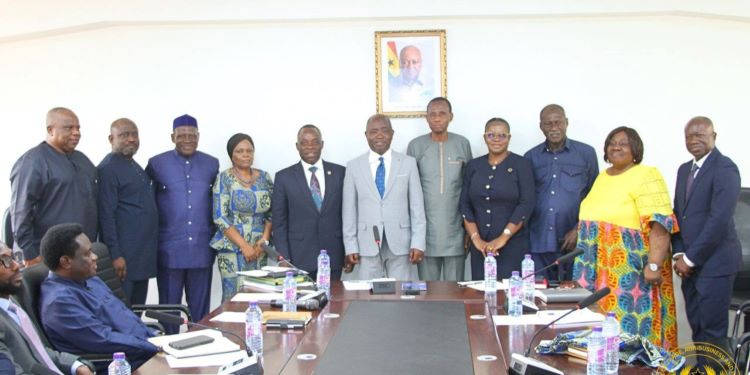
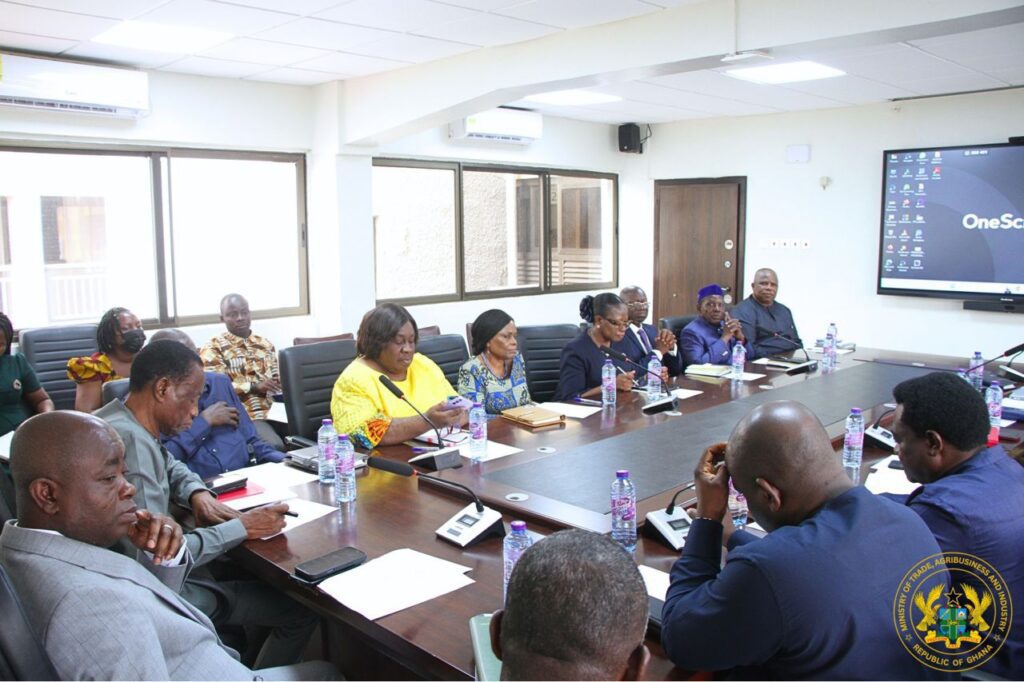
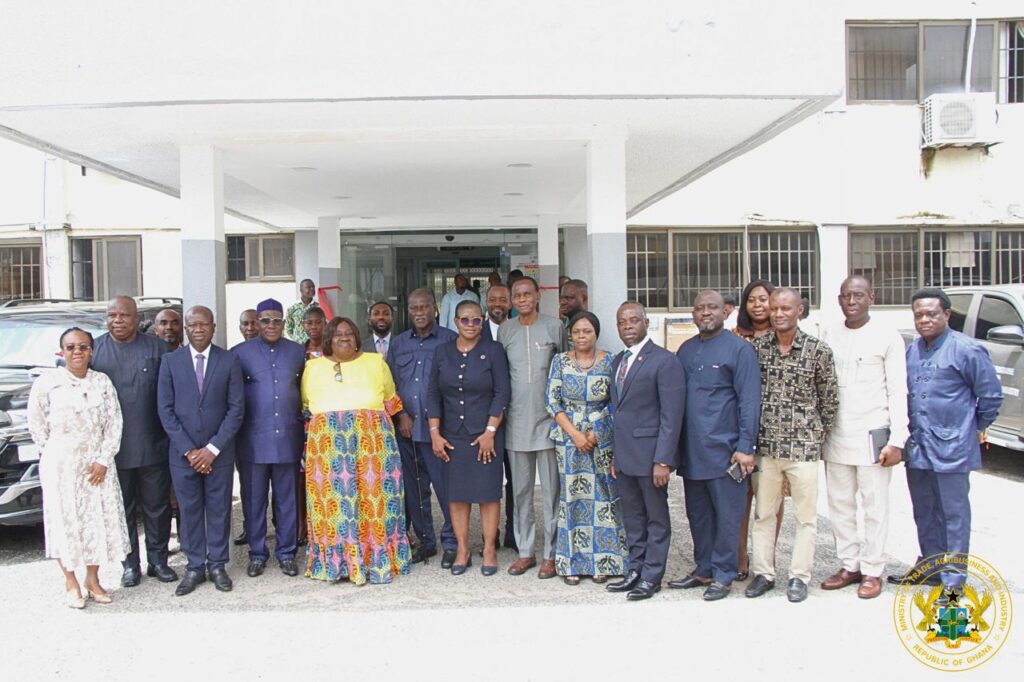
The structural transformation of Ghana’s industrial economy has recently reached a new administrative milestone as the Ministry of Trade, Agribusiness and Industry (MoTAI) opened its doors to the Civil Service Council, led by Chairman Dr. Lawrence Kannea, for a high-level strategic alignment.
The familiarization visit was geared towards synchronizing the government’s ambitious “resetting” agenda with the technical machinery of the public bureaucracy. The leadership of both the political and administrative classes signaled a unified front to transition Ghana from a colonial-era extractive model to a modern, wealth-generating industrial powerhouse.
“The Deputy Minister for Trade, Agribusiness and Industry, Hon. Sampson Ahi, who received the delegation on behalf of the Sector Minister, Hon. Elizabeth Ofosu-Adjare, emphasized the shared responsibility between government and the Civil Service in driving national development”
Ministry of Trade, Agribusiness and Industry
For the Ministry, the visit comes at a time when the efficiency of public service delivery is being scrutinized as the primary engine for national development. Hon. Sampson Ahi emphasized that the Ministry’s success in attracting high-value investment and expanding the industrial base is inextricably linked to the professionalism and fairness of the Civil Service.
He noted that for MoTAI to function as a strategic institution capable of driving national growth, it requires a bureaucracy that is not merely compliant but proactive and merit-driven, and called for fairness and professionalism within the Service.
An important theme of the dialogue was the urgent need to dismantle what has historically been termed the “Guggisberg economy” – a model characterized by the export of raw materials and the import of finished goods.
The Head of the Civil Service, Dr. Evans Aggrey-Darkoh, was explicit in his assessment of this transition, stating that the goal of the current reforms is to industrialize in a way that creates sustainable wealth and mass employment. For him, the shift requires a radical reimagining of the role of the public official.
In this new paradigm, the civil servant is not just a regulator but an architect of value addition, providing the technical support necessary for the political leadership to deliver on its mandate.
Transparent Operations
The technical capacity of the Ministry to execute this vision was a key highlight of the briefing provided by the Chief Director, Mr. Noah Tumfo, who described the Council’s visit as an innovative step toward transparency and revealed the expansive footprint of the Ministry’s operations.
With a staff strength exceeding 350 and a strategic presence in nine key international missions, the Ministry is effectively operating as a global agency for Ghanaian commerce.
This international reach is critical for the “reset” agenda, as it allows the Ministry to facilitate trade and monitor global market trends in real-time, ensuring that Ghanaian agribusiness and industrial products are competitively positioned in the world’s major economic hubs.
It was noted that the operational focus of the Ministry is currently centered on the finalization of the Agribusiness Policy, a document that is expected to be a cornerstone of Ghana’s industrial landscape. Mr. Tumfo highlighted that this policy is designed to strengthen the entire value chain, from raw production to high-tech processing.

The Ministry explained that it aims to de-risk agribusiness for private investors and create a more predictable environment for growth by providing a clear regulatory framework for the sector, adding that the Civil Service Council’s role in this process is to ensure that the staff responsible for implementing such policies are “equipped with the tools and the institutional support to deliver effectively and efficiently.”
Chairman Dr. Lawrence Kannea expressed the Council’s appreciation for the Ministry’s leadership, specifically commending Mr. Noah Tumfo for his dedication to duty. He noted that the Ministry of Trade, Agribusiness and Industry is a key driver of the country’s economic growth and that the ongoing reforms require a collective effort from all stakeholders.
The Council’s visit served as a validation of the good work being done within the Ministry while also highlighting the areas where further restructuring can yield more meaningful results. It reinforced the idea that industrialization is not solely a political project but a national one that depends on the integrity of the bureaucratic infrastructure.
According to MoTAI, the collaboration also touched on the broader goal of creating sustainable employment, as Hon. Sampson Ahi urged the Council to provide the necessary support to enable Ministry staff to reach their full potential. He argued that a well-supported Civil Service is a prerequisite for a thriving private sector.
If the bureaucracy can deliver services with speed and professional excellence, it reduces the cost of doing business and makes the Ghanaian market more attractive to Foreign Direct Investment (FDI). This, in turn, accelerates the creation of the industrial jobs needed to support a growing population and reduce economic vulnerability.
As the engagement concluded, it was clear that the “reset” of Ghana’s economy is fundamentally a project of institutional reform. The transition away from the Guggisberg model toward a modern industrial state cannot happen without a world-class Civil Service.
With the Agribusiness Policy nearing completion and a global network of trade missions in place, the Ministry of Trade, Agribusiness and Industry is well-positioned to lead Ghana into an era of sustained industrial wealth and regional dominance.
READ ALSO: US Likely To Resume Bombing Iran As Ceasefire Nears End