
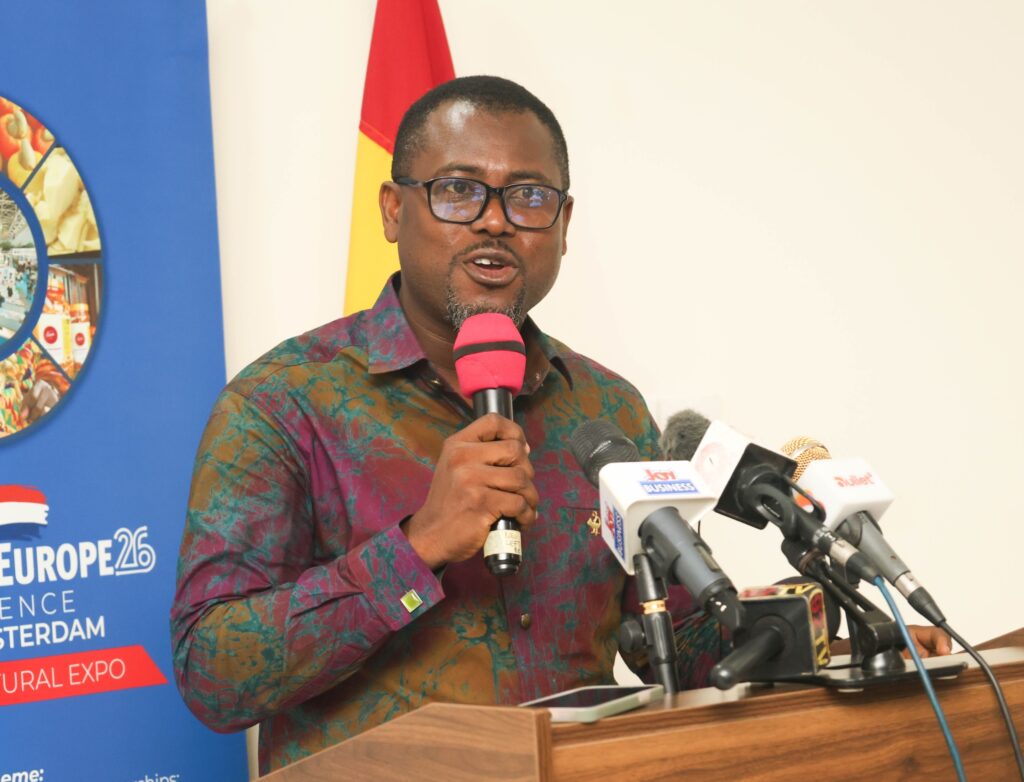
The trajectory of Ghana’s commercial diplomacy has reached a definitive point of departure with the launch of GhanaFest Europe 2026: Live in Amsterdam.
Orchestrated by a formidable institutional coalition led by the Ghana National Chamber of Commerce and Industry (GNCCI) and the Association of Ghana Industries (AGI), the mission represents a tactical migration from the diplomatic quietude of The Hague to the high-velocity commercial engine of Amsterdam.
According to the GNCCI, situating the 2026 experience at the World Trade Centre Amsterdam embeds Ghanaian productivity directly into the circulatory system of global finance and logistics. This structural realignment of the trade relationship between Ghana and the Netherlands seeks to permanently retire the obsolete donor-recipient dynamic in favor of a high-value industrial partnership.
“The GhanaFest Europe 2026 Experience: Live In Amsterdam marks a definitive turning point in the bilateral history of Ghana and the Netherlands. Following a landmark diplomatic debut in The Hague, the 2026 edition scales to Amsterdam, the commercial heart of Europe and a global nexus for finance, logistics, and sustainable trade”
Ghana National Chamber of Commerce and Industry
The move to Amsterdam, scheduled for September 10 to 12, 2026, is a deliberate escalation of the pilot successes achieved in 2025. While the previous edition functioned as a “cultural showcase,” to establish a diplomatic footprint, the 2026 iteration is being marketed as a commercial powerhouse. The shift is absolute.
The narrative has transitioned from the celebration of heritage to the focused creation of wealth. The GNCCI described it as the hallmark of a nation that has reached industrial maturity – a country no longer content to showcase its potential but one that is ready to deliver its performance to the world’s most demanding off-takers.
Trade Bridge and Value Addition
At the core of GhanaFest Europe 2026 is the construction of a sophisticated trade bridge between the Port of Tema and the Port of Rotterdam. The industrial merit of this mission lies in its focus on de-risking the journey of Ghanaian goods.
For the European buyer, the primary hurdles to West African trade have historically been regulatory uncertainty and logistical friction. GNCCI and its partners are addressing these head-on through a one-stop institutional approach, integrating the Office of Diaspora Affairs and sovereign ministries into the private sector’s lead.
The mission is expected to provide a unified front that offers European investors a clear, vetted, and transparent entrance into the Ghanaian market. The technical sophistication of this bridge is evidenced by the commitment to EUDR (European Union Deforestation Regulation) and ESG compliance.
The GNCCI noted that in an era where “sustainability” is a legal prerequisite for European market access, the GhanaFest Europe 2026 is deploying Blockchain and IoT (Internet of Things) solutions to provide “farm-to-fork” traceability.
This is not just a technological flourish; it is a strategic necessity, ensuring that every cocoa bean, shea nut, and coffee cherry is environmentally verified and traceable to the specific farm of origin – positioning Ghana as the most compliant and reliable partner in the West African sub-region.
Perhaps the most provocative element of the Amsterdam mission is the “gold” category of service sectors. Ghana, as Africa’s leading gold producer, is signaling a radical departure from the exportation of raw ore, and the 2026 Experience plans to showcase the nation’s transition into a High-Value Precious Metals Hub.
This will be anchored by new state-of-the-art refineries aiming for London Bullion Market Association (LBMA) certification, ensuring 99.99% purity for the global bullion market. Ghana hopes to capture the missing margins that have historically leaked out of the national economy by moving into local refining and the manufacturing of handcrafted 24-karat jewelry.

This push for value addition extends deep into the agribusiness sector, too. According to the GNCCI, the conversation in Amsterdam will shift from raw bags of cocoa to high-grade derivatives – liquor, butter, powder, and “tree-to-bar artisanal chocolate.”
The strategic objective is to meet the sophisticated standards of the European HoReCa (Hotel, Restaurant, and Catering) market. Whether it is specialty Robusta coffee or botanical oils for the pharmaceutical sector, the mission is poised to prove that the Ghanaian industry can meet the technical and aesthetic demands of the European retail environment.
Strategic Investment Asset
Beyond the hard metrics of trade finance and logistics, the Amsterdam Accord plans to leverage “soft power” as a diplomatic vanguard. The Cultural Festival and Music Concert are not merely entertainment; they are the emotional infrastructure of the trade bridge.
Through commercializing the global sound of Afrobeats and High-life, and scaling traditional textiles like Kente for the luxury fashion market, Ghana is establishing a brand identity that commands a premium. This creative diplomacy serves to lower the psychological barriers to investment, making the Ghanaian market not just a logical choice, but an aspirational one for the European elite.
The GNCCI added that the Grand Finale music concert in Amsterdam will serve as the ultimate networking environment, where the high-stakes B2B deal-making of the afternoon transitions into the prestigious celebration of cross-cultural success.
This will blend rigorous commercial engagement with the immersive power of Ghanaian art and culture, providing a holistic approach to sovereign branding that recognizes that in the modern global economy, a nation’s “sound and style are as much a part of its export portfolio as its minerals and grains.”
“The 2026 Experience is more than an event; it is a high-yield opportunity. Whether you are looking to de-risk your West African supply chain or discover the next global trend in specialty coffee and cocoa, Amsterdam 2026 provides the platform”
Ghana National Chamber of Commerce and Industry

As the GNCCI and AGI prepare for the September 2026 event, the Amsterdam Accord stands as a testament to Ghana’s industrial confidence. It is a declaration that the nation is no longer waiting for aid, but is actively engineering its own prosperity through value addition, technological integration, and strategic alliances.
The mission is casting a wide but precise net across the European economy, targeting institutional investors, procurement heads, and creative entrepreneurs, as the success of GhanaFest Europe 2026 will be measured by the origination of the deals signed in the Amsterdam B2B rooms.
As the trade bridge between Tema and Rotterdam strengthens, GNCCI expressed optimism that the dividends will be felt in every district of Ghana – from the cocoa farms implementing blockchain traceability to the refineries producing 99.99% pure gold.
READ ALSO: Paediatric Society of Ghana Demands Presidential Action Against Galamsey