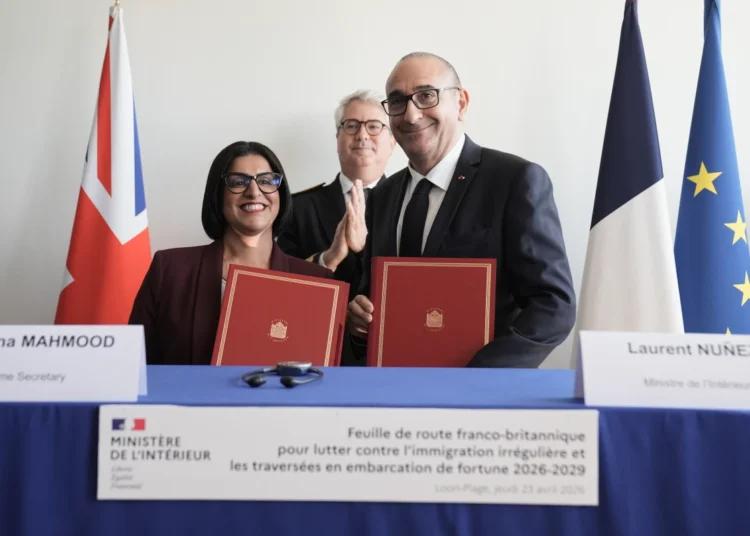
Britain’s Home Secretary, Shabana Mahmood and France’s Interior Minister Laurent Nunez have signed a new three-year multimillion-euro deal aimed at reducing the number of migrants crossing the English Channel in small boats, with increased police patrols and enhanced surveillance in northern France.
Under the deal, the UK will provide 500 million pounds ($675 million) to strengthen measures in northern France, with an additional 160 million pounds ($216 million) depending on the success of new tactics to curb Channel crossings. Britain’s Home Office said that if those efforts fail, the additional funding will be halted after one year.
According to the French Interior Ministry, the agreement provides for boosting the number of officers deployed on the ground from 907 now to 1,392 for the 2026—2029 period, along with the creation of an additional police unit dedicated to combating irregular migration, funded by France.
It will also include the deployment of new technologies aimed at reducing departures of so-called “taxi boats,” the term authorities use for small motorized vessels, usually inflatable, used by smugglers to pick up migrants along long stretches of the northern French coast. Unlike boats that migrants carry into the water themselves, “taxi boats” typically set off largely empty from secluded coastal areas and pick up migrants at prearranged meeting points on beaches.
The deal also expands surveillance capabilities through drones, helicopters and electronic monitoring, to better prevent crossing attempts.
Since taking office nearly two years ago, Starmer’s center-left Labour government has pushed through a series of policies that it hopes will sharply reduce immigration, both legal and illegal. Small boat crossings have become a potent political issue in the UK over recent years. Anger at the seeming inability of successive governments to get a handle on the issue has been behind a series of demonstrations and riots over the past few years and fueled the rise of the hard-right Reform UK, which has been leading in opinion polls for more than a year and is predicted to make sweeping gains in a raft of elections on May 7.
Under the measures adopted, the government now has powers to seize the assets of people-smugglers, beefed up U.K. border surveillance and increased law-enforcement cooperation with France and other countries to disrupt the journey.
So far this year, more than 6,000 migrants have reached the UK after crossing the Channel, down 36% from the same period last year, a drop that may partly reflect more unsettled weather. The real evidence will emerge over the coming months as the weather turns warmer and the Channel turns less choppy. In 2025, a total of 41,472 made the crossing that way — the second-highest annual figure since records began in 2018, after a peak of 45,755 in 2022.
Earlier this month, two men and two women died as they were trying to board an inflatable boat off the coast of northern France. British authorities arrested a man from Sudan on Friday on suspicion of endangering life in that case.The week before, two other people died in similar circumstances off the coast north of Calais.
Before this month’s deadly incidents, migrant aid group Utopia 56 said at least 162 people have lost their lives at the Franco-British border over the past three years.
Deal Hailed As Decisive Effort To Combat Channel Crossings
France’s Interior Minister Laurent Nunez hailed the new agreement, saying that it provides “our security forces with the means to continue their decisive efforts to combat dangerous Channel crossings.”
British Prime Minister, Keir Starmer, said, “Our work with the French has already stopped tens of thousands of crossings and this government has deported or returned nearly 60,000 people with no right to be here.”
“This historic agreement means we can go further: ramping up intelligence, surveillance and boots on the ground to protect Britain’s borders.”
Keir Starmer
A large share of the resources provided under the new deal will be deployed from early summer, traditionally the busiest period for crossing attempts as weather conditions improve.
However, critics say that the new deal, which builds on the Sandhurst Treaty, first signed in 2018 and renewed in 2023, is not addressing the underlying issue. Imran Hussain from the Refugee Council, a UK charity that aims to promote the rights of refugees, said, “Policing alone will not prevent desperate people from turning to dangerous small boats in the first place.”
Campaign groups for migrant rights have long warned that increasingly vigorous efforts by French police to prevent boat departures from beaches, including using knives to hack and puncture inflatable boats to render them unusable, are encouraging the use of “taxi boats,” which increases the risks of drownings, injuries and the need for rescues.