United Kingdom has reiterated its commitment to supporting Syria’s political transition, humanitarian recovery, and long-term stability, highlighting recent diplomatic engagement and coordinated international efforts as signs of cautious progress.
Speaking in the context of the ongoing United Nations engagement on Syria, Ambassador James Kariuki, UK Chargé d’Affaires to the UN, emphasised the significance of improving international cooperation, particularly the impending move of the UN Special Envoy for Syria to Damascus.
According to the Ambassador,the recent visit of Syrian President Ahmed al-Sharaa to London was a significant development in bilateral relations, marked a rare moment of direct engagement, and is expected to pave the way for deeper cooperation on key security and economic issues.
The Ambassador emphasised that strengthening ties with Syria is intended to support efforts aimed at ensuring the lasting defeat of extremist groups such as Daesh, while also contributing to the country’s economic recovery, stating that, “in this spirit, I also welcome the newly established Breath of Freedom Taskforce that will work on the destruction of chemical weapons stockpiles in Syria.”
Kariuki further confirmed UK’s participation in the taskforce and announced more than $9.5 million in additional funding to support Syrian-led disarmament efforts.
Beyond security concerns, the Ambassador highlighted political developments within Syria, particularly efforts to integrate the country’s north-east into the broader state framework. Recent steps, including the appointment of Sipan Hamo as Deputy Minister of Defence and ongoing prisoner exchanges, were described as encouraging signs of progress toward national reconciliation.
Ambassador Kariuki further stressed that continued integration of both military and civilian institutions will be essential in strengthening governance structures and fostering social cohesion.
On the humanitarian front, he acknowledged improved coordination between international organisations and Syrian authorities in addressing urgent needs while laying the groundwork for longer-term recovery. Recent initiatives include high-level visits by senior UN officials, the launch of the UN Humanitarian Response Plan, and the Syrian government’s articulation of its recovery priorities for international cooperation.
The British representative reaffirmed UK’s commitment to supporting these efforts, including assistance for communities affected by recent flooding. However, Ambassador Kariuki stressed that maintaining safe, sustained, and unimpeded humanitarian access across all parts of Syria remains vital to ensuring that aid reaches those most in need.
As Syria navigates a fragile phase of transition, coordinated global support is expected to remain a decisive factor in shaping the country’s future stability and development.
Syria Sets Out Reconstruction and State-Building Plans
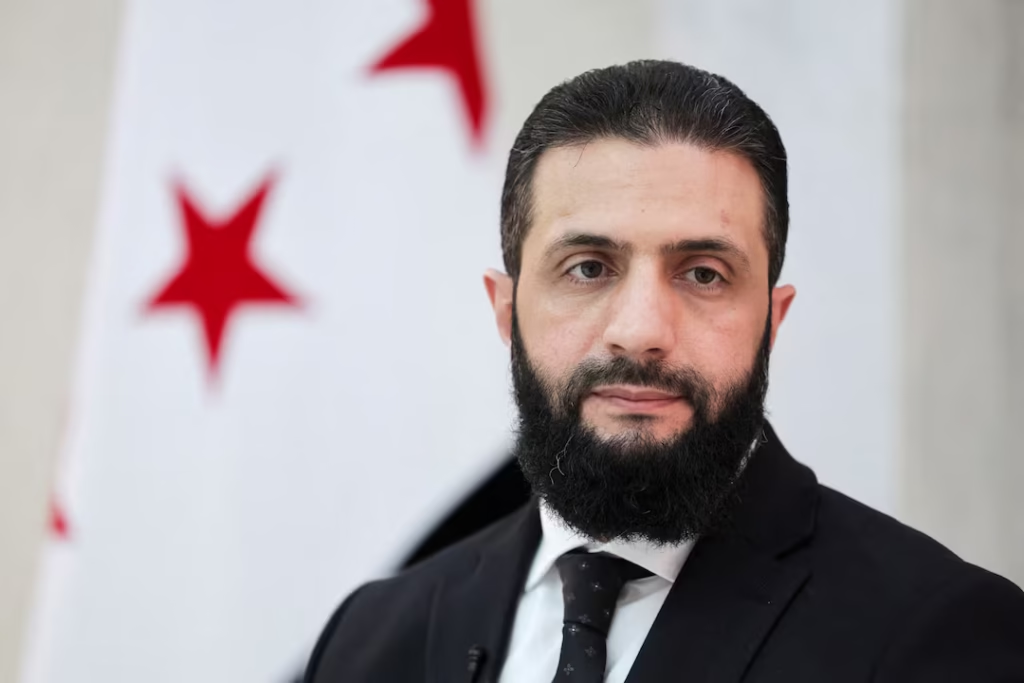
Recently, Syria announced a comprehensive strategy for restoring governmental institutions and pursuing national restoration following years of conflict.
According to Syrian President Ahmad al-Sharaa, the scale of the damage caused by more than a decade of war is alarming, and as such, reforming the energy sector, restoring international relations, and working to lift sanctions and restrictions that continue to stifle economic activity are all priorities.
He went on to say that sustainable growth requires addressing external challenges as well as improving local capability.
President, Ahmad al-Sharaa emphasised the importance of investment in restoring the Syrian economy. However, he highlighted persisting challenges, notably in the banking sector, where outmoded systems, governance concerns, and currency volatility have hampered the capacity to finance rebuilding and growth.
Furthermore, one of the most challenging issues is still energy reform. Al-Sharaa characterised the efforts to restore the electricity supply as a technically challenging process that involved rehabilitating power plants, getting fuel inputs, and restoring damaged infrastructure. Despite these difficulties, he asserts that the energy supply has significantly improved over the past year, with certain locations now receiving 16 to 20 hours of electricity each, a result he feels surpasses expectations.
However, reconstruction continues to be the major obstacle. As a result, the government is pursuing a dual-track reconstruction strategy.
The first track focuses on villages and smaller towns, prioritising the rehabilitation of infrastructure, the removal of debris, and the restoration of essential services, such as schools and hospitals, to enable displaced populations to return gradually.
The second track addresses major urban centres where destruction levels in some areas have reached up to 90–100 percent. In these cases, the government is considering an investment-led model in which private sector participation would play a central role. Under this approach, homeowners would receive new housing equivalent to their previous properties, while investors would be granted opportunities for additional development within modern urban planning frameworks designed to improve infrastructure and service delivery.
President Ahmad al-Sharaa suggested that this model could stimulate economic growth, reduce unemployment and attract foreign investment.
READ ALSO : RFK Jr Clarifies Views On Vaccines