

A new tracking poll by Global InfoAnalytics has revealed that all leading contenders within the National Democratic Congress are currently outperforming former Vice President Dr Mahamudu Bawumia in early projections for the 2028 presidential race, but are lagging President Mahama’s 2024 performance
The March 2026 poll, which compares evolving voter preferences with patterns from the 2024 election, points to emerging shifts across key demographics including education, religion, ethnicity and income levels.
The findings suggest that while the political landscape remains fluid, early indicators favour the NDC field over the New Patriotic Party’s flagbearer, Dr Mahamaudu Bawumia.
At the same time, the data underscores the continued influence of President John Mahama’s electoral performance, which remains a benchmark against which all NDC contenders are being measured.
Mahama Still Sets the Benchmark
According to the analysis, President Mahama continues to outperform all other NDC frontrunners when compared directly against Dr Bawumia across multiple demographic categories.
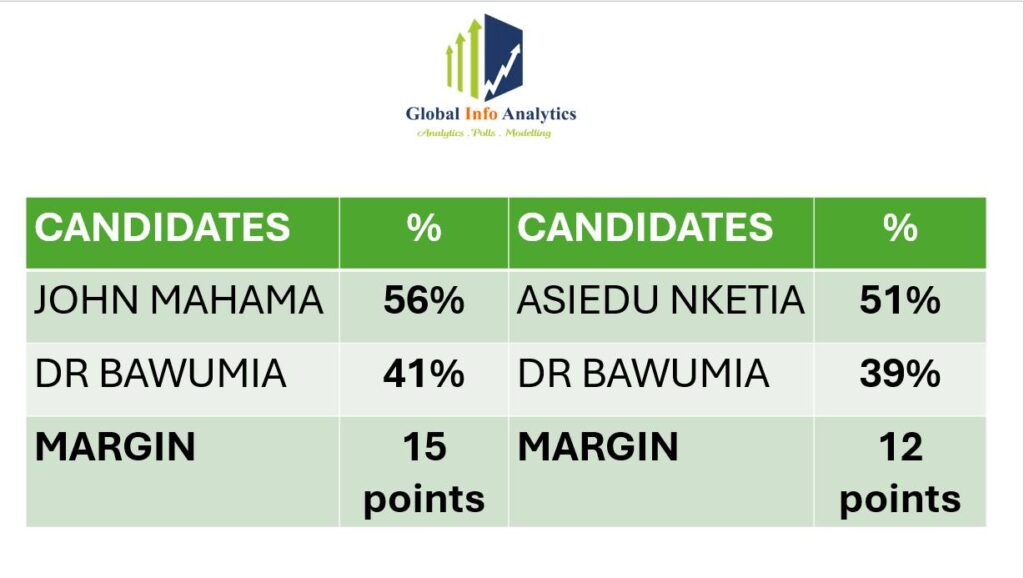
His performance in the 2024 election appears to have set a high standard, particularly in terms of party loyalty and broad based voter appeal. The poll shows that Mahama’s margins against Bawumia in 2024 remain stronger than those currently recorded by other aspirants within the party.
Among NDC voters, Mahama achieved a commanding lead of over ninety percentage points in the last election. By contrast, current contenders are trailing that level of support, with some recording significantly lower margins within the party base.
This trend suggests that while the NDC field remains competitive against external opponents, internal cohesion and candidate consolidation could become critical factors as the 2028 race approaches.
Ato Forson Emerges as Strong Contender
Despite the overall gap with Mahama’s past performance, the poll identifies Finance Minister Dr Cassiel Ato Forson as the most competitive among the NDC frontrunners in head to head comparisons with Dr Bawumia.
He records the widest margin, leading Dr Bawumia by eighteen percentage points, surpassing Mahama’s fifteen point margin from the 2024 election. This positions him as a key figure in the evolving race.
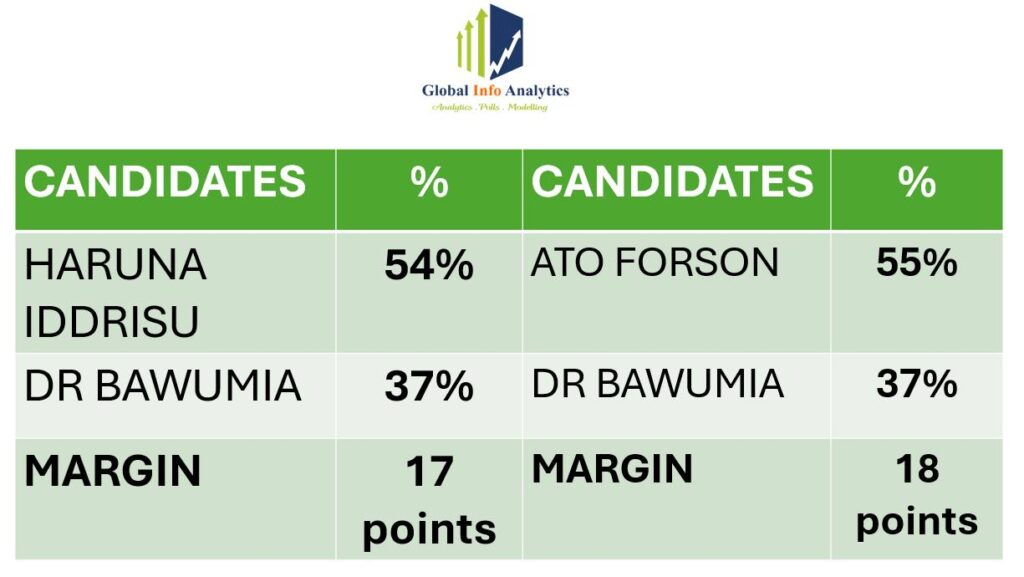
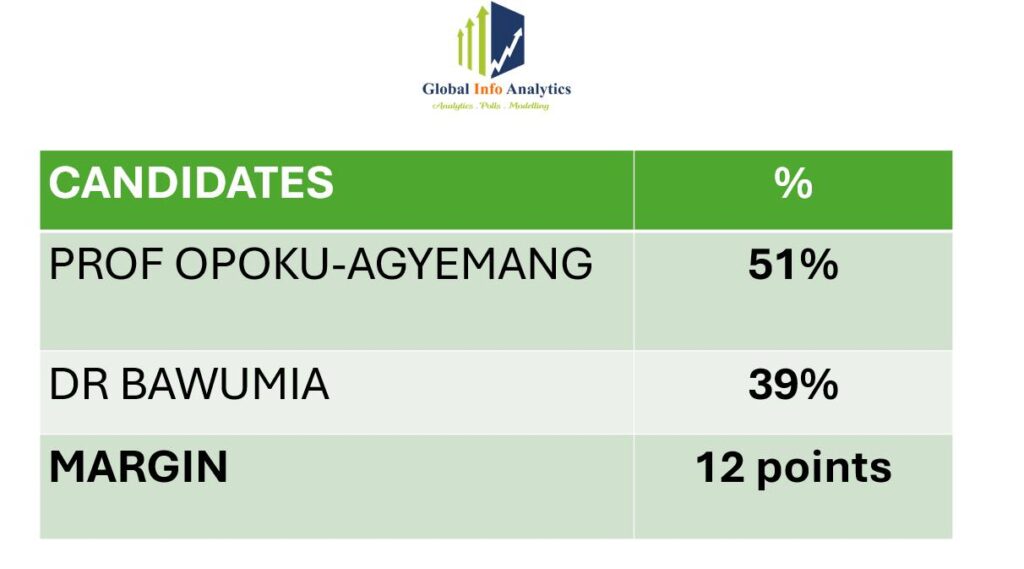
Education Minister and MP for Tamale South, Hon. Haruna Iddrisu, follows closely with a seventeen-point lead, while Johnson Asiedu Nketia and Vice President Professor Jane Naana Opoku Agyemang have a margin of 12 points against Dr Bawumia.
These figures indicate that while all the candidates maintain an advantage over Bawumia, their levels of support vary significantly depending on voter segments.
Cracks Within NDC Support Base
One of the more notable findings from the poll is evidence of declining cohesion within the NDC’s core support base. All the frontrunners are performing below Mahama’s 2024 levels among party supporters, suggesting a potential fragmentation of voter loyalty.
Asiedu Nketia records the lowest margin among National Democratic Congress voters, highlighting the challenge of maintaining the party’s traditional base.
However, analysts suggest that these cracks and apparent divisions may partly reflect the fact that the NDC is yet to elect its flagbearer for the 2028 elections, unlike the NPP, which has already consolidated behind Dr Mahamudu Bawumia.
The absence of a single candidate leading the party at this stage could be contributing to dispersed support across multiple contenders. There is therefore a strong likelihood that once the NDC selects its flagbearer, the eventual candidate could consolidate internal support and significantly improve the party’s overall performance.
Struggles Among Floating Voters
The poll also reveals mixed performance among floating voters, a critical segment that often determines election outcomes. While Mahama secured a comfortable lead among this group in 2024, most NDC candidates are struggling to replicate that success.
Dr Ato Forson is the only contender with a narrow advantage, leading Bawumia by five points among undecided voters. This indicates that while the NDC retains an overall advantage, its ability to attract swing voters may depend heavily on candidate selection and campaign strategy.
Ethnic and Regional Dynamics
The data further highlights shifts in voting patterns across ethnic and regional lines. Among Akan voters, who represent a significant electoral bloc, Mahama previously secured a nine-point advantage in 2024.
However, current projections show most NDC candidates trailing Dr Bawumia within this group, with the exception of Dr Cassiel Ato Forson, who holds a five-point lead.
In the Ga-Adangme group, several NDC candidates are performing close to Mahama’s previous levels, indicating relatively stable support. However, among Ewe voters, all contenders are underperforming compared to Mahama’s earlier results.

Within the Mole-Dagbani group, Mahama’s strong twenty-seven-point lead in 2024 has not been replicated, with most candidates posting significantly lower margins.
Interestingly, the data suggests that the Vice President Prof. Jane Naana Opoku-Agyemang is performing comparatively better within this group, highlighting the complexity of regional and ethnic dynamics in the evolving race.
Regional Bloc Performance
When analysed by region, the poll reveals that Dr Ato Forson is outperforming Mahama in certain strategic areas, particularly among floating voters in regions previously dominated by the NPP.
In Ashanti, Eastern and North East regions, Ato Forson records slight gains among undecided voters, suggesting potential inroads into opposition strongholds.
He also shows marginal improvements among NPP voters in Akan dominated regions, although both he and Mahama remain behind Bawumia within that group.
These findings indicate that while the overall advantage lies with the NDC, the distribution of support varies widely across regions and voter categories.
Emerging Third Force Influence
Another key takeaway from the poll is the impact of emerging third-party candidates on the electoral landscape. Figures such as Alan Kyeremanteng and Nana Kwame Bediako are collectively drawing nearly eight percent of voter support, a development that could influence the balance of power in the 2028 race.
Analysts suggest that this emerging bloc could fragment traditional voting patterns, particularly if it continues to gain traction among disillusioned voters.
Overall, the Global InfoAnalytics poll presents a complex picture of Ghana’s political future. While the NDC appears to hold an early advantage over Dr Bawumia, internal dynamics, voter fragmentation and shifting demographics could reshape the contest in the coming years.
The data highlights both opportunities and challenges for the party, particularly in maintaining unity and expanding its appeal beyond its traditional base.
As the race gradually takes shape, the ability of candidates to consolidate support and connect with key voter groups will likely determine the outcome.
READ ALSO: UK Hits Russian Drone Supply Chains With Sweeping Sanctions