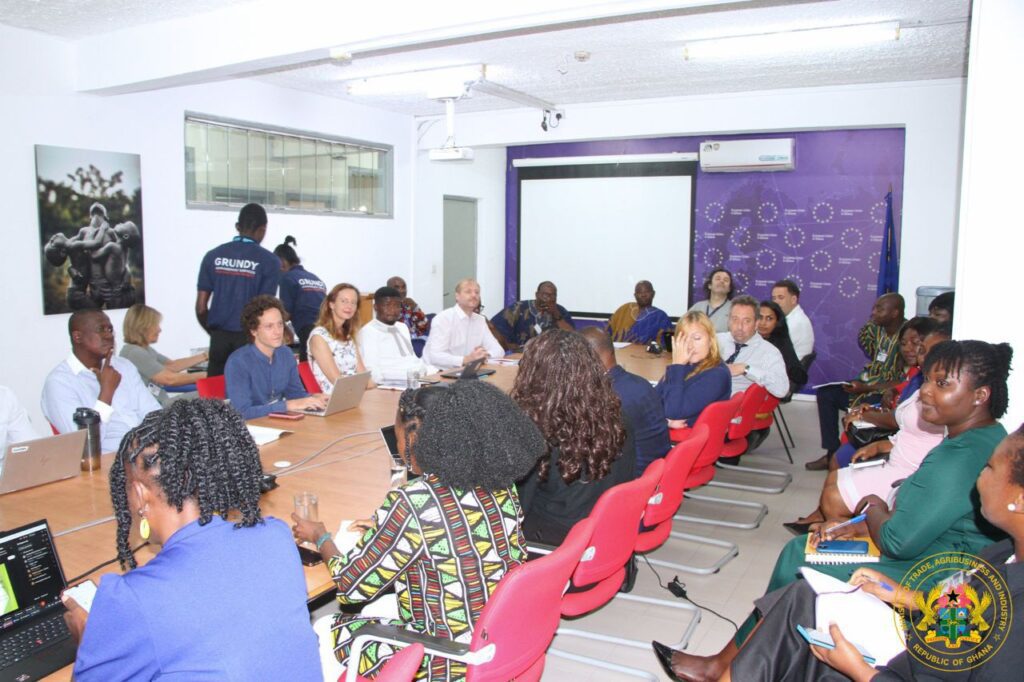
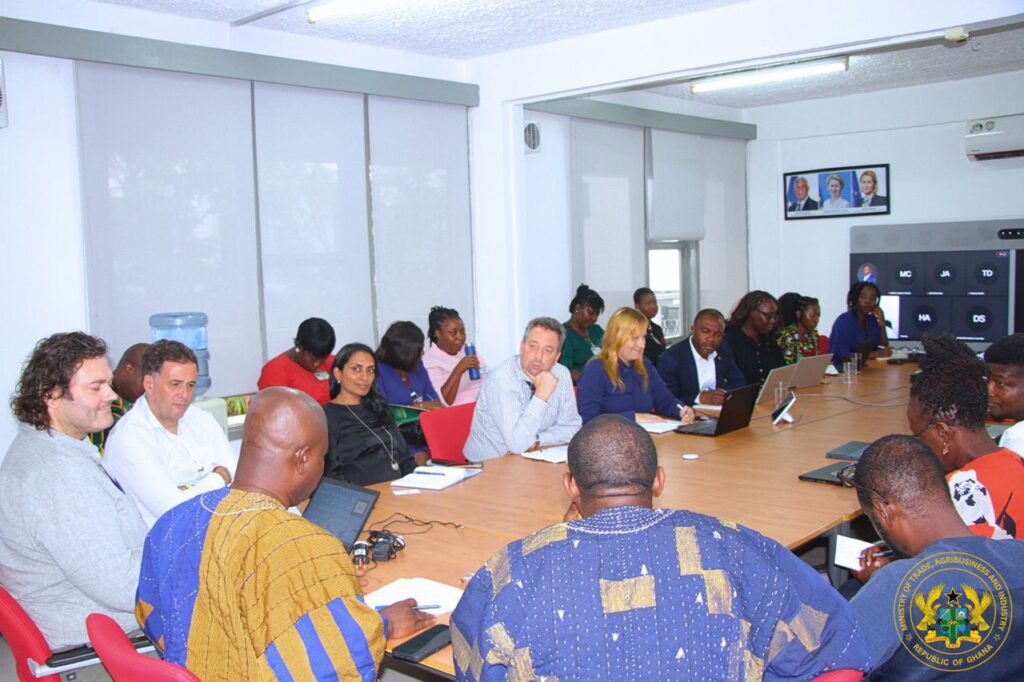
The Ministry of Trade, Agribusiness and Industry (MoTAI) has engaged development partners under the Private Sector Working Group (PSWG) platform to accelerate Ghana’s industrial transformation. The Ministry convened a high-level session to harmonize policy actions and address regulatory bottlenecks that have hindered the competitiveness of the domestic private sector.
This engagement represents a critical synchronization between the state’s industrial “Reset” and the technical and financial capabilities of the international community, signaling a move away from fragmented interventions toward a unified, high-growth strategy.
“During the engagement, the Deputy Minister for Trade, Agribusiness and Industry, Hon. Sampson Ahi, on behalf of the Sector Minister, highlighted the Ministry’s strategic focus under the 24-Hour Economy and Accelerated Export Development Programme (24H+)”
Ministry of Trade, Agribusiness and Industry
The Private Sector Working Group serves as a strategic clearinghouse where the government and its partners, including the European Union and GIZ, can align their priorities. The dialogue was centered on the realization that the transition from a primary commodity exporter to a manufacturing powerhouse cannot be achieved in isolation.
It requires a stable, predictable regulatory environment and a massive influx of targeted investment. For MoTAI, utilizing the platform ensures that the reforms currently being implemented are not only effective domestically but also meet the international standards required to attract long-term global capital.
The 24-Hour Economy and Accelerated Export Development Programme, or 24H+ policies, are the cornerstone of the government’s attempt to reposition the national economy. Hon. Ahi detailed how the 24H+ initiative serves as a productivity multiplier.
The government aims to maximize the utilization of industrial assets, thereby increasing output without necessarily requiring a proportional increase in capital expenditure on new factories, through the implementation of a three-shift system across the manufacturing sector.
This shift is essential for Ghana to capture a larger share of the value chain, repositioning from a primary commodity exporter to a high-value manufacturing and export-led economy. Historically, the country has been vulnerable to the volatility of global commodity prices because it exports raw materials that are then processed elsewhere.
The 24H+ strategy seeks to reverse this trend by providing the infrastructure and security needed for factories to operate around the clock, producing finished goods that carry significantly higher margins. This is the reset in action – turning a daylight-dependent economy into a high-velocity industrial engine that competes on the global stage.
Feeding the Industry
With the narrative of industrialization inextricably linked to the success of the agribusiness sector, Hon. Ahi introduced the “Feed the Industry” initiative, which aims to create a seamless supply chain between Ghanaian farmers and the country’s manufacturing plants.
One of the primary reasons many local factories operate below capacity is the inconsistent supply of high-quality raw materials. He explained that formalizing the link between agriculture and industry will create a self-sustaining cycle where industrial demand drives agricultural productivity, which in turn provides the inputs for high-value exports.
The $10 billion target for non-traditional exports by 2029 is an ambitious benchmark that reflects the Ministry’s confidence in the 24H+ program. According to the Deputy Trade Minister, achieving this figure requires a radical expansion of the export portfolio, moving beyond gold and cocoa to include processed foods, light manufacturing, and textiles.
The textile and garment sector, in particular, was highlighted as a priority area for large-scale job creation. This sector has the “capacity to absorb a significant portion of the domestic labor force,” providing stable employment while producing goods that have a ready market in both the regional ECOWAS bloc and the wider international community.
The Ministry was also transparent about the fact that this industrial leap requires more than just policy documents; it requires technical and financial support that is precisely targeted. The engagement with the Private Sector Working Group was used to underscore the need for assistance in areas such as market intelligence, skills development, and the digitization of trade processes.
In an increasingly digital global economy, the ease of doing business is often determined by the speed of customs clearances and the transparency of regulatory compliance. The Ministry is pushing for comprehensive business regulatory reforms to ensure that Ghana remains an attractive destination for foreign direct investment.
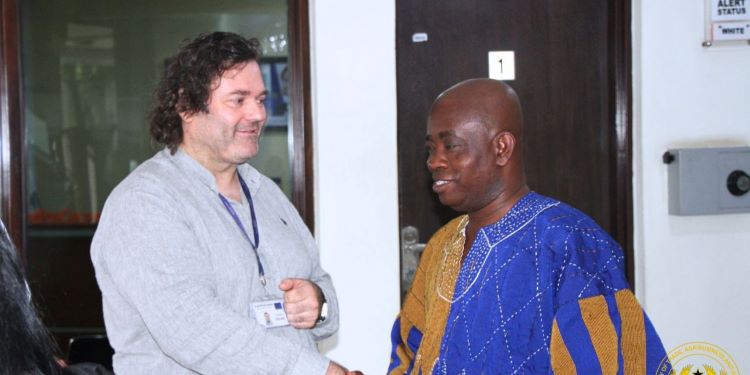
“MoTAI engaged Development Partners to deepen collaboration and accelerate Ghana’s industrial and trade transformation agenda. Representatives from the EU, GIZ, among others, pledged their continued support to the Minister, especially on its key priority projects, reaffirming a commitment to sustained engagement to deliver impactful reforms”
Ministry of Trade, Agribusiness and Industry
The response from the international community was overwhelmingly positive. This support is expected to manifest in the form of long-term financing and the sharing of market intelligence, which will help Ghanaian exporters navigate the complex standards and regulations of foreign markets.
The discussion also touched upon the Green, Digital, and Inclusive Private Sector Development Project, which seeks to ensure that Ghana’s industrial growth is environmentally sustainable and socially equitable, aligning with global trends toward “green” manufacturing.
The engagement has effectively chartered a clear path forward for Ghana’s industrial sector, aligning the interests of the state with those of international development partners.

The Ministry of Trade, Agribusiness and Industry is creating a formidable coalition for growth, to make moving from a primary exporter to a manufacturing-led economy no longer a distant aspiration but a targeted operational goal with clear benchmarks and a defined timeline.
The success of the Feed the Industry initiative and the $10 billion export target will now depend on the speed with which these collaborative frameworks can be translated into on-the-ground reality.
READ ALSO: Ghana Demands Continental Action Against Xenophobic Attacks