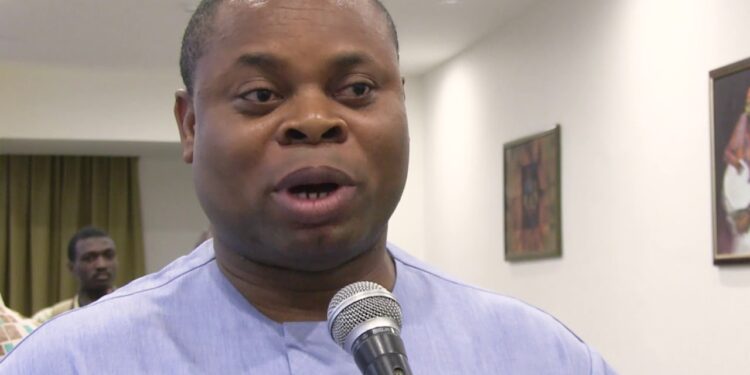
The Founding President of IMANI Centre for Policy and Education, Franklin Cudjoe, has welcomed the passage of Ghana’s new Value for Money legislation but has cautioned that the country cannot afford another well-intentioned institution that fails to confront waste, procurement abuse, and politically connected spending.
Reacting to the formal approval of the Value for Money Bill, Mr Cudjoe described the legislation as a potentially transformative reform in Ghana’s public financial management system.
However, he stressed that the real measure of success will not be the law itself but the ability of the newly established office to detect, prevent, and expose financial misconduct before it drains public resources.
“Bottom line: Ghana has suffered repeated procurement breaches worth hundreds of millions. The new Value for Money Office must work- or we remain spectators to the same theatre”.
Franklin Cudjoe, Founding President of IMANI Centre for Policy and Education
His comments come at a time when the government is preparing to operationalize the new office, which is expected to serve as a major accountability institution tasked with ensuring that public projects, procurement decisions, and state contracts deliver measurable value to taxpayers.

For anti corruption campaigners, policy researchers, and public finance experts, the law signals a new phase in Ghana’s efforts to tighten spending discipline. Yet for IMANI, one of the country’s most influential public policy organizations, the new institution must prove from day one that it is more than another administrative layer.
IMANI Raises Concerns Over Institutional Expansion
Although Mr Cudjoe welcomed the law, he disclosed that IMANI had earlier questioned whether Ghana truly needed another office to perform functions that overlap with existing institutions.
According to him, IMANI actively participated in consultations leading to the passage of the legislation and submitted key technical recommendations aimed at strengthening accountability mechanisms.
Despite those concerns, Mr Cudjoe expressed optimism after indications from the Finance Ministry suggested that the office would operate under a self-financing model.
Governance experts say a self financing model, if properly structured, could reduce operational dependence on annual budget allocations and strengthen institutional independence.
Kelni GVG Scandal Still Haunts Procurement History
To explain why Ghana needs stronger oversight, Mr Cudjoe revisited one of the most controversial procurement scandals in recent memory, the 180 million dollar Kelni GVG telecommunications monitoring contract awarded under the Ministry of Communications.
According to findings published by IMANI, the procurement process behind the contract revealed multiple irregularities that raised serious questions about compliance with Ghana’s public procurement laws.
Mr Cudjoe alleged that the contract was awarded through an unjustified restricted tender process in which only four companies were invited to bid, despite none having a proven track record in the highly specialized telecommunications sector.
He further claimed that procurement justifications were manipulated to create an appearance of due diligence. According to IMANI, some of the companies involved had little operating history, limited capitalization, and no technical credentials.
Mr Cudjoe also alleged that standard qualification requirements, including minimum years of experience and liquidity thresholds, were deliberately relaxed to accommodate selected entities.
One of the most troubling findings, he said, involved a potential conflict of interest within the evaluation process, where an individual involved in assessing bids reportedly had prior links to a company connected to the eventual winning bidder.
IMANI’s report also alleged that the Ministry of Finance approved the 180 million dollar transaction within two working days without receiving the full set of supporting documentation.
According to Mr Cudjoe, petitions, legal objections, and procurement concerns were ignored, while portions of the documentation later raised questions about possible tampering.
Electoral Commission Procurement Cases Raise Fresh Questions
Mr Cudjoe also pointed to procurement concerns involving the Electoral Commission of Ghana as further evidence of systemic weaknesses in public spending oversight.

According to him, IMANI began tracking irregularities linked to the commission’s biometric procurement processes as far back as 2020. He alleged that the bidding process surrounding election technology contracts was manipulated, leading to the resignation of a procurement panel chair who reportedly objected to the process.
IMANI also questioned the replacement of biometric systems valued at approximately 60 million dollars, arguing that the equipment remained functional at the time.
Additional concerns emerged over a software contract that IMANI claims was significantly overpriced compared to its market value. By 2024, Mr Cudjoe said, concerns deepened after biometric equipment valued at approximately 150 million dollars was allegedly disposed of as scrap despite remaining operational.
According to him, some of the equipment was transferred to uncertified recyclers without competitive tendering, raising questions about transparency, asset protection, and value preservation.
In 2025, he noted, the Commission on Human Rights and Administrative Justice upheld an IMANI petition and proceeded with investigations into aspects of the procurement concerns.
A New Test for Public Accountability
For Mr Cudjoe, the creation of the Value for Money Office now presents Ghana with a critical opportunity to break what he described as a dangerous cycle of financial waste.
He insisted that the office must be empowered to investigate inflated contracts, bid manipulation, documentation irregularities, conflict of interest cases, and politically connected procurement decisions, regardless of which administration is in power.

Analysts say the office’s credibility will depend not only on the powers granted under the law but also on the willingness of its leadership to act independently, publish findings transparently, and pursue accountability without fear or political compromise.
As Ghana moves into this new phase of fiscal oversight, the warning from IMANI is unmistakable. The law may now exist, but unless the office delivers real results, the country risks watching the same expensive performance play out once again.