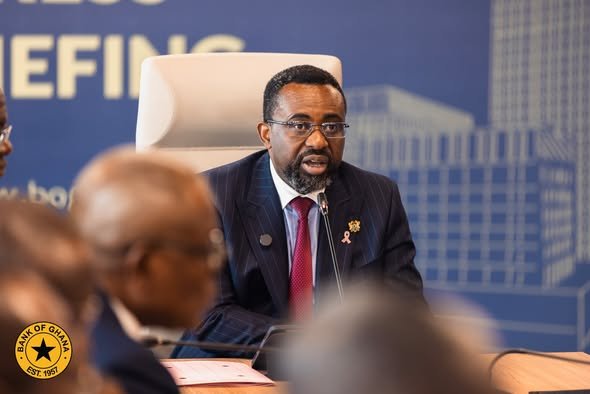
The Bank of Ghana has begun its 130th Monetary Policy Committee meeting under heightened economic uncertainty, with policymakers facing one of the most delicate balancing acts in recent years.
At the center of discussions is the need to preserve Ghana’s macroeconomic stability while ensuring that businesses continue to have access to credit to support expansion and economic growth.
The policy meeting, which comes at a time of low inflation and improving macroeconomic indicators, is expected to shape the direction of monetary policy in the months ahead. The current policy rate stands at 14.0 percent, and market watchers are keenly awaiting signals from the central bank on whether rates will remain unchanged or whether adjustments will be made to stimulate credit growth across the economy.
Governor Signals Major Economic Concerns
Opening the meeting, Dr. Johnson Asiama made it clear that the committee has significant issues to address beyond the traditional inflation and interest rate outlook.
According to the Governor, the committee must carefully review how to realign interest rates across the economy while ensuring that inflation expectations remain anchored. Ghana’s inflation has remained subdued at 3.4 percent, creating room for discussions around monetary easing. However, the Governor warned that underlying risks could quickly reverse the gains made in recent months.
“The Monetary Policy Committee has several substantive issues to address at this meeting. These issues range from realigning the entire interest rate structure in the economy as inflation remains low at 3.4 percent to addressing policies to ensure inflation expectations do not become dislodged.”
Dr. Johnson Asiama
His remarks indicate that although headline inflation appears favorable, policymakers remain cautious about emerging risks that could destabilize the broader economy.
Credit Expansion Takes Center Stage
One of the key themes of this year’s meeting is the concern over credit flow to businesses, particularly within the private sector.
Despite improving macroeconomic conditions, access to affordable credit remains a major challenge for businesses across Ghana. High lending rates and cautious banking sector practices have limited borrowing, slowing investment and expansion in key sectors of the economy.
Dr. Asiama stressed that Ghana’s economic recovery cannot be sustained without a stronger banking sector that is willing and able to support businesses through increased lending.
“Looking forward, the economy will need a strong banking sector, and steps will be needed to ensure that the financial stability concerns are protected and the banking system is made to deliver on credit expansion.”
Dr. Johnson Asiama
This statement reflects growing concern among policymakers that weak credit growth could undermine Ghana’s broader economic recovery efforts, especially for small and medium sized enterprises that depend heavily on bank financing.
Energy Crisis and Global Pressures Raise Alarm
Beyond domestic financial concerns, the Governor also highlighted significant external and internal threats that could weigh heavily on the economy.
Among the biggest concerns is the prolonged geopolitical instability in the Middle East, which continues to create uncertainty in global energy and commodity markets. Rising oil prices and supply chain disruptions could translate into higher import costs for Ghana, increasing pressure on domestic prices.
At the same time, domestic energy supply challenges remain unresolved, creating another layer of vulnerability for the economy.
Dr. Asiama warned that the combination of local energy disruptions and global commodity price pressures could create what he described as a dual channel inflation expectations problem.
If left unchecked, these pressures could undermine confidence in the economy and trigger renewed inflationary risks.
Fiscal and External Vulnerabilities Under Review
The Monetary Policy Committee is also expected to closely examine Ghana’s external sector performance, reserve position, and fiscal outlook.
According to the Governor, some risks are already beginning to materialize while others remain potential threats that could emerge in the coming months.
He cited concerns around current account vulnerabilities, reserve pressures, and possible fiscal risks stemming from weaker external revenue inflows.
The domestic power crisis also remains a critical issue, with its potential impact on industrial productivity, investor confidence, and overall economic output. “These risks will be central to the discussions this week,” Dr. Asiama stated.
His comments suggest that policymakers are approaching this meeting with caution, aware that maintaining economic stability will require coordinated policy responses.
Markets Await Policy Direction
As the committee deliberates over the coming days, investors, businesses, and financial institutions will be watching closely for the final policy decision.
The outcome of the meeting will not only influence borrowing costs and investment decisions but could also shape market confidence in Ghana’s economic recovery path.
For businesses seeking relief from high financing costs, hopes remain high that the central bank may introduce measures that support credit expansion while safeguarding macroeconomic stability.
With global uncertainties rising and domestic challenges still present, the decisions taken at this meeting could define the next chapter of Ghana’s economic journey.
READ ALSO: Africa Poised to Lead in Global Digital Finance Evolution, Says MTN Group CEO