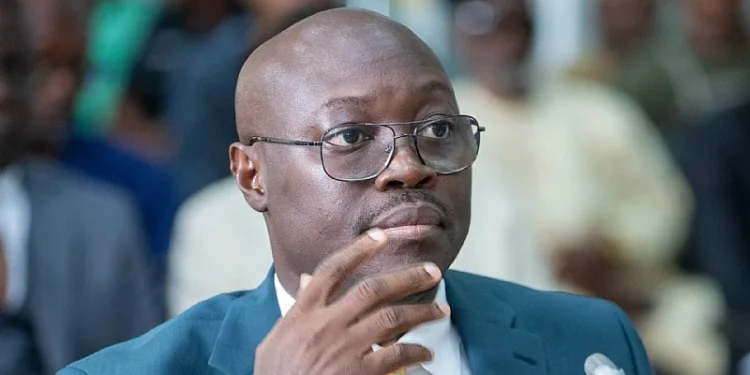
Ghana’s Finance Minister Dr Cassiel Ato Forson, speaking at a panel discussion at the Ishmael Yamson & Associates Business Roundtable, outlined the government’s shift in public spending priorities, emphasizing that oil revenue and other state resources are now being directed toward large-scale infrastructure development rather than dispersed administrative consumption.
The discussion was held under the theme “unlocking the next quarter century: harnessing Africa’s digital infrastructure, trade and integration, energy and industry, governance, and societal development for global relevance.”
In his remarks, he pointed to what government describes as the Big Push programme, which is designed to accelerate investment in infrastructure, with particular emphasis on roads during the initial phase.
According to him, the President’s direction has been to prioritize road infrastructure over the first two years of implementation. He explained that the 2025 budget has allocated about 4.5 billion United States dollars equivalent for road investment, describing it as a central pillar of current fiscal planning.



Oil Revenue Reforms and Spending Discipline
Dr Forson noted that government has restructured how petroleum revenues are used. He said that in earlier periods, oil revenue was distributed across many competing budget items, which reduced its developmental impact.

He explained that reforms have been introduced to ensure that oil earnings are now dedicated strictly to infrastructure. In his words, government has adjusted the legal framework so that Ghana’s oil revenue is reserved for major infrastructure projects over a defined period.
He said the intention is to commit such revenue to a clearly identified national infrastructure agenda for at least the next four years. He contrasted this with previous practices, stating that oil revenue was previously used for a wide range of recurrent and administrative expenditures.
He mentioned that portions of these funds were once used for items such as newspapers and air travel tickets, as well as capacity building workshops and international conferences. He described the new approach as a corrective shift aimed at improving value for money in public spending.
He also stated that oil revenue last year amounted to just under 500 million United States dollars, which he described as relatively limited compared to the scale of infrastructure needs.
Mineral Royalties and Financial Reallocation
A further key reform highlighted by the Finance Minister involved mineral royalties. He explained that revenues from gold and other mineral resources, which previously accrued to the state through the Mineral Income and Investment Fund Mineral Income and Investment Fund, were previously used in ways that included the purchase of government securities such as treasury bills.

Dr Forson stated that government revised this approach, arguing that it was not efficient for state funds to be recycled into government borrowing instruments. He indicated that this decision allowed for the redirection of about 500 million United States dollars in additional resources.
Together with oil revenue, he said these funds have been consolidated into approximately one billion United States dollars. He explained that this pool of resources is currently being directed toward the construction of the Accra to Kumasi Expressway.
Financing the Accra to Kumasi Expressway
Dr Forson stated that the Accra to Kumasi Expressway project is estimated to cost around 4 billion United States dollars. He emphasized that government intends to finance the project without borrowing, relying instead on accumulated oil revenue and mineral royalty inflows over multiple years.
He explained that through the combination of last year’s revenues and projected inflows for 2025, government expects to mobilize approximately 2.5 billion United States dollars by the end of this year. He further projected that continued inflows over the following years would allow the full financing of the project within the 2025 to 2027 period.
He described the approach as a shift away from fragmented spending. He said that in the past, public funds were distributed across a wide range of smaller expenditures, which diluted their developmental impact. The new strategy, he explained, focuses on prioritizing a few major infrastructure projects with long term national value.
Fiscal Outlook and Future Infrastructure Plans
Looking ahead, Dr Forson said government expects to mobilize an additional 1.5 billion United States dollars in the coming year, bringing total resources for the two year period to about 2.5 billion United States dollars.

He added that continued fiscal discipline and resource consolidation would make it possible to fully fund the expressway and other major projects without increasing debt levels.
He further stated that once the current infrastructure priorities are completed, government will move on to other large scale national projects. The long term intention, he explained, is to steadily build infrastructure capacity across the country through sequenced investments rather than scattered expenditure.
He reiterated that the focus of policy has shifted toward ensuring that state revenue, particularly from oil, is reserved for infrastructure that has measurable and lasting impact. He argued that this approach is intended to improve efficiency in public finance and strengthen long term economic development outcomes.
READ ALSO: US-Iran Ceasefire Deal Close but Key Disputes Persist