BOSTenergies Managing Director, Afetsi Awoonor, has announced a sweeping national infrastructure plan designed to preemptively outpace Ghana’s surging fuel consumption patterns.
Speaking at a high-level panel discussion during the Ghana-UK Investment Summit, Mr. Awoonor revealed that the country is undertaking a massive expansion of its petroleum and Liquefied Petroleum Gas (LPG) storage facilities across three strategic zones.
This aggressive infrastructural intervention aims to insulate the domestic economy from volatile market shocks while locking in critical supply corridors across neighboring landlocked Sahelian nations.
“We see a clear growth pattern that tells us that by 2030, it will double again. So if we don’t invest in our infrastructure and get ahead of the demand curve, we stand a chance of being shaken by more supply disruptions and instability. Because now, that’s why Bostenergies, TOR has been working together to grow the capacity of Bostenergies.”
BOSTenergies Managing Director, Afetsi Awoonor
The comprehensive strategy comes in response to an unprecedented, decade-long upward trajectory in regional energy requirements.
According to institutional data, domestic and regional fuel demand has effectively doubled between 2016 and the return of President John Dramani Mahama to office in 2025.
Predictive analytics, artificial intelligence tracking tools, and market surveillance models indicate that this consumption volume will double once more by 2030. Without immediate capital injection to expand national buffer capacities, Ghana risks facing severe supply disruptions and localized economic instability.
Expanding Refining Capacity and Sahelian Export Corridors
To mitigate these risks, BOSTenergies has entered into a strategic operational partnership with the Tema Oil Refinery (TOR) to systematically scale down-stream processing thresholds.
The collaborative framework has already maintained an operational baseline of 45,000 barrels per stream day (bpsd).

An immediate media and engineering plan is currently underway to elevate this immediate output to 60,000 bpsd, providing a crucial buffer for local consumption.
Looking further ahead, the long-term state blueprint includes the integration of an additional 100,000 bpsd processing module, bringing the nation’s unified refining outlook to a level that completely redefines its regional trade posture.
This massive output expansion is structurally engineered to look far beyond Ghana’s borders.
Ghana currently commands a robust overland culinary and fuel supply network stretching into Burkina Faso, Niger, and Mali.
Furthermore, the state has actively leveraged its western maritime zone in Takoradi to cement contractual supply chains running directly into Liberia, establishing a resilient commercial footprint across the West African coast.
Strategic Zonal Storage Layouts and Decentralized LPG Infrastructure
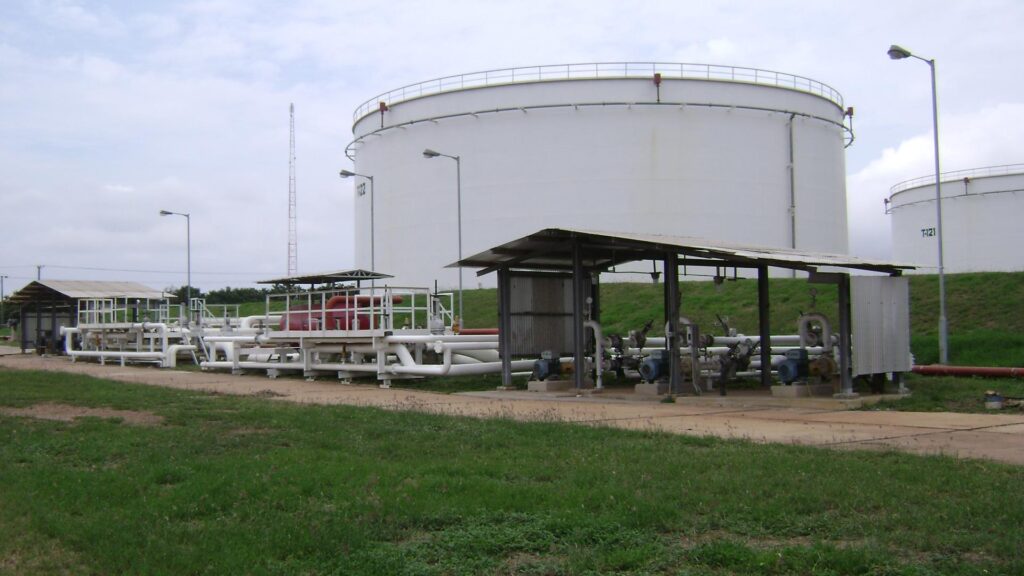
Central to this defensive expansion is the construction of a dedicated petroleum storage facility in Takoradi.
This western hub is specifically designed to manage logistical export operations feeding into Sierra Leone and Liberia, while simultaneously stabilizing domestic distribution across the Western Region.

To prevent bottlenecks, BOSTenergies is concurrently upgrading storage volumes across all its pre-existing regional depots, creating an interconnected web of strategic reserves that can balance national supply during global disruptions.
Simultaneously, the state is addressing clean cooking energy deficits by rolling out large-scale LPG storage tanks totaling 30,000 metric tonnes across three critical intersections.
The Takoradi installation will anchor operations for the western zone, while a secondary terminal in Kumasi will feed the highly populated central zone.
Up north, the Buipe depot will host a major storage deployment engineered to serve the northern territories and provide immediate transshipment access to landlocked Sahelian export partners.
Strengthening Macroeconomic Resilience and Regional Energy Security
Independent structural analysis indicates that the expansion of decentralized storage facilities will fundamentally shift the balance of Ghana’s downstream petroleum industry.

By increasing local storage capacity, the state can significantly reduce its reliance on just-in-time imports, which frequently leave the local economy vulnerable to international price spikes and logistics failures.
Maintaining high-volume strategic reserves allows the National Petroleum Authority to stabilize local pump prices, giving domestic commercial sectors a highly predictable environment for long-term planning.
Furthermore, this infrastructure drive significantly elevates Ghana’s geopolitical leverage within the Economic Community of West African States (ECOWAS).
By embedding its storage terminals directly into the logistics chains of Burkina Faso, Mali, and Niger, the country establishes itself as an indispensable economic anchor for the Sahel.
This network also maximizes foreign exchange inflows via cross-border energy trading, strengthening the cedi against major trading currencies.
Ultimately, getting ahead of the demand curve ensures that Ghana’s internal industrial growth remains uninterrupted while positioning the nation as a reliable guarantor of West African energy security.
REA ALSO: Duncan-Williams Says Vision Key To National Prosperity And Order