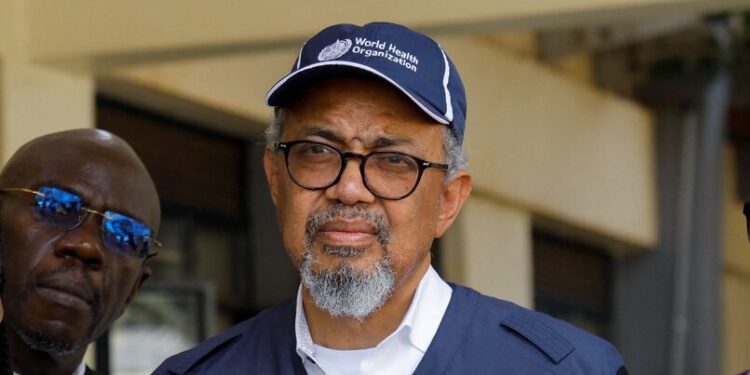
World Health Organization (WHO) Director-General Dr Tedros Adhanom Ghebreyesus has urged Uganda to reconsider its decision to temporarily close its border with the Democratic Republic of Congo (DRC), warning that blanket travel restrictions are not effective in containing disease outbreaks as Ebola cases continue to rise across the region.
Dr Tedros Adhanom Ghebreyesus made the appeal during a visit to an Ebola isolation unit at a hospital in Kampala, where he praised Uganda’s response to the outbreak but cautioned against measures that could disrupt cross-border health coordination.
In response to Uganda’s decision to close its border with the Congo, Tedros stated, “I hope they reconsider.” He highlighted that, while Uganda has responded to the outbreak “promptly and capably,” travel restrictions do not offer a long-term solution to limit the spread of Ebola.
Uganda announced the temporary border closure late last month as part of efforts to limit transmission of the rare Bundibugyo strain of Ebola, which has triggered a growing public health emergency across parts of Central and East Africa.
According to the Ugandan Ministry of Health, the restriction remains temporary and limited exemptions have been introduced for outbreak response teams, humanitarian operations, food and cargo transport, and security-related movement.
“All authorized entrants shall be subjected to strict health screening, completion of locator forms, documentation, and continuous monitoring at all ports of entry in accordance with Ministry of Health surveillance protocols.”
Ugandan Ministry of Health
The Ministry added that individuals entering from the DRC under other circumstances would be placed in mandatory 21-day isolation.
The outbreak, which began in DRC’s Ituri province near the Ugandan border, has now become the epicentre of transmission, accounting for the vast majority of confirmed cases. Africa’s top public health agency reports that of 544 total confirmed cases in the DRC, 515 have been recorded in Ituri alone.
Uganda has so far confirmed 19 cases, most involving individuals who crossed from the DRC.
WHO has declared the outbreak a Public Health Emergency of International Concern, citing the rapid spread of the virus, cross-border transmission risks, and ongoing insecurity in affected regions.
Ituri province, where the outbreak is concentrated, has also been severely affected by armed conflict between government forces and militia groups. The violence has displaced millions of people, complicating access to healthcare and hampering containment efforts.
This is the 17th Ebola outbreak recorded in the DRC since the virus was first identified in 1976.
Moreover, WHO Chief also commended both Ugandan and regional health authorities for their rapid response efforts, describing them as “capable” and “coordinated” despite difficult circumstances.
At the same time, he reiterated WHO’s position that unrestricted border closures can hinder response operations, delay the movement of essential medical supplies, and undermine surveillance systems needed to track and contain the virus.
WHO Calls for Cooperation to Contain Ebola Outbreak

Meanwhile, World Health Organization (WHO) has intensified its call for coordinated international cooperation as efforts to contain the ongoing Ebola outbreak continue across Central and East Africa, warning that only a unified response can effectively halt the spread of the virus.
Humanitarian support is being scaled up in affected regions, with emergency supplies donated by the European Union recently delivered to Bunia, the epicentre of the outbreak in the Democratic Republic of Congo’s Ituri province. Health workers in the area have been grappling with severe shortages of essential protective equipment, including gloves, masks, boots, and critical medical supplies needed for frontline response operations. UNICEF, which is assisting with logistics and distribution, said additional consignments of aid are expected to arrive in phases over the next eight days to reinforce ongoing response efforts.
In parallel, the Africa Centres for Disease Control and Prevention (Africa CDC) and the WHO have jointly launched a continental preparedness and response plan aimed at strengthening containment measures and preventing further regional transmission of the virus.
The six-month strategy, which runs from June to November 2026, is seeking to mobilise US$518 million to support both affected and high-risk countries. The funding will be directed toward improving disease surveillance, expanding laboratory testing capacity, enhancing emergency coordination, strengthening infection prevention and control, and increasing community engagement across borders.
The initiative brings together governments, international partners, and local communities under a unified “One Response” framework designed to accelerate detection, improve coordination, and ensure a faster and more effective containment effort across the region.
WHO Director-General Dr Tedros Adhanom Ghebreyesus stressed that success in controlling the outbreak depends on sustained cooperation between all stakeholders involved in the response.
READ ALSO: Pope Leo Addresses Spanish Parliament