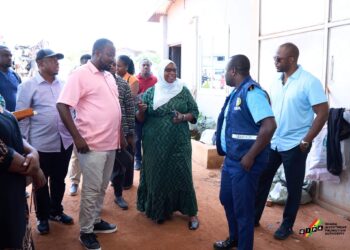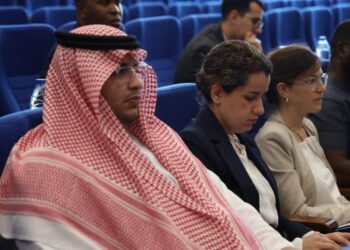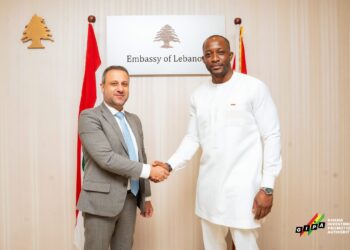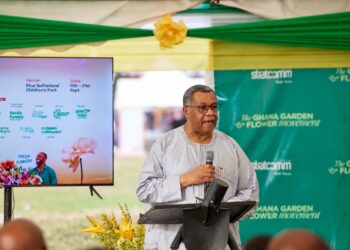
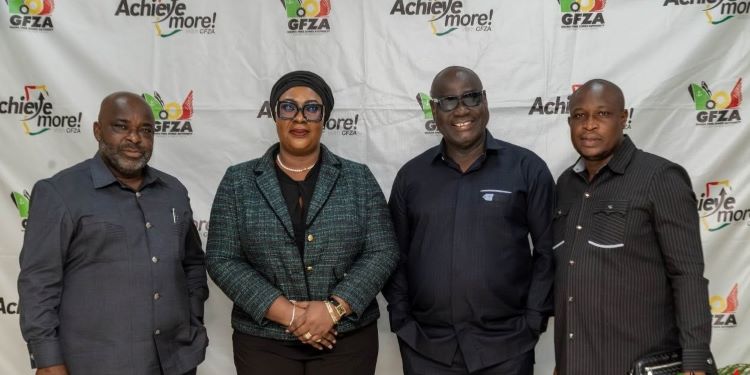
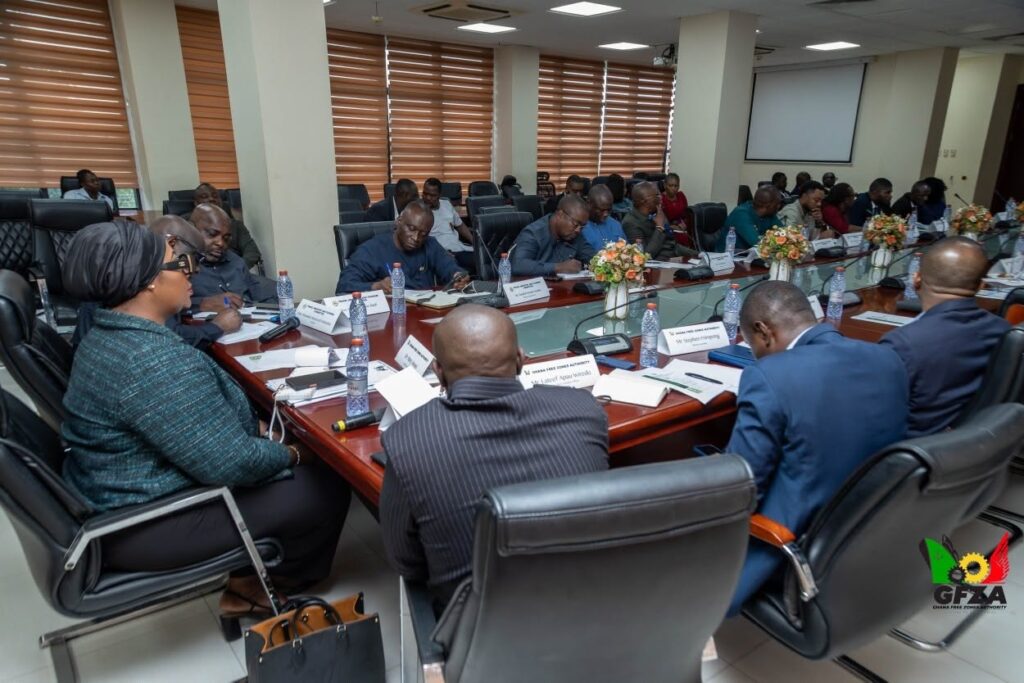
A high-level parliamentary delegation from the Select Committee on Trade, Industry and Tourism has executed a formal working visit to the corporate headquarters of the Ghana Free Zones Authority (GFZA), providing a strategic, closed-door evaluation of the performance metrics, international investments, and obstacles presently defining the Free Zones Scheme.
Led by the Committee Chairman, Hon. Alexander Roosevelt Hottordze, with administrative backing from the Ranking Member and former GFZA Chief Executive Officer, Hon. Michael Okyere Baafi, the working session brought the legislative re-engineering of the country’s industrial enclaves to the forefront of domestic policy.
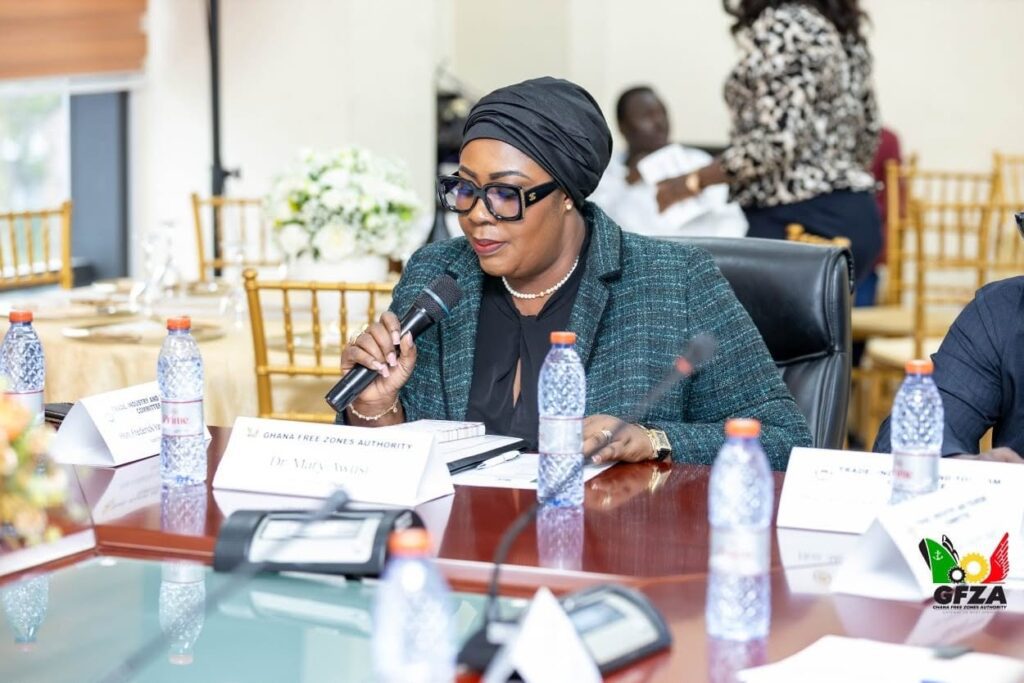
“Welcoming the legislative delegation, the Chief Executive Officer of the Ghana Free Zones Authority, Dr. Mary Awusi, framed the institutional interaction as a necessary checkpoint for state-sponsored industrial growth.
“Dr. Awusi reaffirmed the authority’s alignment with the government’s broader economic transformation agenda, emphasizing that the GFZA remains a primary engine for attracting foreign direct investment (FDI), boosting hard currency reserves, and generating sustainable employment opportunities for citizens”
Ghana Free Zones Authority
The Chief Executive pointed out that the committee’s working visit signals a welcome parliamentary commitment to reinforcing the state institutions that contribute fundamentally to stabilizing the national balance of payments against global economic pressures.
The primary policy flashpoint of the institutional dialogue centered on the growing obsolescence of the foundational Free Zones Act, as Dr. Mary Awusi issued an explicit call to action to the visiting lawmakers, stating directly that the legislative framework governing free zone enterprises must undergo a comprehensive regulatory review.
The international trading architecture has changed completely since the inception of the original scheme, and maintaining outdated regulatory protocols actively limits the competitive advantage of manufacturing entities operating within Ghana’s industrial enclaves.
She noted that to prevent manufacturing capital from migrating to more agile regional economies, the GFZA requires a modernized piece of legislation that accounts for digital trade logistics, evolving global tariff structures, and harmonized cross-border manufacturing demands.
To supply lawmakers with an empirical breakdown of the authority’s strategic vector, a comprehensive presentation was delivered on behalf of the Chief Executive by the Director of Corporate Affairs, Dr. Patience Agbleze Acorlor.
The presentation detailed the core legal mandate of the GFZA, documenting its historical contributions to job generation, technological transfer, and macro-level asset accumulation.
However, Dr. Acorlor’s brief focused heavily on the next phase of institutional growth, highlighting the exact operational reforms required to establish Ghana as the premier export processing hub in West Africa.
Shielding Industrial Land Banks
Beyond the legislative sphere, the discussion focused on the physical and logistical constraints threatening industrial expansion across the country. A core strategic objective of the GFZA management is the acquisition and development of geographically diverse industrial land banks outside the traditional industrial zones of Accra and Tema.
This decentralized approach ensures that the economic wealth of the Free Zones Scheme is felt in other regions. However, this industrial expansion plan is facing significant challenges from unauthorized land sales, speculative border developments, and active encroachment on state-allocated land reserves.
When private entities or local actors encroach upon demarcated industrial land banks, they disrupt regional utility layouts, delay major infrastructure installation, and deter international manufacturing conglomerates that require legally unassailable land titles before transferring capital.
The GFZA executive team engaged extensively with the select committee to draw up a robust, state-backed legal and physical mechanisms to safeguard these designated territories.
The Authority’s central argument was that protecting these land reserves is a matter of long-term economic security, and the government must utilize its full enforcement power to protect these zones from speculative destruction.
A major part of the high-level engagement concentrated on how the GFZA is re-aligning its licensed enterprises to maximize the immense commercial opportunities within the African Continental Free Trade Area (AfCFTA).
Because the AfCFTA framework significantly drops tariff barriers on a vast array of intra-African industrial commodities, the rules governing how free zone products enter local and continental markets must be completely reconciled.
The committee and management analyzed current licensing procedures and statutory requirements, ensuring that Ghanaian-based manufacturers can easily claim originating-status certifications without encountering paralyzing bureaucratic delays at home. The assembly also addressed the urgent need to upgrade domestic workforce capacity.
For free zone enterprises to successfully transition into high-value manufacturing, electronics assembly, and specialized agribusiness, the local labor pool must possess advanced technical skills.
The GFZA outlined its internal strategies to collaborate with local technical universities, ensuring that the human capital supplied to these industrial zones matches the precise operational needs of modern international corporations, thereby maximizing the domestic economic retention of foreign investment.
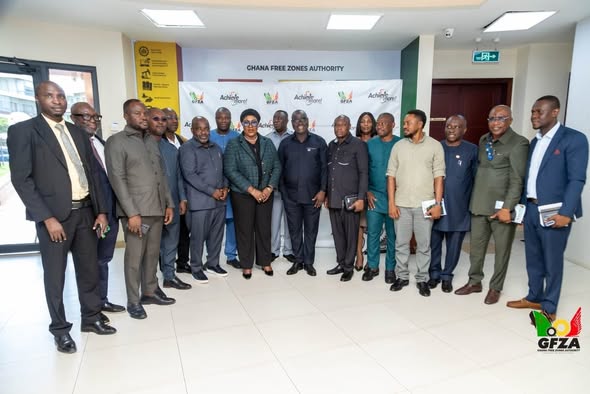
The high-level oversight visit concluded with a strong show of institutional unity between the legislative and executive arms of government.
The Chairman of the Parliamentary Select Committee, Hon. Alexander Roosevelt Hottordze, alongside the Ranking Member, Hon. Michael Okyere Baafi – whose unique perspective as a former CEO of the authority added deep technical weight to the committee’s findings – praised the executive management team for their operational transparency and clear national vision.
“He assured the Authority of the Committee’s support in addressing the challenges confronting the sector and pledged Parliament’s commitment to working collaboratively with the Authority to strengthen the Free Zones Scheme for national development”
Ghana Free Zones Authority
READ ALSO: Trade Minister Hails Landmark Shift from Exporting Raw Petroleum Products