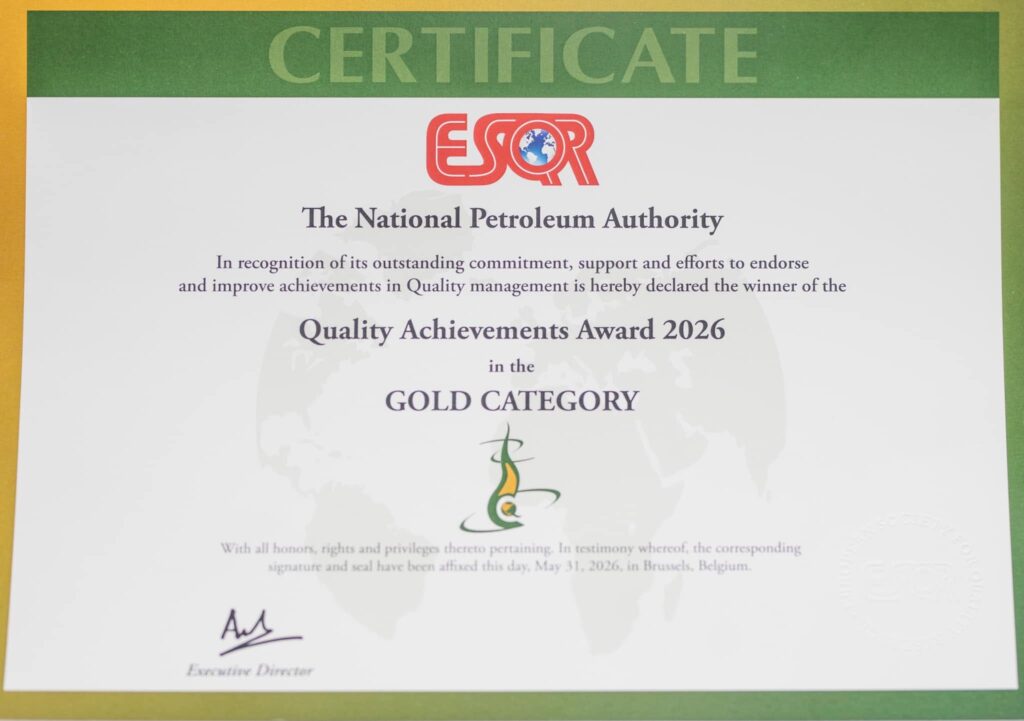
National Petroleum Authority (NPA) has been recognized on the global stage for its unwavering dedication to operational excellence, securing the prestigious 2026 Quality Achievements Award.
Bestowed by the European Society for Quality Research (ESQR), this global accolade highlights the statutory regulator’s continuous improvement frameworks and strict adherence to top-tier institutional governance.
The milestone celebration took place during the annual ESQR Quality Achievements Awards and Convention, hosted on May 31, 2026, in the diplomatic hub of Brussels, Belgium.
“The award reflects the Authority’s dedication to upholding efficiency, transparency, safety, and excellence in the petroleum sector, while continuously enhancing service delivery to stakeholders and the public. The event brought together business leaders, academics, quality professionals, diplomats, and representatives of organizations from Europe, the Americas, Africa, Asia, and Australia to celebrate excellence in quality management and organizational performance.”
National Petroleum Authority (NPA)
This international recognition places Ghana’s petroleum regulator among an elite cohort of global public administrations and corporate entities vetted for outstanding corporate commitment to quality management practices.
Under the progressive leadership of Chief Executive Godwin Kudzo Tameklo Esq., the authority has systematically overhauled its supervisory protocols to foster a highly reliable energy market.
By defeating tough competition from distinguished institutions worldwide, the NPA proved its regulatory mettle, convincing the ESQR selection committee that its administrative strategies are yielding measurable advancements in the downstream petroleum value chain.
Operational Redesign and Tech-Driven Quality Assurance
The institutionalization of the Petroleum Product Marking Scheme (PPMS) stands as a stellar operational achievement, utilizing advanced bio-chemical markers to track fuel integrity from initial supply points down to retail pumps.
By deploying state-of-the-art LSX3000 handheld detection devices, field compliance teams now transmit real-time fuel testing data directly to secured cloud servers.
This digitalized infrastructure has successfully wiped-out product adulteration, giving retail consumers absolute value for money while stabilizing market benchmarks.

Furthermore, the Quality Control Department has institutionalized a rigorous mandatory laboratory analysis regime.
No maritime vessel or bulk distribution company can discharge fuel stocks into national storage depots without obtaining certified conformity approvals that match strict Ghana Standards Authority (GSA) metrics.
These highly synchronized vetting processes effectively shield the Ghanaian market from sub-standard petroleum imports, protecting delicate automobile systems and significantly lowering harmful environmental emissions across the country.
Combatting Illicit Trade Through Strategic Interventions
To safeguard national revenue and block financial leakages, the regulator has ramped up its anti-smuggling combat operations to record levels.
The executive leadership recently collaborated with the Western Naval Command to locate and destroy illegal fuel boats operating along the coastal corridors, sending a stern warning to economic saboteurs.

This aggressive frontline enforcement is complemented by a widespread public safety initiative dubbed the “Stay Back, Stay Safe” campaign, designed to educate vulnerable frontier communities on the catastrophic dangers of fuel siphoning and illicit product handling.
Simultaneously, the regulator is driving forward consumer-centric transparency by demanding that fuel stations issue official receipts for every point-of-sale transaction, enabling seamless dispute resolutions.
On the structural side, the NPA is piloting a national 24-Hour Economy framework for the petroleum downstream sector to ensure stable product distribution around the clock.
By actively reviewing the National Petroleum Authority Bill to stiffen licensing requirements, the agency continues to prove that it values regulatory resilience above all else.
Institutional Safety and Welfare Reforms
In line with the premium quality standards celebrated at the Brussels convention, the NPA has forged strategic alliances with the Chamber of Oil Marketing Companies (COMAC) to launch the comprehensive Safety Week initiative.
Focused on the corporate theme “Manage the Risk Before It Becomes an Incident,” this collaborative program integrates strict health, safety, security, and environmental (HSSE) rules deep into everyday retail operations.

The regulator is working directly with the Driver and Vehicle Licensing Authority (DVLA) to train tanker drivers, systematically reducing hazardous road accidents involving highly inflammable products.
Welfare administration has also taken center stage through the newly introduced Driver and Mate Remuneration Framework, managed via the Unified Petroleum Pricing Fund (UPPF).
This innovative social policy standardizes compensation models for haulage personnel, directly reducing transit risks caused by operator fatigue.
By successfully combining technical innovation, strict anti-smuggling policies, and industry welfare updates, the NPA has fully earned its title as a model public institution, setting a shining example for energy regulators right across the African continent.
READ ALSO: Ghana to Host Upcoming 5th ECOWAS Trade Ministers Meeting