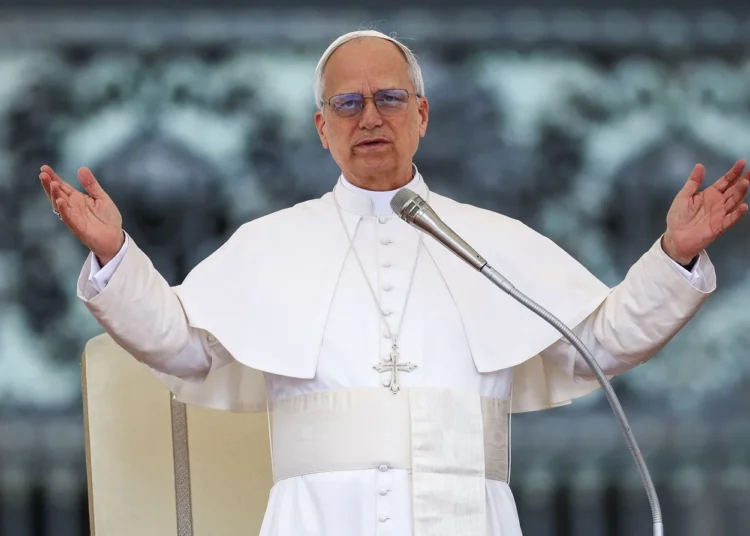
Pope Leo XIV has appealed to world leaders to treat refugees and migrants more humanely, warning in a visit to Spain’s Canary Islands that history would condemn those who allowed people fleeing war or poverty to suffer.
The Pontiff arrived in the Canary Islands; one of Europe’s migration hotspots, earlier today, fulfilling a long-held wish of his predecessor, Pope Francis, who died a year ago without making a planned trip to the islands.
He is spending the final two days of his weeklong trip to Spain in the Canary Islands, a Spanish archipelago closer to Africa than the Iberian Peninsula and a key point of entry for migrants who make the perilous Atlantic crossing from West Africa.
The stop in the Spanish archipelago off the western coast of Africa is a centrepiece of the Pope’s weeklong tour of Spain, in which he has also warned that escalating conflicts have pushed the world into a profound crisis.
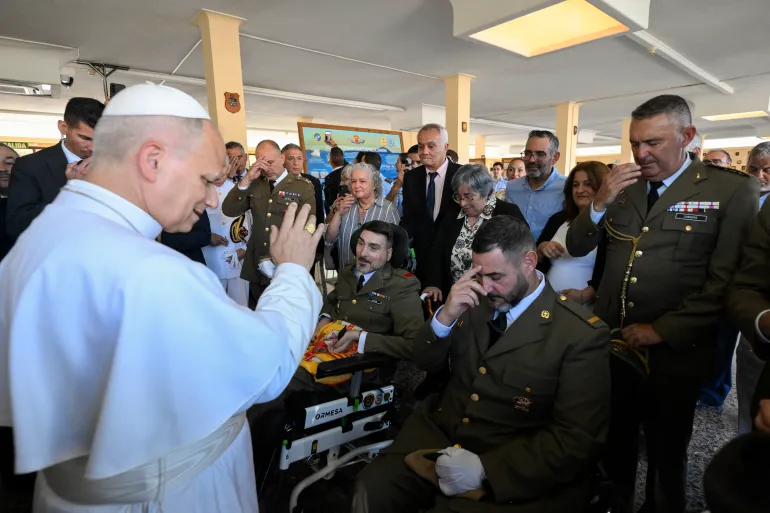
Upon his arrival, Leo went straight to the port in Arguineguín, where in 2020 arrivals reached such numbers that migrants were forced to sleep on the dock in makeshift camps in the open air.
Many spent weeks with just a blanket and no showers. Potential asylum seekers had no proper access to legal advice and some people were held for weeks, much longer than the three days that the law allowed. The ombudsman later forced the government to shutter the makeshift camp and relocate the migrants in hotels that had been emptied by COVID-19.
In what he called an “appeal to the conscience” of politicians in Europe and the international community, Pope Leo said that “human dignity has no passport and does not lose its value when crossing a border.”
Speaking at Gran Canaria’s Port of Arguineguin, dubbed the “Dock of Shame” by relief organisations after some 1,000 people were stranded in squalid conditions there in the early months of the COVID-19 pandemic, the Pontiff said to thousands gathered near a memorial to migrants lost at sea, “We cannot grow accustomed to counting the dead.”
He appealed to the “conscience of Europe, which cannot claim to uphold human dignity while growing accustomed to the Mediterranean and the Atlantic becoming unmarked graves.”
He urged countries of origin to create the security and economic conditions so people are not forced to flee, and for transit countries to protect migrants so they don’t fall prey to smugglers. He also listed the rights of migrants to flee or remain.
“May history not accuse us of turning the pain of those who suffer into a common sight along our shores. Today, here by the sea, every individual that arrives asks us what remains of our humanity.
“Sooner or later, it will be known whether we protected life or whether we yielded to indifference.”
Pope Leo XIV
According to the NGO Caminando Fronteras, at least 3,090 people died in 2025 trying to reach the Canary Islands. A year prior, more than 46,000 migrants reached the archipelago off northwestern Africa – a record year – often in packed, unseaworthy boats.
In contrast with most of Europe, Spain has adopted a more open stance on migrants, introducing a programme to grant residency to more than half a million undocumented people. The initiative, however, has drawn criticism from far-right leaders in Spain and across the continent, and the country is struggling with the slow pace of granting legal status to thousands in limbo.
Pope Leo’s Visit Hailed As “Significant Milestone”
Juan Carlos Lorenzo, Coordinator of the Spanish Commission for Refugees in the Canary Islands, said that Leo’s visit to the Canaries, where the Pope will meet with about 1,000 refugees and migrants tomorrow, was a “significant milestone.”
“It will serve as a strong affirmation of the defence of human rights, respect and the dignity that all people deserve, regardless of their origin.”
Juan Carlos Lorenzo
The Canary Islands have long been a stepping stone for migrants trying to reach Europe from West Africa and Morocco. Some experts consider the Atlantic route they take to get here more deadly than the more well-known central Mediterranean smuggling route from Libya and Tunisia to Italy.
Migrant arrivals in the Canary Islands peaked in 2024 at nearly 47,000. Following pressure and deals between the European Union, Spain and the governments of several West African nations, arrivals have fallen dramatically, with just over 3,000 people landing there in the first five months of 2026.
Next month, on July 4, the American Pope will spend U.S. Independence Day on the island of Lampedusa, where Pope Francis in 2013 first denounced the “globalization of indifference” the world shows migrants.
READ ALSO: Meloni Urges EU To Appoint Envoy For Negotiations With Russia