Chief Executive Officer of the Ghana Gold Board, Sammy Gyamfi, has asserted that restoring the country’s ecological heritage supersedes assigning blame for historical environmental damage, framing the entity’s new environmental reclamation drive as a forward-looking national obligation.
This underlines a strategic pivot by the regulatory body, which is choosing to prioritize practical, restorative action over political or historical finger-pointing regarding the “galamsey” crisis.
By focusing resources on correcting systemic environmental degradation rather than dwelling on when or how the destruction occurred, the Gold Board aims to unify stakeholders under a single, non-partisan objective: reviving the state’s damaged ecological infrastructure to protect its vital resource-dependent economy.
“It’s all Ghana and for us it’s not about who destroyed it. It is about what we can all do to reclaim that beautiful reserve that God endowed us with for a rich service intended purpose within the ecosystem that we have.”
GoldBod CEO, Sammy Gyamfi

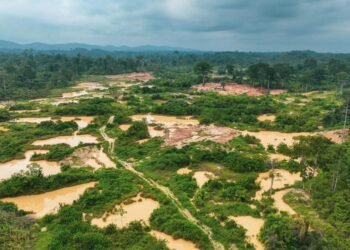
This position comes as the Gold Board launches its flagship national reclamation and environmental restoration programme, designating the heavily degraded Tano-Nimiri Forest Reserve as its pioneer project site.
Records from the Forestry Commission reveal that illegal miners aggressively invaded this specific protected reserve prior to 2025, systematically stripping away its rich vegetative cover long before the current structural iteration of the Gold Board was fully established to manage these challenges.
Despite the fact that the Board had no hand in the destruction, leadership has committed to funding the entire cleanup operation, emphasizing that the overarching goal is to reclaim the country’s natural endowments for their intended biological and communal purposes.
The Urgent Need for Broad-Scale Habitat Remediation
The critical state of Ghana’s forest reserves requires immediate, intensive rehabilitation due to the profound ecosystem services these blocks provide to the West African sub-region.
When illegal mining operations clear extensive tracts of vegetative cover, they do not merely remove trees; they obliterate the delicate topsoil architecture, trigger severe land fragmentation, and destroy critical wildlife corridors.

The choice of Tano-Nimiri as the inaugural site highlights the severity of the crisis, as the reserve has suffered from extensive canopy loss and soil compaction that completely halts natural forest regeneration.
Without active human intervention, such as structural soil remediation and targeted replanting of native species, these areas risk transitioning into permanent, barren wastelands.
Furthermore, the loss of these forest ecosystems directly undermines regional climate resilience and microclimate stability, which are vital for the nation’s dominant agricultural frameworks.
Protecting Water Security and Mitigating Toxic Contamination
A primary driver necessitating immediate land reclamation is the severe, ongoing contamination of major river systems and underground aquifers that originate within these protected areas.
Illegal small-scale mining typically relies on the unregulated use of heavy metals, such as mercury and lead, to extract gold from alluvial deposits, leaving behind highly toxic tailing ponds.

These chemical pollutants leach continuously into the local water table, turning pristine forest streams into highly turbid, poisoned channels that threaten the health of millions of citizens.
For the Gold Board, addressing this pollution is a matter of urgent national security, as the cost of water treatment for public utilities has escalated unsustainably over recent years.
The reclamation process involves neutralizing these toxic pockets, filling dangerous open pits, and stabilizing riverbanks to prevent further heavy-metal runoff and mass erosion.
Leaving these open mining pits unfilled poses a continuous physical hazard to local communities and prevents any form of safe, alternative land use for generations.
By systematically capping these sites and using advanced civil engineering techniques to restore natural drainage patterns, the initiative prevents the long-term bioaccumulation of toxins in the local food chain.
This focus on chemical and physical stabilization is essential to ensuring that surrounding populations can once again access safe drinking water and utilize nearby lands without facing severe health liabilities.
Securing Economic Sustainability and Resource Balancing
Beyond the immediate environmental benefits, the reclamation programme represents a vital economic strategy designed to protect the long-term viability of Ghana’s rural economy and agricultural sectors.

The aggressive spread of unregulated mining has historically cannibalized prime agricultural land, particularly within the cocoa-growing belt, threatening the livelihoods of smallholder farmers and jeopardizing vital cash crop exports.
By establishing a clear framework for restoring degraded lands, the Gold Board demonstrates that mineral wealth extraction does not have to result in the permanent destruction of agricultural capital.
The program seeks to prove that responsible resource management must balance lucrative mining yields with the preservation of arable land.
READ ALSO: Afari Military Hospital Delay Exposes NPP, NDC Failures – Kennedy Agyapong