Finance Minister and Member of Parliament for Ajumako Enyan Essiam, Dr Cassiel Ato Forson, is leading the race to become the National Democratic Congress flagbearer for the 2028 general election, according to a new nationwide survey conducted by Global Info Analytics.
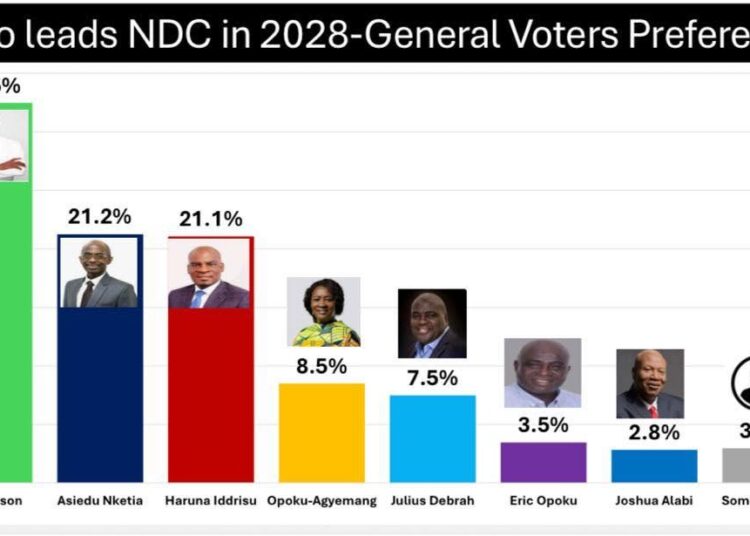
The poll, which sampled voters across all 16 regions of Ghana between May 30 and June 12, 2026, places Dr Forson at 32.5 percent support among general voters, giving him a clear early advantage in the emerging succession race within the opposition party.
The findings suggest that although competition remains strong within the NDC, Dr Forson currently holds the highest level of national support among the leading contenders considered in the study.
Closely Fought Contest Among Top Candidates
The survey shows a tight contest among the next two leading figures. NDC National Chairman Johnson Asiedu Nketia ranks second with 21.2 percent, narrowly followed by Education Minister and Member of Parliament for Tamale South, Haruna Iddrisu, who recorded 21.1 percent.

The data is based on responses from 8,784 voters nationwide and indicates that while Dr Forson leads comfortably, the race for second place remains extremely close.
Global InfoAnalytics noted that some aspirants have experienced declines in support compared to its March 2026 tracking poll, suggesting shifting preferences among voters as the political landscape evolves.
Vice President Professor Jane Naana Opoku-Agyemang recorded the sharpest drop, falling by 5.5 percentage points to 8.5 percent. Johnson Asiedu Nketia declined by 3.9 percentage points, while Haruna Iddrisu recorded a reduction of 1.9 percentage points.
Regional Patterns Shape Candidate Strengths
The poll highlights clear regional variations in candidate support across the country. Dr Forson is reported to have strong backing in Akan dominated and swing voter regions, contributing significantly to his national lead.

Johnson Asiedu Nketia maintains strong dominance in the Volta and Oti regions, where he remains the preferred choice among respondents in those areas.
Haruna Iddrisu continues to enjoy strong support in the northern part of the country, where he commands about 60 percent backing within that regional bloc.
These patterns suggest that regional alignment remains a key factor shaping internal party competition ahead of the 2028 electoral cycle.
Head-to-Head Comparisons
The survey also examined hypothetical one-on-one matchups among the leading contenders. In direct contests, Dr Forson defeats both Johnson Asiedu Nketia and Haruna Iddrisu with identical margins of 62 percent to 38 percent.
This suggests broad appeal beyond his base support in the multi- candidate field. However, a direct contest between Asiedu Nketia and Haruna Iddrisu shows a much closer race, with Haruna Iddrisu edging ahead by 51 percent to 49 percent.
The results indicate that while Dr Forson maintains a strong lead in broader comparisons, competition among other top contenders remains highly competitive.
Potential Matchups Against Bawumia
The poll further assessed how possible NDC candidates would perform in a general election against former Vice President and opposition NPP’s 2028 flagbearer, Dr Mahamudu Bawumia in 2028.
Dr Forson leads Dr Bawumia by 54 percent to 34 percent among all voters surveyed. His advantage is even stronger among first time voters, where he leads by 53 percent to 29 percent.

Johnson Asiedu Nketia is projected to defeat Dr Bawumia by 49 percent to 38 percent, while Haruna Iddrisu leads the former Vice President by 51 percent to 36 percent.
Professor Jane Naana Opoku Agyemang shows a narrower advantage, leading Dr Bawumia by 44 percent to 40 percent, a margin within the poll’s stated error range. These results provide an early indication of how different NDC figures might perform in a national election scenario.
Survey Methodology and Coverage
Global InfoAnalytics stated that the poll combined 7,484 face to face interviews with 1,302 online responses. The survey covered all 16 regions of Ghana and was designed to reflect national voter sentiment.
The research firm reported a confidence level of 99 percent with a margin of error of plus or minus 1.5 percent. According to the firm, the findings offer a credible snapshot of evolving political dynamics within the NDC as the party begins to position itself for the post-Mahama era.

The results come amid growing discussion within the National Democratic Congress about future leadership, even though the party has not officially opened its flagbearer contest.
Dr Forson’s lead positions him as a key figure in early succession considerations, while strong regional bases for other contenders suggest that the race remains open and potentially competitive.
As the 2028 election cycle draws closer, internal party alignments, regional support bases, and voter sentiment shifts are expected to play a decisive role in shaping the final outcome of the contest.
READ ALSO: Starmer Issues Warning to Burnham Over Leadership Bid