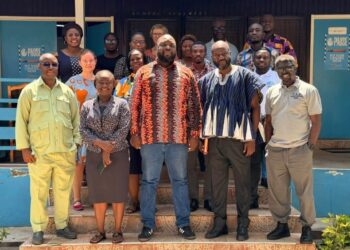

The Ghana Free Zones Authority (GFZA) has extended its warmest congratulations to Cargill Ghana Limited, marking a momentous corporate milestone of twenty years of impactful role and continued success under the state’s specialized Free Zones Scheme.
Within the landscape of national industrial policy and trade promotion, this two-decade anniversary is being viewed as a validation of the regulatory and economic frameworks engineered to support export-led growth.
For the GFZA, the long-term partnership underscores a stable, predictable corporate environment that allows global manufacturing entities to establish deep roots, integrate cleanly into domestic production networks, and maintain sustained commercial growth over multiple economic cycles.
“Operating at the heart of Ghana’s cocoa processing sector, Cargill Ghana Limited has made significant strides in transforming raw cocoa into high-value products for the international market.
“Through innovation, strict quality control and world-class processing capabilities, the company continues to reinforce Ghana’s reputation as a key player in the global cocoa industry and your operations have also contributed significantly to job creation”
Ghana Free Zones Authority
The GFZA’s commendation highlighted a deep appreciation for large-scale investments that align with national blueprints. In an economic sector as critical to the country’s macroeconomic stability and global standing as agriculture, the presence of a committed, world-class processing partner over twenty continuous years provides an invaluable anchor for local supply chains.

For the Authority, the relationship with Cargill Ghana Limited reflects a mutual commitment to building industrial resilience, ensuring that the country remains highly competitive in attracting foreign direct investment while systematically reinforcing domestic production lines.
Operating at the heart of Ghana’s cocoa processing sector, the company has made massive structural strides in shifting the country’s position away from the passive exportation of raw cocoa beans toward the active production and shipping of highly refined industrial derivatives.
The GFZA noted that this transformation ensures that a significantly greater portion of the value chain is captured within domestic borders, maximizing foreign exchange revenues, stabilizing local trade balances, and expanding the country’s industrial baseline – a premier model for the wider domestic agribusiness ecosystem.
The capacity to process raw agricultural commodities locally requires substantial, long-term capital commitments, specialized heavy machinery, and highly integrated logistics networks. Over the past twenty years, the company has successfully scaled these operations to meet the rigorous, high-volume demands of global buyers.
The GFZA noted that by continuously investing in advanced factory infrastructure under the protective and enabling umbrella of the Free Zones Scheme, the company has turned policy intentions into visible industrial outputs that actively feed into premium international commercial channels.
Innovation, Quality, and Sovereign Reputation
To maintain a commanding position in the highly competitive international trade arena, industrial operators must prioritize continuous technological refinement and strict quality standards.

The Authority noted that through relentless innovation, strict quality control, and world-class processing capabilities, Cargill Ghana has maintained elite operational excellence over its twenty-year tenure, especially in the modern global marketplace, where international buyers are rigid about product uniformity, biochemical safety, and processing efficiency.
The continuous deployment of world-class processing capabilities directly influences how international commodities traders perceive the sovereign brand.
When a domestic enterprise consistently delivers high-standard refined goods, it elevates the entire national industry, demonstrating that the local workforce and infrastructure are fully capable of sustaining high-precision corporate manufacturing. The GFZA emphasized that these sustained high-standard operations have a powerful compounding effect.
Beyond export volumes and trade balancing, the social impact of this two-decade industrial partnership has been felt deeply across the domestic labor market, as the company’s sustained operations have contributed significantly to widespread job creation, providing stable, high-value employment opportunities within the advanced manufacturing sector.
In an economy focused on expanding sustainable livelihoods for its citizens, the presence of an industrial employer that maintained active production lines over twenty consecutive years has offered an invaluable avenue for professional development and localized economic security.
When examining the broader macroeconomic landscape, the twenty-year success story of this partnership serves as an empirical confirmation of the underlying philosophy that governs the Ghana Free Zones Scheme.

Moreover, the long-term presence and continuous expansion of a major multinational processing firm within this framework provides clear evidence that the package of incentives, administrative support, and economic zone protections is working exactly as intended.
As this landmark twentieth anniversary is celebrated across the agricultural and trade sectors, both the statutory regulator and the corporate operator look forward to a continued trajectory of mutual growth and synchronized industrial development.
The GFZA expressed its deep appreciation for this great partnership, acknowledging that the shared achievements provide a powerful foundation for future economic expansions – with the collaboration standing as an excellent model for other prospective investors looking to tap into the country’s rich resources and stable investment climate.
READ ALSO: US-brokered Agreement Between Israel and Lebanon Criticised