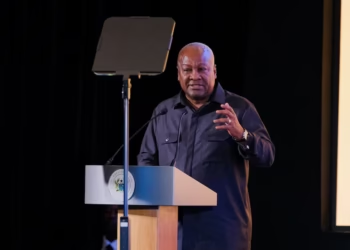
Ghana’s healthcare system is facing an alarming shortage of physician anaesthesiologists, a situation the Director-General of the Ghana Health Service (GHS), Dr. Samuel Kaba Akoriyea, has described as requiring immediate and coordinated national intervention to safeguard safe surgical care across the country.
Speaking as the Special Guest of Honour at the 30th Anniversary celebration of the Ghana Society of Anaesthesiologists (GAS) in Accra, Dr. Akoriyea warned that the country’s specialist workforce remains critically inadequate despite growing healthcare demands.
Describing anaesthesia as “the backbone of modern medicine and safe surgery,” he stressed that no modern health system can function effectively without a strong and well distributed anaesthesia workforce.
While congratulating the Ghana Society of Anaesthesiologists for three decades of dedicated service, Dr. Akoriyea also paid tribute to generations of physician anaesthesiologists whose commitment has strengthened healthcare delivery throughout Ghana.
However, he noted that the anniversary celebration should also serve as a moment of reflection on the enormous workforce gap confronting the specialty.
Only 200 Specialists Serve the Entire Country
The Director-General disclosed that Ghana currently has approximately 200 physician anaesthesiologists serving the country’s entire population, describing the figure as “grossly inadequate” considering the nation’s population and increasing surgical needs.

“Modern medicine would not be possible without anaesthesia.”
Director-General of the Ghana Health Service (GHS), Dr. Samuel Kaba Akoriyea,
According to him, the shortage extends beyond numbers, affecting the quality, supervision, training and equitable delivery of anaesthesia services nationwide.
Although he acknowledged the contribution of more than 636 Certified Registered Nurse Anaesthetists, Dr. Akoriyea explained that their efforts alone cannot replace the specialised expertise provided by physician anaesthesiologists.
“They have helped bridge the gap, but their numbers alone cannot substitute for the equitable training, deployment, supervision, and subspecialisation needed to improve surgical outcomes, maternal health, and the overall quality of care across the country.”
Director-General of the Ghana Health Service (GHS), Dr. Samuel Kaba Akoriyea,
The Director-General observed that many health facilities, particularly those outside major cities, continue to struggle with limited access to specialist anaesthesia services, creating disparities in surgical care across the country.
He therefore called for deliberate investments to strengthen the specialist workforce and improve equitable access to safe surgery for all Ghanaians.
Four Immediate Measures to Curb the Situation
To tackle the shortage, Dr. Akoriyea proposed what he described as four immediate actions that could significantly increase the number of physician anaesthesiologists within the Ghana Health Service.
The first recommendation is the development and implementation of a national strategic plan for anaesthesia.
According to him, a comprehensive national framework would guide workforce development, improve planning and support long-term investment in specialist anaesthesia services.
His second proposal focuses on expanding telemedicine and consultant outreach programmes to strengthen supervision of anaesthesia services, especially in underserved communities where specialist support remains limited.
Dr. Akoriyea called for immediate study leave with pay for Ghana Health Service doctors who decide to specialise in anaesthesiology, explaining that such incentives would encourage more physicians to enter the specialty.
The fourth proposal advocates stronger collaboration between physician anaesthesiologists and Certified Registered Nurse Anaesthetists to improve professional practice and enhance service delivery throughout the health system.
“Together, these measures could begin to close the gap between the demand for safe surgical and anaesthesia care and the limited specialist workforce currently available to provide it.”
Director-General of the Ghana Health Service (GHS), Dr. Samuel Kaba Akoriyea,

Ghanaian Doctors Can Deliver World-Class Care
The Director-General pointed to the successful separation of Ghana’s craniopagus conjoined twins as proof that Ghana possesses the expertise to perform highly complex medical procedures when healthcare professionals receive adequate institutional support.
He specially recognised Dr. Wulf, Dr. Sarpong and the multidisciplinary anaesthesia team that spent nearly two years preparing for the landmark surgery.
Describing the achievement as remarkable, Dr. Akoriyea said it demonstrated that “Ghanaian doctors can deliver world class care when provided with the necessary tools and support.”
He also honoured pioneering healthcare workers who served in remote communities decades ago under extremely difficult conditions.
Many of these professionals, he recalled, worked without electricity, reliable telecommunications or adequate infrastructure, yet remained committed to delivering quality healthcare to underserved populations.
“Their sacrifices laid the foundation for the progress the sector enjoys today.”
Ghana Society of Anaesthesiologists (GAS)
Director calls for More Investment intervention
Reflecting on Ghana’s healthcare journey over the past three decades, Dr. Akoriyea acknowledged that the country has made considerable progress in expanding access to healthcare services.
Nevertheless, he pointed out that Ghana’s life expectancy remains below the global average, highlighting the need for sustained investment in specialist healthcare and quality service delivery.
According to him, increasing the number of physician anaesthesiologists must become a national priority if Ghana is to improve surgical outcomes, maternal healthcare and emergency medical services.
Call for Unity Among Health Sectors
The Director-General further urged greater collaboration across Ghana’s healthcare sector, reminding participants that healthcare is a shared national responsibility.
“Every Ghanaian, including health workers themselves, is a potential patient,” stressing that every mother safely brought through surgery and every child successfully treated represents an investment in the country’s future.

Quoting Professor Gladys Amponsah and English writer John Ruskin, Dr. Akoriyea encouraged anaesthesia professionals to answer “the call of their generation” and avoid “the pain of regret.”
He challenged members of the Ghana Society of Anaesthesiologists to lead the transformation of the specialty over the next thirty years, expressing confidence that future generations would remember this period as the era that fundamentally changed anaesthesia care in Ghana.
As part of the anniversary celebration, Dr. Akoriyea presented a citation on behalf of the Ghana Health Service to the Ghana Society of Anaesthesiologists in recognition of the organisation’s dedicated service to the country, with particular mention of its contribution during the successful separation of Ghana’s craniopagus conjoined twins.
The Director-General’s remarks have once again brought national attention to the shortage of physician anaesthesiologists, a challenge that mirrors Ghana’s broader specialist workforce deficit. His call for urgent policy action, expanded specialist training and stronger collaboration highlights the need for sustained investment to ensure that every Ghanaian has access to safe anaesthesia and surgical care regardless of where they live.
READ MORE: GES Settles 2023–2026 Academic Intervention Backlog for Senior High Staff