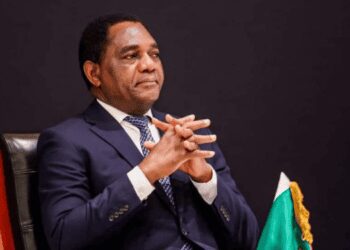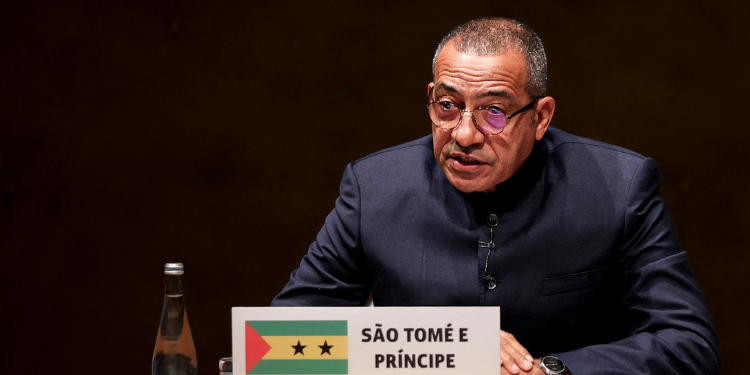
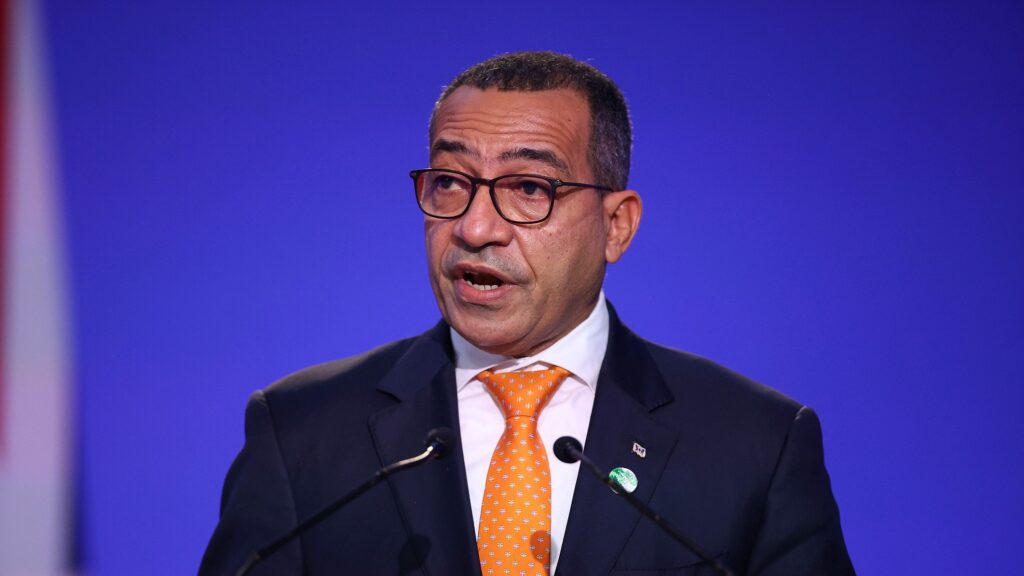
President Carlos Vila Nova has secured a second five-year term as president of São Tomé and Príncipe after winning a decisive first-round victory in the country’s presidential election.
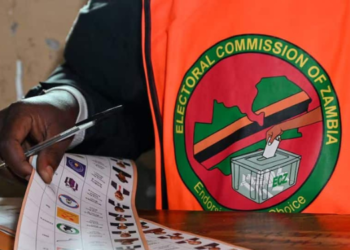
Preliminary results announced by the National Election Commission showed Vila Nova capturing more than 55% of the vote, comfortably surpassing the threshold required to avoid a second-round runoff.
His closest rival, Nito Abreu, received more than 41% of the ballots cast, while the remaining candidates shared the rest of the vote.
The outcome marks a significant political achievement for President Vila Nova, who contested the election as an independent candidate despite first rising to the presidency in 2021 with the backing of the ruling Acção Democrática Independente (ADI) party.
His re-election comes after months of political uncertainty following a public split with the ADI, the party that helped propel him to office. The relationship deteriorated last year when Vila Nova dismissed Prime Minister Patrice Trovoada, triggering divisions within the governing party and reshaping the country’s political landscape ahead of the presidential race.
Despite those internal disagreements, voters ultimately handed the incumbent a renewed mandate, suggesting that many citizens placed greater confidence in his leadership than in the fragmented political alliances that emerged during the campaign.
With around 142,000 registered voters from throughout the archipelago and the country’s diaspora, the election carried on São Tomé and Príncipe’s long-standing reputation of peaceful democratic elections, which has set the island apart since multiparty politics were introduced in 1990.
ADI parliamentary leader Nito Abreu, Vila Nova’s main opponent, ran on a platform of employment possibilities for youth and addressing the increasing number of individuals fleeing the country in pursuit of better economic chances outside.
Throughout the campaign, Abreu argued that youth unemployment, inflation, corruption, fuel shortages and unreliable electricity supplies required urgent government action. Those issues dominated public debate as candidates sought to convince voters they could deliver meaningful economic reforms.
Although Abreu failed to prevent Vila Nova from securing another term, his campaign highlighted widespread concern over the country’s economic future and the need to expand opportunities for a population of roughly 240,000 people.
São Tomé and Príncipe Enters New Democratic Chapter
The re-election of Carlos Vila Nova comes after more than five decades of political transformation in São Tomé and Príncipe, a country that has evolved from a one-party socialist state into one of Africa’s most consistent examples of peaceful democratic transition.
The island nation’s political journey began after independence from Portugal in 1975, when Manuel Pinto da Costa of the Movement for the Liberation of São Tomé and Príncipe (MLSTP) became the country’s first president. The new government initially adopted political and economic structures influenced by Eastern European socialist models, with the state playing a central role in economic planning and administration.
However, economic hardships, falling living standards and mounting public dissatisfaction eventually pushed the country toward political reform. A progressive liberalisation process began in 1985 and culminated in 1990 with the establishment of multiparty democracy through constitutional revisions, marking a historic transition away from one-party government.
The first democratic presidential election was held in 1991, when Miguel Trovoada, a former prime minister, became president after running unopposed. The country’s political structures remained precarious despite the shift being a significant democratic milestone. In 1995, Trovoada was momentarily removed from government in a bloodless military coup. Trovoada was reinstated within a week when the coup leaders changed their minds due to diplomatic pressure and worries about the loss of foreign support.
Trovoada gained re-election in 1996 but was constitutionally prevented from seeking another term in 2001. Businessman Fradique de Menezes of the Independent Democratic Action (ADI), a group connected to Trovoada’s political movement, succeeded him.
De Menezes’ presidency was marked by tensions between the government and parliament, particularly as the National Assembly was dominated by the MLSTP–Social Democratic Party. The political rivalry was a reflection of larger institutional power struggles that continued to influence the nation’s governance.
In 2003, de Menezes was deposed during another military coup, but international diplomacy won his restoration to office. He later gained re-election in 2006 under the Democratic Movement Force for Change, a party that had broken away from the ADI.
Despite repeated elections that were largely considered free and peaceful, São Tomé and Príncipe continued to face challenges linked to weak public administration, corruption and economic constraints. Expectations surrounding offshore oil exploration in the mid-2000s and significant debt relief in 2007 offered hope for economic transformation, although major oil revenues failed to materialise.
Moreover, the country’s political competition continued into the 2010s. In 2011, former president Pinto da Costa narrowly defeated ADI candidate Evaristo Carvalho in a runoff election, securing 52% of the vote. However, the ADI strengthened its influence after winning a parliamentary majority in 2014, leading to Patrice Trovoada becoming prime minister.
Carvalho later returned to the presidency in 2016 after winning a disputed election process, while political alliances continued shifting. By 2018, the MLSTP-PSD formed a governing coalition after the ADI lost its parliamentary majority, with Jorge Bom Jesus becoming prime minister.
In 2021, Carlos Vila Nova emerged victorious in a competitive presidential race, defeating Guilherme Posser da Costa in a runoff with more than 57% of the vote.
His latest victory continues São Tomé and Príncipe’s tradition of constitutional transfers of power while highlighting the country’s ongoing effort to balance democratic stability with demands for stronger governance and economic development.
READ ALSO: Armed Forces University Nears Launch, Education Minister Announces