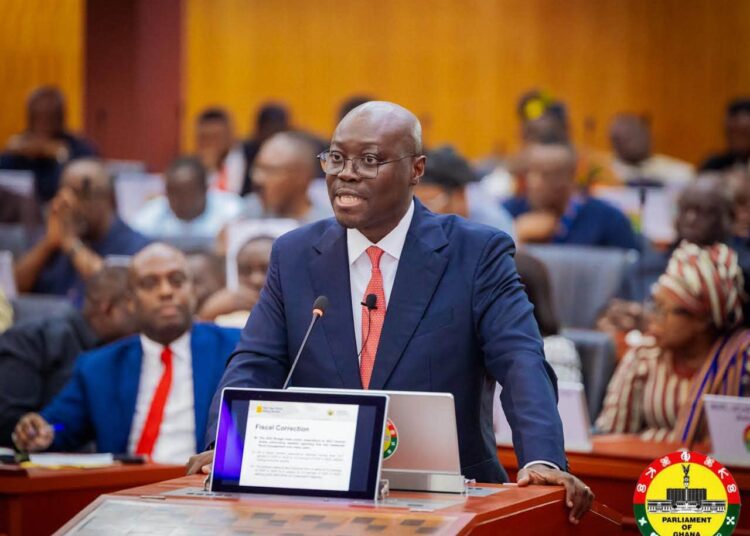
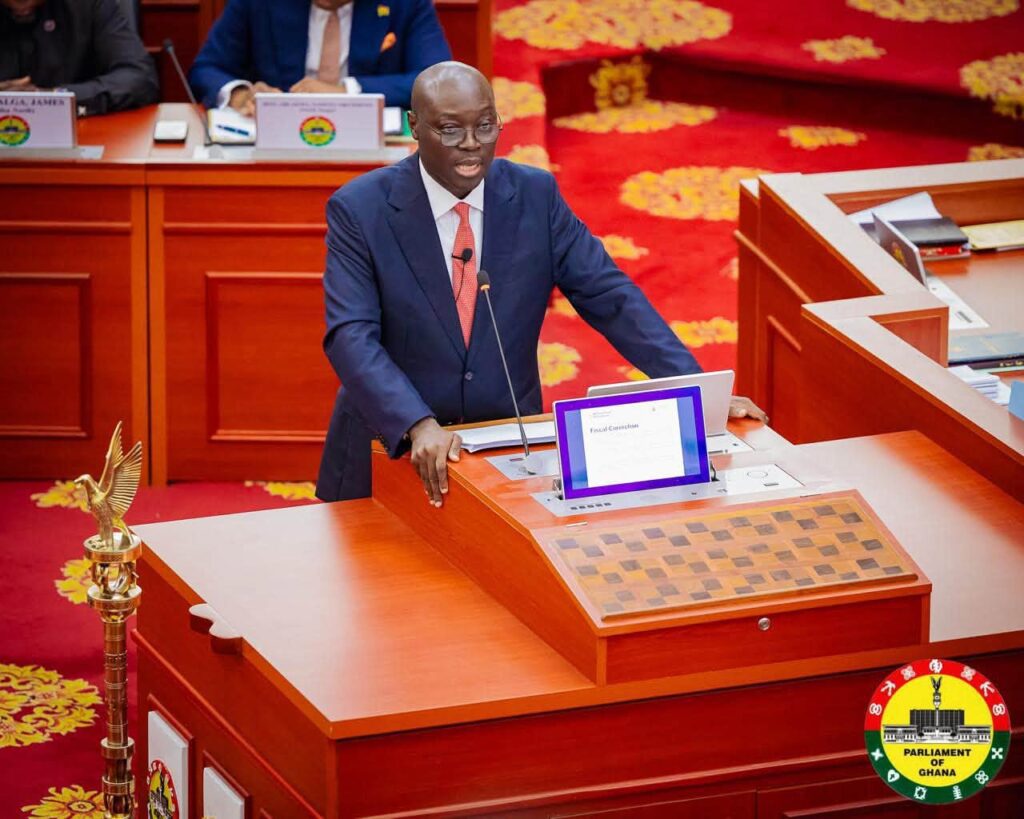
Finance Minister, Hon. Ato Forson, presenting the Mid-Year Budget Review before the Parliament of Ghana, declared that the nation’s crude oil output has outperformed initial projections for the year, signaling a dramatic turnaround in the domestic extractive sector.
Addressing the Speaker and members of the house, the minister highlighted that recent policy interventions and upstream investments have effectively arrested a multi-year decline, putting Ghana back on a trajectory of sustained energy production.
“Right Honourable Speaker, these reforms are already delivering results. Oil production has exceeded expectations this year, with Jubilee increasing from a projected 68,000 barrels to about 95,000 barrels per day. Mr. Speaker, Power Sankofa is now producing about 28,000 barrels per day.”
Finance Minister, Hon. Ato Forson
This remarkable recovery follows a period of contraction during which total crude oil production plummeted from a peak of 71.4 million barrels in 2019 to roughly 36 million barrels in 2025.
To reverse this trajectory, the government introduced a suite of investor-friendly fiscal and regulatory reforms aimed at boosting commercial confidence and attracting fresh foreign direct investment into offshore fields.
These strategic policy measures successfully unlocked over $3.5 billion in new capital commitments from key upstream operators, specifically partners in the Jubilee and Offshore Cape Three Points (OCTP) fields.
Revitalizing Ghana’s Upstream Hydrocarbon and Natural Gas Yields
The surge in daily extraction rates reflects the immediate impact of capital injection and operational optimization across Ghana’s core offshore basins.
Beyond the sharp jump in crude oil extraction at the Jubilee field, daily output from the Sankofa field under the OCTP project has stabilized at robust levels, reinforcing overall national yield.

Equally critical to this extractive turnaround is the accompanying boom in natural gas output. Highlighting the expansion in thermal feedstocks, Hon. Ato Forson informed Parliament that “gas production has also increased from 245 million to about 282 million standard cubic feet per day.“
To sustain this momentum, the Finance Minister announced that “a new agreement with the OCTP partners will increase gas production further to 350 million standard cubic feet per day.”
This upstream gas ramp-up ensures a steady supply of indigenous fuel to power domestic thermal plants, reducing reliance on expensive imported heavy fuel oils.
Macroeconomic Cushioning and Fiscal Revenue Stabilization
For a country navigating fiscal consolidation, a sustained surge in hydrocarbon output delivers crucial macroeconomic benefits.
Higher crude production directly amplifies government revenues through direct equity interest, petroleum income taxes, and corporate tax payments from multinational operators.

These revenues flow into the Petroleum Holding Fund (PHF), providing direct budget support through the Annual Budget Amount Allocated (ABFA) while swelling the Ghana Stabilization Fund and the Ghana Heritage Fund.
Furthermore, increased petroleum export volumes generate substantial foreign exchange inflows. As crude oil remains one of Ghana’s premier export commodities alongside gold and cocoa, elevated daily production strengthens the country’s balance of payments.
The resulting inflow of foreign currency helps build foreign reserve buffers at the Bank of Ghana, mitigating exchange rate volatility and providing critical stability to the Ghana Cedi against major trading currencies.
Energy Security, Industrialization, and Socio-Economic Gains
The substantial boost in domestic natural gas supply directly addresses Ghana’s power sector challenges by guaranteeing a cheaper, cleaner, and more reliable feedstock for thermal power generation.
Expanding gas deliveries to 350 million standard cubic feet per day eliminates fuel supply bottlenecks in the power generation value chain, lowering the cost of electricity production for utility providers.
This cost containment helps ease the debt burden within the energy sector, often referred to as the energy sector shortfall, while providing cheaper power to commercial and industrial consumers.
Ultimately, cheap and reliable energy serves as a catalyst for industrialization under national growth agendas, supporting heavy manufacturing, agro-processing, and local value addition.
The influx of over $3.5 billion in upstream investment stimulates local content participation. Ghanaian service companies, logistics providers, and technical contractors stand to gain high-value contracts, driving direct and indirect employment, technological transfer, and capacity building for the local workforce.
READ ALSO: ”Privileged” Elliot Anderson Seals £116m Manchester City Move