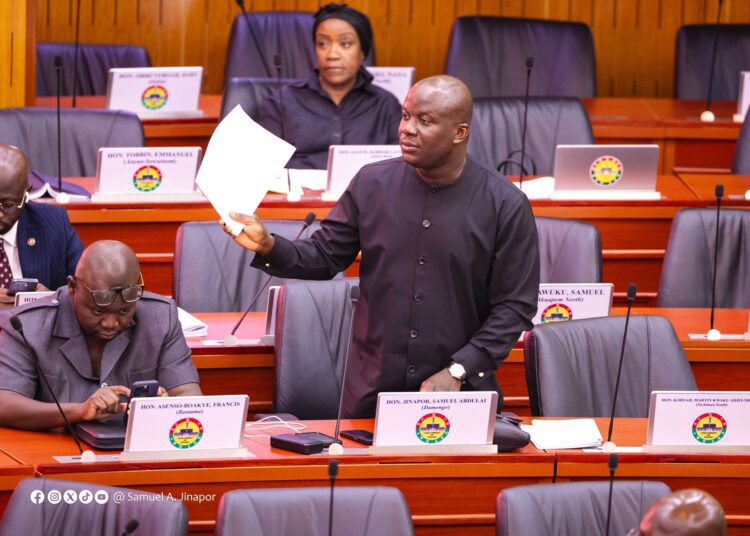
Former Lands and Natural Resources Minister, and the Member of Parliament for Damango Hon. Samuel Abu Jinapor, has clarified the legal and regulatory framework that established Ghana’s local gold off-take structure, highlighting the government’s invocation of its statutory powers to build national reserves.
The Damango Member of Parliament pointed out that the Ministry invoked state pre-emptory rights under Section 7 of the Minerals and Mining Act, 2006 (Act 703) on November 23, 2023, following extensive engagements with major industry groups such as the Ghana Chamber of Mines and the Ghana National Association of Small-Scale Miners.
This legislative mechanism enabled the issuance of policy directives to the Minerals Commission and the Precious Minerals Marketing Company (PMMC)—later amended on January 4, 2024—to operationalize mandatory local sales of gold to central authorities prior to international shipping.
“It is important to emphasize the unimpeachable fact that, it is these reserves accumulated under the Domestic Gold Purchase Programme that has been the backbone of our National economy to date. Indeed, at the 77th Annual New Year School and Conference held at the University of Ghana on 6th January 2026, the Governor of the Bank of Ghana, Dr. Johnson Asiama, said the Domestic Gold Purchase Programme has strengthened external buffers and macroeconomic stability, noting that the Programme has been crucial to the stabilisation goal of the Bank of Ghana. This Government’s ‘Ghana Accelerated National Reserve Accumulation policy (GANARAP),’ is nothing more than a renaming of the Domestic Gold Purchase Programme.”
Hon. Samuel Abu Jinapor

While on the operational mechanics of the mandate, the former Minister detailed how the directives established mandatory purchase quotas across both large-scale and artisanal mining operations.
Under the framework, large-scale mining operations were required to sell twenty percent (20%) of their refined gold output directly to the Bank of Ghana in local currency before exporting their remaining yields.
Concurrently, all Community Mining Schemes and licensed small-scale operations were directed to sell their entire production output to the state through the PMMC.
To enforce strict compliance across the supply chain, the Ministry issued supplementary directives on May 3, 2023, prohibiting the Minerals Commission and PMMC from processing export documentation without the express written approval of the Minister.
Regulatory Enforcement and Supply Chain Safeguards
To prevent illicit gold from entering state repositories, government enforcement focused strictly on verified operations. Regulatory authorities coordinated with sector associations to ensure that every small-scale and community mining license incorporated explicit clauses mandating local sales to state entities.

The enforcement apparatus was jointly executed by the Minerals Commission, the Bank of Ghana, and the PMMC, supported by the Ghana Chamber of Mines.
The former Minister noted that these structured interventions received global coverage, as reported by Reuters, while driving commercial output. Official figures indicate that despite these stringent internal controls, Ghana’s national gold exports climbed from 6.6 billion US Dollars in 2022 and 7.6 billion US Dollars in 2023 to reach a record 11.6 billion US Dollars in 2024.
Policy Continuity and Rebranding Dynamics
Evaluating the current policy landscape, Hon. Jinapor emphasized that recent administrative measures build directly upon established frameworks despite changing nomenclature.
He observed that the current administration’s “Ghana Accelerated National Reserve Accumulation Policy (GANARAP)” represents “nothing more than a renaming of the Domestic Gold Purchase Programme”.

Furthermore, he raised concerns over reserve utilization under the current regime. He noted that the renamed framework “has resulted in the sale of more than half of the gold accumulated” under the previous administration’s Domestic Gold Purchase Programme.
This assertion highlights critical questions regarding long-term asset retention versus short-term fiscal monetization within the extractive sector.
Historical Origins of Central Bank Reserves
The necessity for this comprehensive clarification stems from ongoing public and political debates regarding the origins of Ghana’s improved macroeconomic stability and central bank reserves.
With competing political narratives surrounding foreign exchange stabilization and gold reserve accumulation, setting the record straight becomes vital for industry transparency, institutional memory, and international investor confidence.

Hon. Jinapor reiterated that public records must accurately attribute the foundation of the national reserve strategy.
“Let the public record of our country reflect that the Domestic Gold Purchase Programme which has resulted in the exponential increase of the reserves of the Central Bank of our country and contributed significantly to our national economy was the brainchild of H.E Dr. Mahamadu Bawumia,” he concluded, reinforcing the argument that current economic buffers rest upon statutory pre-emptive directives established under his tenure
READ ALSO: UN Panel Reinforces Ghana’s Reparations Push, Says States Legally Bound to Pay
.