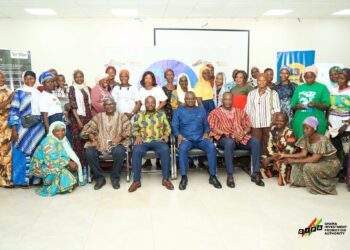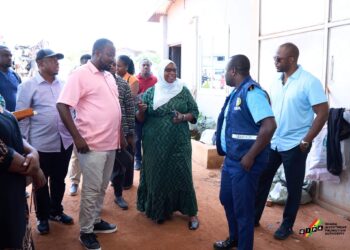
The government’s plan to expand Ghana’s garment and textile manufacturing industry receives a boost as the Minister for Trade, Agribusiness and Industry, Hon. Elizabeth Ofosu-Adjare, inspects a proposed site for a new garment factory in Cape Coast in the Central Region.
The inspection follows President John Dramani Mahama’s commitment to establish garment factories in the Central, Eastern and Bono Regions as part of a broader industrialisation drive.
The proposed facility is expected to become a key pillar of government’s industrialisation and job creation agenda, with the garment and textile sector identified as a strategic area for expanding domestic production, adding value to local raw materials and creating employment opportunities for young people.
Hon. Ofosu-Adjare undertakes the inspection together with the Chief Director and senior officials of the Ministry of Trade, Agribusiness and Industry players. Speaking during the visit, the Minister expresses satisfaction with the proposed site, particularly its accessibility and proximity to major road networks.
She says the location will make it easy for workers to commute to and from the facility, a critical factor for the successful operation of a labour intensive factory. She discloses that the chiefs and people of the area have made the land available for the project and have already commenced preparatory works, including excavation and clearing.
According to her, the site could be ready within one to two months, subject to the completion of the ongoing preparatory works by the community.
“The enthusiasm of the local community to host the factory is very encouraging. The chiefs and people are eager and have already started work on the land. This shows their commitment to the project.”
Hon. Ofosu-Adjare
Hon. Ofosu-Adjare says the project will provide much-needed employment opportunities for residents of Cape Coast and its environs while stimulating economic activity in the Central Region.
“Garment factories create jobs. They provide direct employment for thousands of young people, especially women, and they also support indirect jobs in transport, catering, maintenance and other services.”
Hon.Ofosu-Adjare
She points to the recently commissioned Northshore Apparel Hub in Savelugu in the Northern Region as a practical demonstration of the employment and industrial opportunities that the garment sector can generate.
The Northshore facility, which was commissioned on August 28, 2026, is expected to create about 3,000 jobs in its first phase, with employment projected to reach 10,000 when fully operational. The factory is also positioned to support Ghana’s export ambitions, with its management already preparing to begin international shipments to markets in Europe and the United States.
The Minister explains that the Savelugu project is being positioned as a model for how government’s 24-Hour Economy initiative can support increased production and employment. Plans to operate multiple shifts at the facility are expected to further expand job opportunities, maximise use of installed machinery and boost production capacity.
Against this backdrop, she says government is determined to extend similar opportunities to other parts of the country to ensure balanced industrial development. On. Ofosu-Adjare, however, explains that the establishment of a government-supported industrial project requires several stages and due processes that must be followed to ensure value for money and sustainability.
“Anytime you are doing a government project, you go through a process. There are feasibility studies, technical assessments, procurement processes and other requirements that must be satisfied.”
Hon.Ofosu-Adjare
Minister Assures Community as Transaction Advisors Work on Garment Projects
She assures the chiefs and people of Cape Coast that the necessary processes are being pursued to enable the project to move forward as quickly as possible. The Minister discloses that transaction advisors have been engaged and are currently working on the various proposed garment projects across the three regions.
She adds that once the requisite processes are concluded and approvals secured, construction can commence.
“The transaction advisors are working on the projects. Once the processes are concluded, we will be able to start construction. We will come back to inform Nananom and the people once a definitive timeline is established.”
Hon.Ofosu-Adjare
The proposed Cape Coast factory is expected to benefit from Ghana’s existing trade advantages, including the African Growth and Opportunity Act (AGOA), the African Continental Free Trade Area (AfCFTA) and the interim Ghana-EU Economic Partnership Agreement, which provide duty-free and quota-free access for garments produced in Ghana.
The chiefs and community leaders present during the inspection express appreciation to government for selecting Cape Coast as one of the beneficiary regions for the garment factory project.
They pledge their continued support to ensure the project becomes a reality. They also appeal to government to expedite processes to enable construction to begin, noting that unemployment among the youth in the area remains a major concern.
The Ministry of Trade, Agribusiness and Industry says the garment and textile sector remains a priority under government’s industrial transformation agenda due to its potential for mass job creation, foreign exchange earnings and women’s economic empowerment.
The inspection of the Cape Coast site marks another step in government’s efforts to build a strong domestic garment industry capable of competing globally while creating decent and sustainable jobs for Ghanaians under the 24-Hour Economy policy.
READ ALSO :Mahama Lists Reparations Gains Since Ghana’s Landmark United Nations Resolution