A new United Nations Environment Programme (UNEP) report has warned that global temperatures are likely to surpass the Paris Agreement’s 1.5°C threshold in the coming years, but indicated that stronger action could still reduce how far and how long temperatures remain above the target.
The report, Limiting Overshoot, argues that while a temporary breach of the 1.5°C threshold is increasingly likely, exceeding the limit should not become a permanent destination. Instead, countries should pursue an “overshoot, peak and decline” pathway that keeps temperature increases as low and brief as possible before bringing global temperatures back below 1.5°C.
The pathway would require immediate and sustained reductions in greenhouse gas emissions, including methane, followed by a transition towards net-zero emissions and eventually net-negative emissions.
According to the United Nations Environment Programme (UNEP), carefully governed carbon dioxide removal (CDR), which involves removing carbon dioxide from the atmosphere and storing it through approaches including afforestation, will equally be necessary as part of the longer-term effort.
The warning comes as climate impacts are already becoming more visible worldwide, with extreme heat, wildfires, floods and other weather-related disasters placing increasing pressure on communities and national economies.
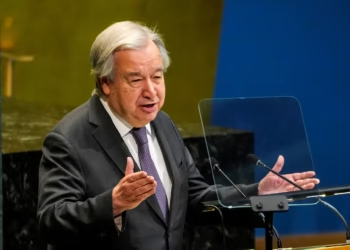
UN Secretary-General António Guterres noted that the accelerating impacts should serve as a warning of the consequences of allowing temperatures to remain elevated.
“This summer’s scorching heat, raging wildfires and deadly floods are a warning of what lies ahead. We must make the overshoot above 1.5 degrees as small and short as possible. That demands an overshoot of ambition.”
António Guterres
UNEP’s assessment reinforces earlier warnings that the world is moving beyond the temperature pathway envisaged when the Paris Agreement was adopted. Its 2025 Emissions Gap Report found that the multi-decadal average of global temperature rise is expected to temporarily exceed 1.5°C, while current national climate commitments remain insufficient to put the world on a Paris-aligned pathway.
The latest assessment therefore shifts attention from whether the world can avoid any exceedance altogether to how governments can prevent that exceedance from becoming deeper, longer and more damaging.
According to UNEP, even the most optimistic scenario would see global temperatures peak at around 1.8°C above pre-industrial levels, placing warming above the 1.5°C ambition established by the Paris Agreement.
Most other pathways would result in substantially higher temperature peaks, increasing the likelihood and severity of climate-related impacts.
Moreover, the report stresses that every additional fraction of a degree matters. As temperatures rise beyond 1.5°C, extreme weather events are expected to intensify, while ecosystems and human systems face mounting pressure.
Potential consequences include more severe heatwaves, floods, and other extreme weather events, alongside ecosystem degradation and growing threats to food and water security.
Low-lying coastal communities and Small Island Developing States could face particularly serious consequences as sea levels rise, while cities and critical infrastructure become increasingly exposed to climate hazards.
The impacts are also expected to extend into public health and economic systems, with extreme heat and climate-related disasters threatening livelihoods, disrupting economic activity and increasing pressure on already vulnerable populations.
Inger Andersen, Executive Director of UNEP, stated that the growing impacts demonstrated the urgency of keeping any period above 1.5°C as limited as possible.
“There are no good outcomes if we remain above 1.5°C. Across the globe, extreme heatwaves are already proving that climate impacts will strike faster, hit harder, and last longer – costing more lives and causing deeper disruption.”
Inger Andersen
He added, “Now is the time we must double down on climate action. We can – and must – get on the right path. By cutting greenhouse gas emissions, strengthening resilience and adaptation, and ensuring exceedance of 1.5°C is as small and short as possible.”
UNEP warns that the probability of irreversible climate tipping points increases as warming becomes more intense and persists for longer periods.
Among the risks highlighted are destabilisation of major ice sheets, degradation of the Amazon rainforest and disruption of the Atlantic Meridional Overturning Circulation, a major system of ocean currents that helps regulate global climate.
Some of these changes could occur abruptly, while others could accumulate gradually until they reach potentially irreversible thresholds.
Mitigation and Adaptation Must Advance Together
Against this backdrop, UNEP argues that the world must pursue rapid emissions reductions while simultaneously strengthening societies’ ability to cope with climate impacts that are already occurring.
The report identifies mitigation and adaptation as mutually reinforcing components of the response.
Immediate action to reduce greenhouse gas emissions would help limit future warming, while adaptation measures could reduce the vulnerability of communities, infrastructure and economies to the impacts that can no longer be avoided.
UNEP mentioned that adaptation efforts must increasingly become transformational rather than simply responding to existing risks.
It added that governments will need to anticipate emerging and potentially abrupt climate threats and build resilience into development planning. Measures capable of delivering both mitigation and adaptation benefits should therefore be prioritised.
The report also stresses that the transition away from fossil fuels can generate important economic and social co-benefits.
UNEP argues that these benefits strengthen the case for accelerating climate action even beyond the need to meet temperature targets.
But the scale of the challenge means governments cannot rely on technological solutions alone.
The report identifies strong political leadership, multilateral cooperation, effective policies, inclusive governance and adequate finance as essential conditions for keeping the overshoot pathway viable.
It also places equity and justice at the centre of the response, arguing that countries with greater historical responsibility for climate change should move faster and demonstrate greater ambition.
READ ALSO: Mudryk Joins Tottenham on Loan as Danso and Sarr Depart