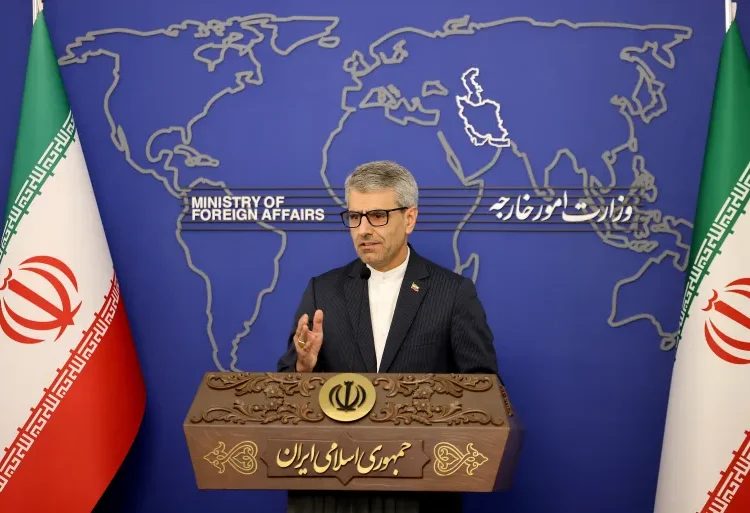
Esmaeil Baghaei, Spokesman for Iran’s Ministry of Foreign Affairs has called for global action over US strikes.
He called for international condemnation of a reported attack in Sirik. “This cruelty cannot be separated from the chain of atrocities that preceded it,” he said, referring to other strikes that Iran says caused significant civilian casualties during the conflict.
He specifically cited attacks on Minab and Lamerd on the first day of the war. Iranian officials have previously alleged that U.S. strikes on an elementary school in Minab killed more than 150 people and that an attack on a sports hall in Lamerd killed at least 21 people. Those casualty claims have not been independently verified.

Baghaei emphasized that Iran would respond to what he described as “savage crimes” with “firmness” but also criticised governments that have remained silent over the reported civilian casualties.
“Still, those governments and international institutions that remain silent in the face of such barbarism, or seek to justify such acts, must understand that their silence is not neutrality.”
Esmaeil Baghaei
Iranian officials have repeatedly condemned U.S. military operations, arguing that attacks on Iranian territory violate the country’s sovereignty and have caused civilian casualties. Washington, however, has maintained that its strikes are directed at military capabilities and are intended to counter threats to American forces and international shipping.
Iran Accuses US Of Deadly Wedding Strike
Baghaei’s statement came as Iran accused the United States of striking a residential building during a wedding celebration in the southern county of Sirik, killing at least five people, including a child, and injuring dozens more.
Iranian officials said that the strike hit a house in the city of Kuhestak early Wednesday, as the United States carried out another wave of attacks against targets it described as linked to Iran’s military. Baghaei described the reported attack as “brutal” and said more than 50 people, including women and children, had been killed or wounded.
Iranian state media reported that at least five people were killed in the strike. Hossein Kermanpour, an official with Iran’s Ministry of Health, said on social media that a child was among those killed and that electricity and telephone services had been cut in the area. Reza Shahidiyan, Governor of Sirik County, later told Iran’s state broadcaster IRIB that 63 people had been wounded.
He said that women and children accounted for 50 of the casualties. All of the wounded were transported to a hospital in the nearby city of Minab, where Shahidiyan said they were in stable condition. Local authorities continued assessing the damage and responding to the aftermath of the reported strike.
The allegations emerged as the United States announced a new round of military operations against Iran. U.S. Central Command said that American forces had targeted Iranian military infrastructure following what Washington described as attempted attacks by the Islamic Revolutionary Guard Corps (IRGC) against commercial shipping in the Strait of Hormuz.
According to the U.S. military, the latest strikes targeted Iranian air-defence installations, radar systems, maritime assets, communications facilities and mine-laying capabilities. Washington has said that such operations are intended to protect American personnel and commercial shipping from attacks in and around the strategic waterway.
The latest military action follows a renewed exchange of fire between the United States and Iran over the weekend, marking the first direct confrontation between the two countries in more than a month.
Iranian officials said their forces retaliated against American military positions and assets in Jordan, Bahrain and Iraq following U.S. strikes on Iranian targets. Kuwait also reported intercepting drones and missiles during the escalation.
The confrontation has centred increasingly on the Strait of Hormuz, a crucial international shipping route through which a significant share of the world’s seaborne energy supplies normally passes. The waterway has become a major point of contention since the United States and Israel began their military campaign against Iran on February 28.

Iran has sought to restrict shipping through the strait, while the United States has accused Tehran and the IRGC of threatening commercial vessels and attempting to deploy naval mines. The competing claims have raised concerns about the security of one of the world’s most important maritime corridors and the potential impact on global energy markets.
The latest allegations add another layer to an increasingly dangerous confrontation between Washington and Tehran. With military strikes continuing and tensions surrounding the Strait of Hormuz unresolved, the risk of further escalation remains high.
READ ALSO: COCOBOD Pays GH¢2.68bn to Complete 2026 DDEP Obligations, Clears GH¢162m Cocoa Bills