Former Bosnian Serb Military Commander, Ratko Mladic has been buried in Belgrade with full military honors, as thousands of mourners gathered to pay tribute to the convicted war criminal despite warnings from the European Union against glorifying his legacy.
Mladic, who died last week while serving a life sentence for genocide, war crimes and crimes against humanity, was buried today in a coffin draped in the Serbian flag following a funeral service attended by political figures, nationalist supporters and representatives from Republika Srpska.
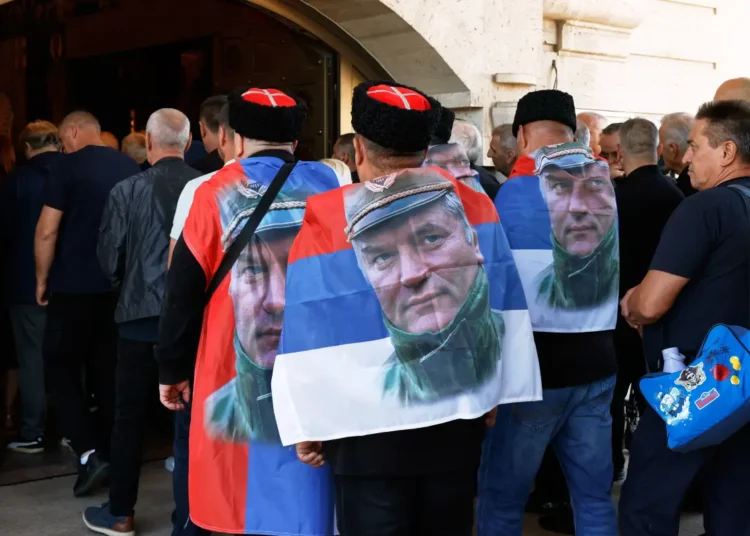
Thousands of mourners began gathering early at the small Serbian Orthodox Church of St. Luke in Belgrade, where Mladic’s body lay in state. His military officer’s cap and saber were placed on his coffin, which was surrounded by men dressed in military fatigues. Police had closed off parts of the city around the church and cemetery ahead of the ceremony as crowds gathered to honor the former Bosnian Serb commander, who remains a hero to many Serbs despite his conviction by an international tribunal.
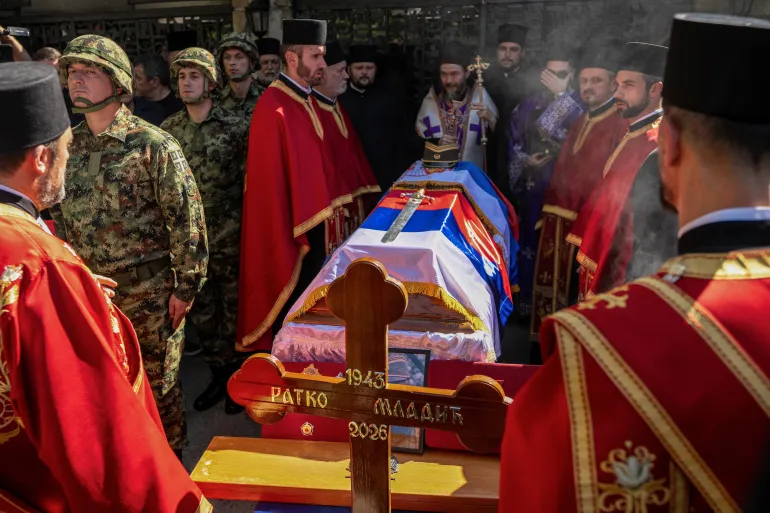
The Head of the Serbian Orthodox Church, Patriarch Porfirije, led the funeral service before Serbian army soldiers carried Mladic’s flag-draped coffin to the cemetery. Mourners applauded as a military orchestra played during the procession.
Mladic was buried with full military honors and the participation of members of the Serbian government, despite strong criticism from European officials and victims’ groups over the public tribute to a man convicted of some of the worst atrocities committed during the Bosnian war.
Among those attending were opposition figures in Serbia, former and current officials from Republika Srpska, one of Bosnia and Herzegovina’s two entities, as well as pro-Serbian politicians from neighbouring Montenegro.Russia’s ambassador to Serbia, Alexander Botsan-Kharchenko, was also present, alongside Bosnian Serb nationalist leader Milorad Dodik.
Serbian President Aleksandar Vucic did not attend the funeral. Vucic, who has sought to maintain relations with both Western countries and Russia, had previously supported what he described as a “dignified funeral” for Mladic. Vucic’s son, Danilo, attended the ceremony, while Mladic’s family had publicly thanked the Serbian President for his support.
Mladic died at the age of 84 on August 27 in The Hague, Netherlands, where he had been serving his life sentence. He was convicted in 2017 for his role in the 1995 Srebrenica massacre, in which more than 8,000 Muslim men and boys were killed.
He was also found responsible for the prolonged siege of Sarajevo and other war crimes committed during the 1992–1995 Bosnian conflict, including the establishment of detention camps for non-Serb civilians and captured enemy soldiers.
The United Nations tribunal that prosecuted Mladic found him guilty of genocide, crimes against humanity and war crimes. His funeral has consequently become a deeply divisive event, reflecting continuing disagreement in the region over the legacy of the Bosnian war and the responsibility of those convicted for atrocities committed during the conflict.
EU Condemns Glorification Of Mladic
The European Union has strongly criticised the public homage paid to Mladic, warning that the glorification of convicted war criminals conflicts with the values expected of countries seeking EU membership. The EU’s foreign service said that “any glorification of war criminals, genocide denial and revisionism contradict the most fundamental European values and have no place in the EU or in EU candidate countries.”
The bloc also expressed solidarity with victims, survivors and their families affected by the wars that followed the breakup of Yugoslavia. The reaction comes as Serbia continues its bid for EU membership and faces pressure from Brussels over its handling of its wartime past.
Marta Kos, the EU’s Enlargement Commissioner, had already cancelled a planned visit to Serbia in protest against the public response to Mladic’s death. Kos said, “The glorification surrounding his death is incompatible with the values on which the EU path is built.”
The criticism has also been echoed by victims’ groups in Bosnia. The Mothers of Srebrenica, an organisation representing relatives of those killed in the 1995 massacre, urged the EU to respond to the funeral, warning that the event could become a major gathering of supporters of the ideology associated with Mladic. “The glorification of genocide is not honor, it’s a shame,” the group said on X.
Vucic, meanwhile, described the funeral as an “emotional outpouring” and argued that the gathering was not an indication that the Serbian government had formally endorsed the event.
The competing reactions have placed renewed attention on Serbia’s relationship with the EU, particularly as Brussels continues to assess the country’s progress towards membership. Mladic’s burial has also reopened painful memories in Bosnia and Herzegovina, where victims’ families continue to commemorate those killed during the war.
For supporters who gathered in Belgrade, however, the former commander remains a symbol of Serbian wartime resistance. His critics view the military honors and public tributes as an unacceptable celebration of a man whose actions were condemned by an international tribunal. The funeral has therefore become more than a farewell to Mladic, highlighting the unresolved divisions surrounding the Bosnian war.
READ ALSO: EU Unveils €200m Greenland Investment