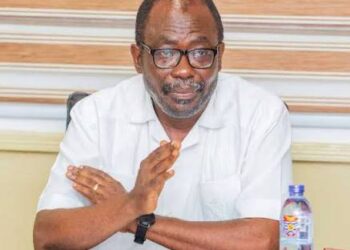
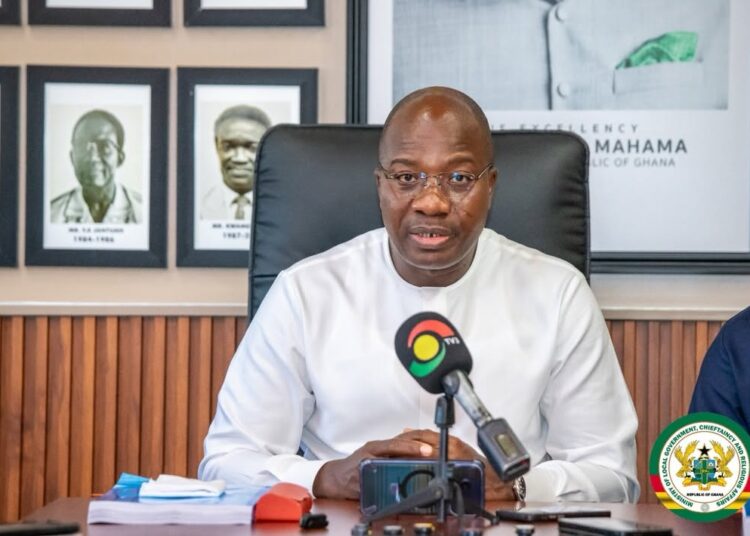
Minister for Local Government, Chieftaincy and Religious Affairs Mahama Ayariga has proposed dedicating a contraflow lane to Ayalolo buses during peak hours, floating the idea during a working visit to the bus rapid transit operator as part of efforts to improve the reliability and speed of public transport in Accra.
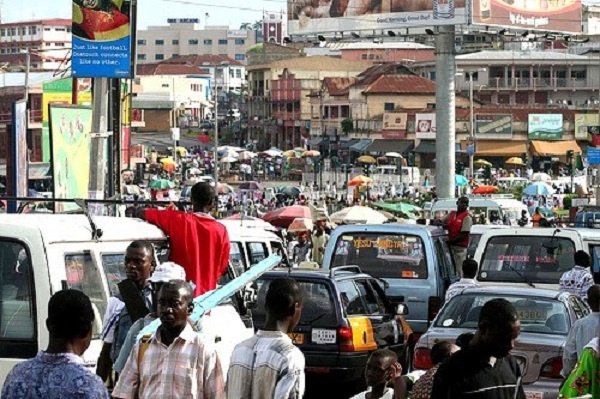
The Bawku Central MP said he intends to raise the proposal directly with the Interior Minister and the Inspector-General of Police, exploring whether one lane on the opposite side of major routes could be temporarily reserved for Ayalolo buses during the morning rush, allowing them to bypass the congestion that typically slows every vehicle on the road at that time.
Hon Mahama Ayariga’s proposal centres on repurposing a lane running against normal traffic flow specifically for Ayalolo during defined peak windows.
“We want to sit with the Interior Minister and then the IGP and his team and see if it is possible that at peak hours from 6 am to 9 am in the morning, one of the lanes on the opposite side can be dedicated to Ayalolo so that they will move fast”.
Minister for Local Government, Chieftaincy and Religious Affairs, Hon. Mahama Ayariga
He pointed to existing police resources he believes could support the scheme without requiring significant new investment. Noting that the IGP has already procured motorbikes for the Motor Traffic and Transport Unit, Ayariga observed that officers currently park those bikes at traffic lights, watching buses pass rather than actively assisting their movement.
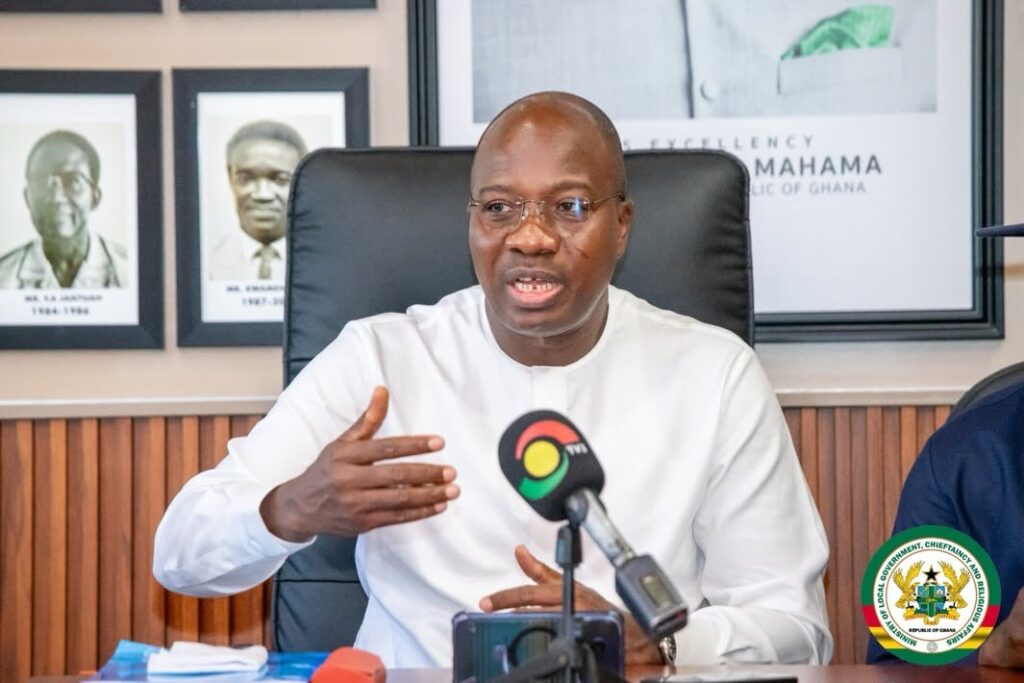
He proposed putting that equipment to more direct use. “If we can have each bike leading one bus between the hours of 6 am and 9 am to really ensure that it is safe and then provide advance warning to oncoming vehicles on the major routes,” he said, describing a system in which police outriders would escort individual buses along the contraflow lane, alerting oncoming traffic to the temporary lane change.
Mapping Ghana’s Major Commuter Routes
Hon Mahama Ayariga said the scheme would need to be paired with clear public designation of the specific corridors involved, so drivers know exactly when and where the reduced lane configuration applies.
He outlined several routes as candidates for the designation.
“We can educate the public and say, from Adenta to Accra Central, this is a major route. From Kasoa to Accra Central, it’s a major route. From Nsawam to Accra Central, it’s a major route. From Accra to Tema is a major route,” he said, arguing that clear public communication about which roads carry the contraflow arrangement, and during which hours, would be essential to the scheme working safely.
The Minister was careful to frame the proposal as preliminary rather than settled government policy.
“We will explore all those. I’m not announcing them as a policy. I’m just suggesting in my non-engineering mind what we could actually do,” he said, acknowledging that the idea would need technical and safety review by relevant agencies before any implementation.
He extended the concept beyond the morning rush to a proposed afternoon window as well, suggesting operations could run from around 4 pm to 7 pm to capture the evening commute, while being careful to clarify that the timing was not intended to encourage workers to leave their jobs earlier than scheduled.
“I’m not encouraging you to leave work at 4 pm. I’m just saying that you should prepare,” he said, addressing transport operators directly. “You, as a transport company, should prepare to run the operation between 4pm and 7pm.”
Building a System Commuters Can Rely On
Hon Mahama Ayariga framed predictability as the central goal behind the proposal, arguing that consistent, dependable service during clearly defined hours would gradually shift commuter behaviour toward greater reliance on public transport.

“If we design a system that way, people will get used to it. We might establish it as a rapid transport system and people will patronise if they can count on it. If they know they can count on it, they would try and count on it.”
Minister for Local Government, Chieftaincy and Religious Affairs, Hon. Mahama Ayariga
That argument positions the contraflow proposal as more than a traffic management fix, framing it instead as a foundation for building sustained public confidence in Ayalolo as a genuine alternative to private vehicle use during Accra’s most congested hours, provided the scheme can secure the inter-agency cooperation and safety clearances it would require to move from suggestion to implementation.
READ ALSO: Oil Shock Raises Inflation Risk in Ghana’s Transport Fare Debate