United Kingdom has announced sanctions targeting Israeli settlements in the occupied West Bank.
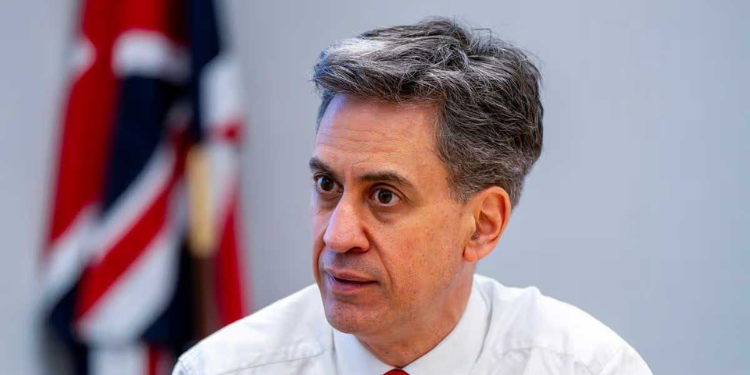
According to UK Foreign Secretary Ed Miliband, the government would formally recognise Israel’s occupation of the West Bank as unlawful in its entirety.
Speaking in the House of Commons, Ed Miliband stated that “the British government agrees that there is ethnic cleansing of Palestinians in areas of the West Bank, perpetrated by settler terrorists.”
Under the new measures, Britain will ban imports of goods originating from illegal Israeli settlements in the occupied territories, establish a comprehensive sanctions regime against companies and individuals providing services to settlements, and prohibit the advertising of settlement properties in UK.
The government will also impose personal sanctions on individuals accused of promoting settler violence and introduce a further restriction on arms licences and other exports that materially contribute to Israel’s occupation.
Britain is among 12 countries backing the new trade-related measures, alongside Canada, Denmark, Finland, France, Iceland, Ireland, Norway, Poland, Portugal, Spain and Sweden.
Meanwhile, the expansion of Israeli settlements has long been viewed by Palestinian leaders and much of the international community as a major obstacle to the creation of a viable Palestinian state.
Ed Miliband noted that the urgency of the British response had been heightened by Israel’s settlement expansion, noting that more settlements had been approved during the previous four years than in the preceding two decades combined.
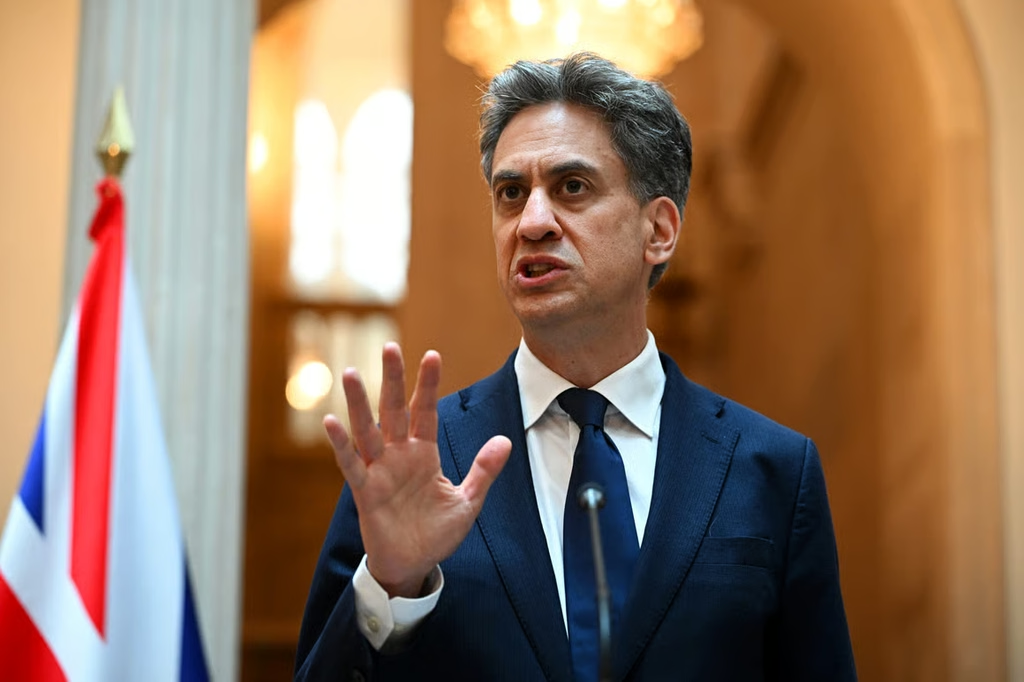
He also noted that those financing or facilitating settlements would “face the full force of UK sanctions,” while indicating that legislation necessary to implement the measures and trade restrictions would be introduced within nine months.
The Foreign Secretary presented the decision not simply as a response to settlement expansion but as a broader reassessment of Britain’s responsibilities towards the Israeli-Palestinian conflict.
As a “proud British Jew,” Miliband stated, “I am proud of my Jewishness and unwavering in my support for the state of Israel.“
“And there is absolutely no contradiction between this and my support for the state of Palestine. Indeed, quite the opposite. The two-state solution is based on an explicit belief that the only route to security for both peoples is to live side by side in peaceful coexistence with freedom, security and self-determination.”
He stated, “our argument is not with the people of Israel, with whom the UK has unshakeable bonds. Our argument is with the conduct of its government.”
Sanctions, Israeli Retaliation and the Wider Political Battle
Israel’s Foreign Minister Gideon Saar has strongly condemned the announcement, accusing the British government of adopting an increasingly hostile position towards Israel and interfering in the country’s domestic political process ahead of its elections.
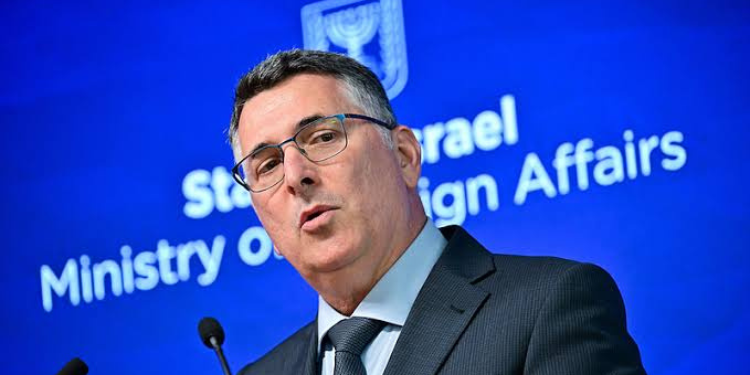
Gideon Saar accused Miliband of making “outrageous lies” and claimed that the Labour government was “systematically working against the state of Israel.”
He also accused Britain of fuelling antisemitism and said Israel would respond to the British measures.
According to Saar, “If Britain acts against Israel, Israel will act against Britain.”
Israel subsequently announced that it would shut down the British consulate in Jerusalem, a move that could further strain diplomatic relations. The British Consulate General in Jerusalem represents UK government in Jerusalem, the West Bank and Gaza and plays a role in political, commercial, security and economic engagement involving Palestinians.
Israel’s response came as the United States also warned Britain that the sanctions could provoke consequences.
US Ambassador to Israel Mick Huckabee has also stated that Washington was considering possible action against Britain, including measures that could restrict trade between the UK and some US states that have legislation opposing boycott, divestment and sanctions campaigns.
The political dispute within Britain has also exposed divisions over whether sanctions can effectively influence Israeli settlement policy without causing unintended economic consequences for Palestinians.
Shadow Foreign Secretary Tom Tugendhat acknowledged that “illegal settlements are wrong” but criticised the government’s approach, arguing that restrictions on settlement-related trade could harm Palestinians because the Israeli and Palestinian economies are deeply interconnected.
He warned that Britain risked implementing policies that would not achieve their intended objective while creating difficulties for Palestinian workers and businesses.
The Palestinian leadership, meanwhile, welcomed the British announcement while arguing that it did not go far enough.
Palestinian Ambassador to UK Husam Zomlot described the sanctions as a “turning point in UK-Palestine relations,” arguing that Britain was beginning to move from condemnation towards consequences.
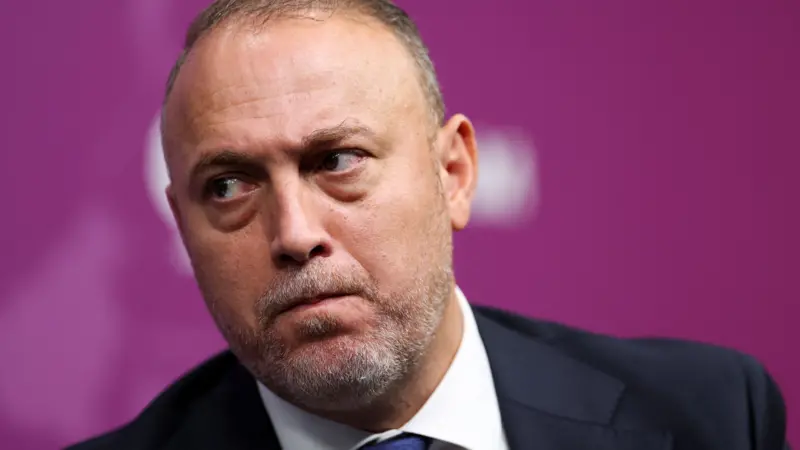
He argued that Britain could not recognise Palestinian statehood while allowing the continued expansion and annexation of territory intended to form part of that state.
Zomlot added that the British decision was “long overdue” and should therefore be regarded as the beginning rather than the conclusion of a broader international effort.
UK government did not label Israel’s actions in Gaza as genocide, preferring to leave the determination to international courts.
Miliband stated that UK will support “full, robust and fair judicial processes” to determine genocide and will not pre-empt the findings of international courts.
Additionally, recent reports from international bodies have provided “increasing evidence that war crimes exist.”
Apart from the West Bank, Britain announced other actions related to the wider regional conflict, such as the reimposition of significant economic sanctions on Iran in collaboration with the United States and the European Union, as well as sanctions against Al-Qard al-Hassan, the financing arm of Lebanese Hezbollah.
Miliband described the broader crisis as one that had produced “the most unimaginable trauma and suffering in the last three years death, destruction and dehumanisation on an appalling scale.”
READ ALSO: Yamal Fires Back at Dembélé After Ballon d’Or Top-Three Snub