The Ghana Investment Promotion Authority (GIPA) is intensifying its campaign to establish Ghana as West Africa’s premier destination for European industrial capital, high-tech agro-processing, and manufacturing partnerships.
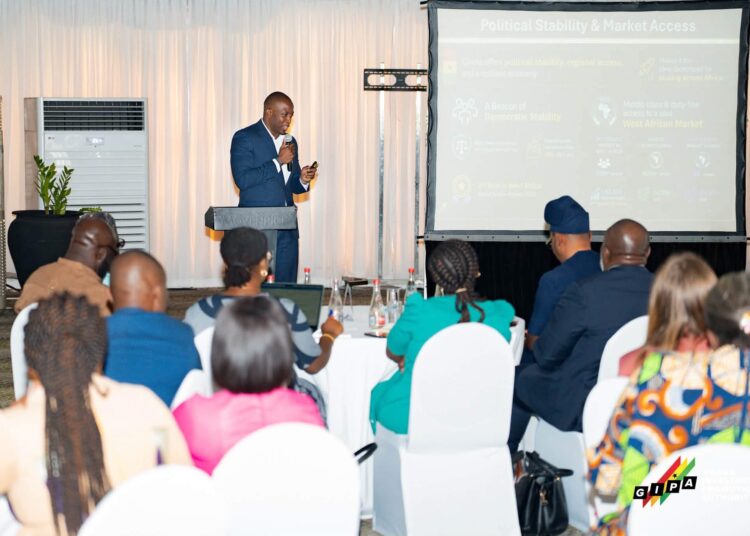
The Deputy Chief Executive Officer of GIPA, Mr. Abdul Razak Baba, leading this promotional drive, delivers a comprehensive investment pitch during the high-level Bavarian Business Delegation Symposium and Networking Event, held at the Mövenpick Ambassador Hotel Accra.
The exclusive forum brings together influential Bavarian enterprise leaders and high-level representatives from key Ghanaian regulatory, financial, and research institutions.
The discussions focus on forging immediate, actionable cross-border partnerships, with a strong emphasis on agribusiness development, value-added food processing, technology transfer, and localized industrial output.
Addressing the corporate assembly, Mr. Abdul Razak Baba presents a data-driven breakdown of Ghana’s competitive advantages within sub-Saharan Africa.
He emphasizes that the domestic economy is transitioning toward structural industrialization, creating profitable entry points for foreign investors equipped with technical expertise.
Mr. Baba highlights strategic sectors where Bavarian companies can easily integrate their capital and equipment into the local production landscape. He underscores that GIPA actively prioritizes public-private collaborations that transcend raw commodity export, focusing instead on setting up domestic factories capable of processing cash crops, manufacturing machinery, and scaling logistics networks.
The Deputy CEO assures the German business leaders that Ghana remains open for secure business operations. He points to the country’s relative democratic stability, strong regulatory frameworks, and its unique geographic positioning as the official host of the African Continental Free Trade Area (AfCFTA) Secretariat.
Which grants manufacturers in Ghana tariff-free access to a broader 1.5-billion-consumer African market.
Strategic Institutional Collaboration for Investor Success
To instill commercial confidence, the symposium features active participation from a broad coalition of crucial Ghanaian state institutions and regulatory authorities. The collaborative setup signals a unified government commitment to removing bureaucratic bottlenecks and offering seamless operational transition for foreign entities.
The institutions engaging the Bavarian business leaders include:The Food and Drugs Authority (FDA): Detailing standardized compliance procedures, quality control metrics, and automated licensing protocols required to safely scale food production and export pipelines.
The Ghana Free Zones Authority (GFZA): Presenting highly lucrative tax holidays, complete duty exemptions, and fully serviced industrial enclaves designed to support export-oriented production plants.
The 24-Hour Economy and Accelerated Export Development Secretariat: Outlining the operational state framework that supports round-the-clock factory operations, offering subsidized utility tariffs, enhanced local security, and faster customs clearance to maximize output.
The Council for Scientific and Industrial Research (CSIR) – Food Research Institute: Presenting breakthrough local scientific findings, commercially viable crop variations, and post-harvest preservation technologies designed for industrial adoption.
The synchronized presentation from these agencies highlights the practical functioning of the government’s recently deployed systems aimed at addressing long-standing investor concerns regarding customs, licensing, and land security.
Forging Bilateral Alliances Through Agribusiness
The international event is organized through a joint partnership by the Delegation of German Industry and Commerce in Ghana (AHK Ghana), the Bavarian Ministry of Economic Affairs, Regional Development and Energy, and Bayern International.
The initiative reflects a growing European interest in shifting from traditional development aid toward direct commercial engagement and reciprocal trade structures.
The business dialogues concentrate heavily on modernizing the agribusiness value chain. The delegation explores opportunities to deploy high-grade German engineering solutions, specialized farm machinery, and industrial cold-chain technologies across Ghana’s primary agricultural belts.
By injecting advanced technical systems into the domestic agricultural landscape, both nations aim to reduce post-harvest waste, stabilize crop yields, and open doors for standard-compliant Ghanaian exports into the wider European Union market.
Furthermore, the focus on technology transfer addresses a critical objective for the Ghanaian government. Local stakeholders emphasize that true partnership requires more than the importation of finished European products.
It must include the deliberate training of local technicians, the setup of regional maintenance facilities, and the collaborative design of processing tools tailored to West African farming ecosystems.
Strengthening Long-Term Ghana-Germany Ties
The successful conclusion of the symposium sets a definitive milestone for continued economic engagement between the two republics. The networking sessions allow private-sector operators to hold private business-to-business (B2B) consultations, map out immediate corporate joint ventures, and schedule site inspections across various industrial enclaves.
As the global market increasingly demands resilient, distributed supply chains, Ghana’s aggressive courtship of premium industrial states like Bavaria demonstrates a sophisticated approach to sovereign wealth creation.
GIPA and its sister agencies remain highly active, ensuring that the preliminary connections established at the Mövenpick Ambassador Hotel quickly translate into new manufacturing plants, active technology exchanges, and long-term jobs for the Ghanaian workforce.
READ ALSO:Government Spokesperson Has No Mandate On Drug Matter — Ntim Fordjour