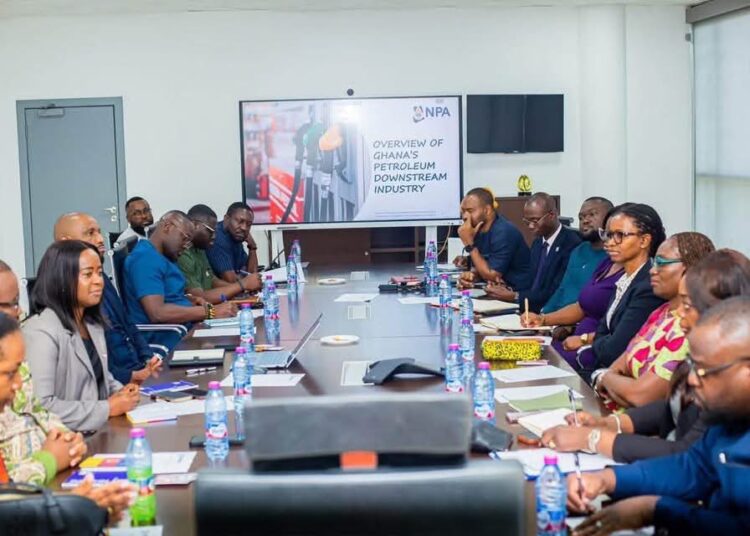
The National Petroleum Authority (NPA) has opened its downstream petroleum regulatory experience to Eswatini as part of a technical study visit designed to deepen cooperation between African petroleum institutions.
A three-member delegation from the Eswatini National Petroleum Company (ENPC) visited the NPA to examine Ghana’s approach to regulating the downstream petroleum industry, with particular attention to the institutional systems used to promote product quality, safety, efficiency and market oversight.
The engagement comes as ENPC works to strengthen its institutional and operational capacity as Eswatini’s national oil company, making Ghana’s experience potentially relevant to the development of its own petroleum-sector systems.
The delegation comprised ENPC Board Member Dumezweni Dlamini, Chief Executive Officer Nontombi Motsa and General Manager for Strategy and Communications, Musa Shongwe.
Ghana’s Regulatory Experience Offers A Practical Reference
For Eswatini, the value of the engagement lies in gaining practical exposure to a petroleum regulatory framework that has developed alongside Ghana’s downstream industry.
The NPA’s mandate places it at the centre of Ghana’s downstream petroleum sector, where effective oversight has implications extending beyond regulation itself.

Product quality, safety, market conduct and supply arrangements ultimately affect consumers, businesses and national energy security.
Welcoming the delegation on behalf of the NPA Chief Executive, Director of Quality Assurance, Setsoafia K. Agbenoto, stressed the importance of African institutions learning from one another as they seek to build more resilient petroleum sectors.
“Knowledge-sharing among African petroleum institutions is essential as countries work to strengthen energy security and build resilient petroleum industries,”
Mr Agbenoto
The emphasis on peer learning is particularly relevant for countries developing or strengthening national petroleum institutions because regulatory capacity cannot be built solely through legislation.
It also depends on institutional experience, technical expertise and the ability to translate policy into effective market oversight.
For Ghana, sharing that experience also provides an opportunity to demonstrate the institutional capabilities developed within its downstream petroleum sector.
ENPC Seeks Lessons As Eswatini Builds Capacity
The visit forms part of a broader programme by ENPC to engage Ghanaian institutions across the petroleum value chain.
That wider approach is significant because the effectiveness of a national oil company depends on how well its commercial responsibilities interact with the broader energy system.

ENPC is mandated to contribute to the security of petroleum-product supply in Eswatini through the sourcing, storage and trading of petroleum products.
Its engagement with the NPA therefore gives the company an opportunity to examine how regulation and market oversight can support the wider objective of petroleum security.
The delegation’s study of Ghana’s downstream experience can consequently provide institutional lessons as ENPC develops its own operating capabilities.
Rather than simply replicating Ghana’s arrangements, the knowledge exchange can help Eswatini assess which approaches are adaptable to its own market structure, institutional environment and petroleum-supply requirements.
This is where technical study visits can have a deeper value than conventional bilateral engagements: they allow institutions to examine how regulatory principles operate in practice.
Regulatory Cooperation Has Broader Energy-Security Implications
Petroleum regulation is ultimately connected to energy security.
A petroleum market can have sufficient physical supply but still face significant challenges if product quality is poorly controlled, market participants are inadequately supervised or safety standards are inconsistently enforced.

For that reason, regulatory institutions form an important part of the infrastructure underpinning petroleum security.
Ghana’s experience therefore offers Eswatini lessons that extend beyond individual regulatory procedures. Effective oversight can contribute to a market in which consumers have greater confidence in petroleum products and industry participants operate within clearer standards.
Mr Dlamini, who led the ENPC delegation, expressed appreciation for the NPA’s willingness to share its experience with the company.
“We are grateful for the reception and the willingness to share best practices with ENPC,” Mr Dlamini said.
The statement reflects the central purpose of the engagement: using institutional cooperation to accelerate learning rather than requiring each country to develop solutions independently.
African Institutions Can Build Capacity Through Peer Learning
The engagement between the NPA and ENPC also illustrates a broader opportunity for African energy institutions.
Countries across the continent have different levels of petroleum-sector development, but many face common challenges around supply security, infrastructure, regulation, technical capacity and institutional effectiveness.
Peer-to-peer cooperation can therefore complement formal policy and technical assistance by creating direct channels through which institutions can share operational experience.
For Ghana, such engagements provide an avenue to project its downstream regulatory expertise beyond its borders. For Eswatini, they offer access to lessons from a country with an established petroleum industry and specialised regulatory institutions.
The significance is ultimately less about transferring a particular Ghanaian regulatory model to Eswatini and more about creating the institutional relationships through which African countries can adapt proven approaches to their own circumstances.
As ENPC continues developing its capacity, its engagement with Ghanaian petroleum institutions could provide a foundation for further technical cooperation.
The NPA’s willingness to host the delegation reinforces the potential for African petroleum institutions to become partners in building the regulatory and technical capabilities needed to strengthen the continent’s energy security.
In an energy environment where supply disruptions, infrastructure constraints and changing market conditions can quickly affect economies, stronger institutions are not merely administrative assets. They are part of the continent’s broader energy-security architecture.