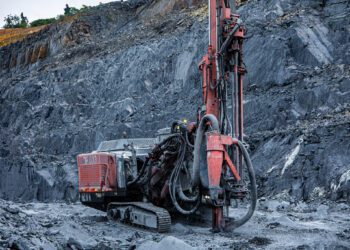
The Institute of Statistical, Social and Economic Research (ISSER) has issued a stern warning regarding the severe environmental and social tolls associated with Ghana’s expanding mining activities, emphasizing that resource extraction continues to jeopardize local communities despite fueling national revenue streams.
While the extractive industry remains a cornerstone of the country’s macroeconomic profile, ISSER highlights that non-renewable resource depletion and ecological degradation pose critical threats to long-term sustainable development.
The research institute underscores that short-term fiscal gains must not overshadow the irreversible land degradation, water pollution, and socio-economic disruptions suffered by host mining communities across the nation.
“Mineral resources are exhaustible, and extraction imposes environmental and social costs, particularly on mining communities. Higher mineral revenues can expand fiscal space, but their development benefits depend on how effectively the proceeds are allocated and spent. Debt obligations, competing expenditure priorities and weak implementation can limit these benefits.”
ISSER 2025 STATE OF THE GHANAINA ECONOMY REPORT
Expanding on these ecological and societal warnings, ISSER points out that mineral resources are inherently exhaustible and that their exploitation exacts heavy, long-lasting penalties on peripheral areas.
Although real mining sector tax revenues recorded substantial growth between 2015 and 2024, the structural paradox lies in the fact that these earnings have failed to systematically mitigate the heavy localized burdens of extraction.
Mining communities frequently absorb the environmental fallout ranging from destroyed arable farmlands to contaminated river bodies without witnessing corresponding investments in infrastructure, environmental remediation, or localized development projects.
Consequently, the institute cautions that without stringent regulatory frameworks and responsible revenue management, the true cost of mineral extraction will consistently outweigh its economic yields.
Fiscal Revenue vs. Public Investment Disconnect
Ghana’s extractive sector continues to demonstrate a troubling disconnect between rising state earnings and crucial capital investments in social sectors.
According to the ISSER 2025 State of the Ghanaian Economy report, real mining sector tax revenues increased substantially between 2015 and 2024, albeit through an uneven growth trajectory.
However, during this exact same timeframe, public capital expenditure and education spending as shares of Gross Domestic Product (GDP) experienced a notable decline.
This misalignment indicates that despite the influx of mineral proceeds into state coffers, sovereign financial allocation has prioritized debt servicing and competing administrative expenditure over structural human capital development and essential infrastructure.
Furthermore, while national health indicators such as child mortality rates dropped steadily over the decade, ISSER explicitly clarifies that “these improvements cannot be attributed directly to mineral revenues.“
The failure to translate resource wealth into enduring social infrastructure underscores a persistent policy gap.
As national debt obligations continue to constrain the executive arm’s spending choices, mineral revenues are increasingly absorbed by macroeconomic debt stabilization rather than targeted community development.
The institute warns that expanding fiscal space through resource extraction remains a meaningless metric unless accompanied by transparent, well-implemented spending frameworks that directly benefit the citizens residing in resource-rich zones.
The Imperative for Structural Resource Governance Reform
Addressing Ghana’s extractive challenges requires an immediate overhaul of governance frameworks to ensure that mineral proceeds deliver lasting socio-economic benefits.
The necessity for strategic policy reform is driven by the reality that unmanaged extraction depletes non-renewable assets without leaving equivalent physical or human capital in its wake.
Weak implementation mechanisms and fragmented allocation strategies currently prevent mining communities from accessing the dividend of the wealth generated beneath their soil.
To reverse this trajectory, policymakers must establish institutional safeguards that ring-fence a dedicated percentage of extractive revenues specifically for localized ecological restoration, climate resilience projects, and public infrastructure.
Ultimately, converting finite mineral wealth into sustainable national assets remains the central economic challenge for Ghana’s future fiscal planning.
As ISSER observes, the presence of higher revenues is merely a preliminary step; the ultimate development impact rests on “how effectively the proceeds are allocated and spent.”
Without curbing the environmental damage inflicted on mining regions and reorienting budgetary allocations toward education and capital investments, the country risks exhausting its precious natural endowments while compounding its ecological liabilities.
Enforcing stricter environmental compliance on mining firms alongside disciplined, transparent wealth re-allocation remains the only viable pathway toward equitable economic growth.
READ ALSO: Witkoff In Russia For Talks On Ukraine War